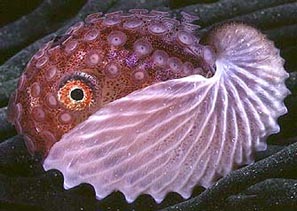
Thursday, April 19, 2007

The Amazing Blanket Octopus!

Dear Constant Readers,

I was going to write a blog on cryptic giant octopuses, but as it got increasingly bloated, I stumbled on something that I knew I had to cover. My time is rather limited between a block of testing and finals, so another one of those 10 hour time-killers is sorta out of the picture. Don't worry, who knows what monstrosities I'll cook up over summer, muhahaha. Cryptozoology and monsters will have to wait, but this animal is just as interesting, if not more so, because it is quite real.

Octopuses (not octopi or octopodes) are some of the most fascinating creatures on the planet, well, to me of course. They are highly derived cephalopod molluscs like the squids of my past posts; except having eight-arms, a fused head and mantle, and a very reduced or absent shell. Other stereotypical characteristics (benthic habitat, rapid color changes, lack of fins and cirri, et cetera) apply to the family Octopodidae which is by far the most familiar to the public. However, the group has a surprising amount of diversity including totally pelagic (free-swimming) forms, a blind form, jello-like forms, forms with fins, a form with a "shell", and so forth.

The taxa that I'm going to talk about belong Argonautoida superfamily which have specialized to be free-swimming. These of course include the bizarre "shelled" Argonauts, and possibly the world's largest species of octopus, both of which I'll have to talk about later. They are also united by the strange feature of having one of the male's arms detach during mating. But I think one can argue that there is one oddball in this already peculiar group.

Tremoctopus is a genus consisting of four species and resting in its own family. For octopuses they are quite large, getting up to 2 meters (6.5 feet) long and weighing around 10 kg (22 lbs). However, this is only for females as the males only reach 2.4 cm with a weight of 0.25 grams! This makes the females up to 40,000 times larger than their male counterparts, nearly two orders of magnitude. This is apparently the most extreme sexual dimorphism seen in an animal that could be considered "large", see this paper for more. The males appear to have large eyes for finding the females, and after their arm detached during mating it is believed to be fatal.

Also remarkable about these species is the defensive behavior of the males and immature females. They have been known to take the stinging tentacles from Portugeuse Man O' War siphonophores and use them as a defensive (and offensive?) weapons while protecting themselves with unknown mechanisms. A combination of this and the pelagic habitat may have caused the incredible sexual dimorphism, as other animals (sea slugs, hermit and boxer crabs) who use this bizarre defence do not exhibit the dimorophic trait. Another trait due to the pelagic habitat is the presence of a "swim bladder", a trait present only in a few other Argonautoids and a convergence upon fishes.

Odd thought these traits may be, what is really impressive (and the reason for this post) is the general appearance of this animal. The name is a reference to very heavy webbing between the four dorsal arms (the same used to hold tentacles earlier in life), which makes it look distinctive from all other octopuses. I hope I can use these images, because I'm definitely not going to be able to match this, especially as far as coloration is concerned. People seeing me work on this could not even identify the images as coming from an octopus. Enjoy:


There is an excellent picture at the Tree of Life webpage, that was taken by Arthur Silva and appeared in the April 2007 BBC Wildlife magazine, although this does unfortunately appear to be copyright violation. So I guess I'm morally obligated not to post it here or link to it. Sigh, it really was a very nice picture. Now with summer on the way I'll be sure to create lots of nice public domain images of an unfortunate lesser quality.

There were also nice photographs taken of Tremoctopus violaceus by Cassandra L. Cox off the coast of Florida in 2005. They can be found here since there seem to be difficulties uploading at the moment.


Finally, an actual image! Taken from this page which has other fantastic pictures. This specimen is identified as Tremoctopus gracilis and was taken by Marcello Conticelli off Ponza, Italy. Let's see how the copyright holds up on this one...


For the sake of posterity I am a bit worried about putting up a YouTube video. When other octopuses swim, they put their arms in a similar wing-like posture, but this is something else entirely...


I hope I can see you all sometime before the month is out. More cephalopods? Something different? Who knows.

Oh yes, and Happy Birthday Caitlin!


-Cameron

Tuesday, April 3, 2007

A Somewhat Confusing Skull

Dear Constant Readers,

Before I get too far into this post, I would thank my sister, Caitlin McCormick, for being such a trooper and taking all of the pictures that I requested. I did realize that skull identification was made much more difficult being half a region away from the specimen as well as not having any photographs. Without it, I would just be rambling to myself about stuff that I kinda remembered.

When Darren Naish blogged this fascinating post on Saturday, one of the mysterious cat skulls reminded me somewhat of a skull I had found some years back (couldn't have been too many years) in Rhode Island. Aside from the melanistic Kellas cat from Scotland and the even more mysterious Mastiff Cats, the Dufftown skull apparently represents yet another mysterious cat from Britain, the atrociously named "rabbit-headed cat". Just read all of the links for a fascinating tale, and and this post too while you're at it.

The cat skull that I found, just to give a bit of background, was found in the town of Barrington, Rhode Island, which is quite suburban. There's a cool little map function on my flickr that can let you pinpoint the nigh-exact location of the skull, for anybody curious. It was found within what could be described as a 20 acre swampy bramble patch; in fact it was found in a frozen vernal pool. The skull was mostly sticking out when I found it, but I couldn't help but wonder if it had somehow been deformed by freezing temperatures (without breaking?). However, it is quite symmetrical and has features not explainable by deformation. What are the odds that the skull I find happens to be a little on the odd side?


Barrington skull (left), Dufftown skull (center), Kellas cat (right). The Kellas cat is quite similar to normal domestic cats.


As you can see in the picture, I think there were some grounds for remembering the Barrington skull as being similar to the Dufftown cat, although it is hard since they are not at the same angle. The postorbital bar (the bony ring around the eye) appears closed or nearly closed on the Dufftown cat, and is closed for sure on the Barrington skull. The nasal region, level of canine development (look at the prominence of the roots) and skull shape appear somewhat similar. However, the Dufftown cat exhibited a lot of weird characteristics that my specimen didn't have. My argument was that perhaps it was within individual variation too. The external appearance of the Dufftown cat is known, and it certainly is quite weird. There are some ferals living out in the woods (I recall maybe 3-4 different individuals), but none of them look odd or unusually large at all.

Darren pointed out that there seem to be a lot of characteristics of the Barrington skull pointing away from a domestic cat and towards a Bobcat. It is quite amazing that animals with around 8 million years (or so I interpreted) of separation could be confused like that. But sure enough, there does seem to be similarity between them. I'll use photographic comparisons to further illustrate my confusion.


Barrington skull (side), Bobcat (middle), Domestic cat (bottom).

This is the first sort of comparison that I did, and it seems like the domestic cat makes a slightly better candidate. It should be noted that the nasal bone projection, skull flatteness and length, sagittal crest development and of course occipital bar closure is more pronounced in the Barrington skull than in the other two. There are similarities to the Bobcat skull too (note the apparent frontal concavity), but I can't help but wonder if some apparent similarities were due to size rather than phylogeny. According to bone clones a domestic cat cat skull in 4" and a bobcat skull is 5", and this appears to measure in between (Caitlin, back me up on this!).


Barrington skull (top), Bobcat skull (middle), Domestic cat (bottom)

While taken alone, the Bobcat skull seems to make a pretty likely candidate, which is what I first did. But when I found a good image of a domestic (well, feral) cat skull, that seemed like an even better candidate. The snout projection and narrow braincase (noticeably narrower in the Barrington skull) seem pretty similar between my skull and the bobcat, although the bobcat skull seems much more developed muscularly. However, the angle of the orbits and nasal opening and the shape of the zygomatic arch appear similar between the Barrington skull and that of a domestic cat. And it appear that domestic cats can have closed postorbital bars, see here and here. If any of you image hounds out there on the internet known of or have better comparisons, please let me know.

I'm going to hesitate on doing another anterior view comparison without the same angle. It should be noted that a bobcat skull (from here) does appear to have a similar nasal openings and canine development. However, the shape of the skull doesn't seem as flattened.

And this, Caitlin, is why the last picture you took for me was so important.

Barrington skull (top), Bobcat skull (middle), Domestic cat skull (bottom).


Darren Naish pointed out that Bobcats in fact lack a anterior pair of upper premolars, and my specimen appeared to. However, it sure does seem like from this picture that is in fact has those tooth sockets, the teeth having fallen out. While this may seem subtle, dental characteristics are strong diagnostic tools when it comes to identification. Caitlin, if you could be so kind as to confirm those are sockets and not just spots or something, well, thanks.

So it looks like this skull is not from a bobcat, and appears more similar to the skull of a domestic cat. I say more similar because it doesn't match up perfectly. As you could see, there do seem to be some characteristics that lay outside what I would expect for normal variation. I highly doubt that this is some exotic species, but it could be from an odd breed of cat. Of course, there probably are a whole host of strange subtle characteristics that I missed out on here too. Not having a database of cat skulls is frustrating as well. From a preliminary standpoint, I think the Barrington skull can demonstrate the variation on the boring old housecat. I think.

Some more blogs in the future, I'm unfortunately going to be quite busy in the near future though. Stupid Organic Chemistry.


Go Team McCormick!


-Cameron


Update: 4-21-07

I have come across this webpage which had another photograph of the Dufftown skull compared with a normal cat skull, dorsal this time.

Domestic cat skull (left), Barrington skull (center), Dufftown skull (right). Note that these skulls have been resized for the sake of comparison. The normal cat skull is around 9.4 centimeters (3.7 inches) and the Dufftown skull is around 10.1 cm (4 inches) judging from the source photo. The Barrington skull measured 10.9 cm (4.3 inches).


It could almost be viewed that these skulls represent varying degrees of muscular development from the domestic to Dufftown to Barrington as the most developed. Features that are only hinted at in the domestic cat skull are very prominent in the Barrington skull. There does not appear to be any hint of the parietal concavity in the smooth domestic cat skull, but there does seem to be one in the Dufftown skull and there definitely is one in the Barrington skull. I imagine that it can get quite confusing and controversial which traits are due to muscular development and which could be used as diagnostic tools. The Dufftown skull seems noticeably narrower than the other two, although the brain case of the Barrington skull is more narrow still. It should be noted that the nasal opening of the Barrington skull is much more upturned with oddly projecting bones, as opposed to the more downturned domestic cat skull and the even more downturned Dufftown skull. If anybody owns or knows about any skulls similar to the Barrington one, I'd greatly appreciate knowing about them.

It should be noted that the external appearance of the owner of the Dufftown skull is known, and it is quite strange looking:


While the image is often "squished" on webpages making it look even weirder, this certainly doesn't look like a normal cat. But is it different enough to warrant a new species? If anybody knows about any more views of the Dufftown skull, I'd also appreciate it.


Sunday, April 1, 2007

Late Breaking News

Dear Continuous Readers,

As you may have gathered by the past posts, currently I am under-taking the laborious process of transforming my old Cryptozoology web-page into blog form. This has required a great deal of re-researching, and whilst on a certain subject, I happened to receive a startling communication. Rather than give the details immediately as a more vulgar web-page would, I'll give the current article in a form leading to the discovery. This will make it all the more shocking to you, and hopefully illustrate that this Cryptozoology is not in vain as some have predicted!


Historical Data

Our first piece of datum comes from the coast of Thula, Iceland in the year of 1674. The account, being related in the obscure 1923 booklet Sea-Serpentes and Other Exquisite Corpses by F. H. Pabodie, tells of the capture of a strange creature in a trawl. The appearance of the still-living creature was likely to cause panic amongst the super-stitious townspeople, so it was carted under-blanked to a nearby barn. A local scientist, Yeremi Haarde, examined the specimen under close scrutiny. Here is a sample of his written documentation:

The heade was in the maner of a Cat, but with-out Eares. Teith were num-brous, smalle, and quite Sharpe. The Bodie was the sise of a comon-Dog, but more of the Forme of a sea-Oter. In-lieu of Limbes were Flap-pers, the sise of a hande but with twain the number of fingars. Much in the mannar of an Armor-dilla, the Bodie was cover'd with rouf intar-locking armorous Plates and Skaeles. The taile was in the Forme of a sea-Carpe but turn'ed the opposite mannar...

There was also a rough little sketch that went along with this description, but unfortunately I do not happen to be in possession of a scanner and/or camera at the moment. As such, I will attempt to reproduce the drawing to the best of my abilities.


In the spring of 1795, 50 miles off the coast of Puerto Duttono, Argentina a remarkable sighting occured. On a science vessel called the Alert, biologists including A. Alborg, E. Haeckel, T. H. Huxley and Dr. W. D. Duy observed, under close quarters, a remarkable animal. This account was preserved in the Heuvelmans archives from a London Epitaph article from October 28, 1765. It was seen by every passenger on board for half an hour at a distance of half a mile to only a few dozen meters. Conditions were cloudy, although the animal could be keenly observed. One Sir Thomas P. Ward, having observed the animal through a pair of field spectacles. As such, he was able to give the most detailed account. Here is a portion of his observations:

The animal at first appeared to be a member of the Reptile clan, perhaps the mighty Dinosauruses of Owen, but in other regards appeared to be a Mammal. The head was a simple oval in shape, about the size of a gasket switch, and had a horribly stupid expression upon it. The cow-eyes stared in a dull manner towards the ship, and brown mucous emanated from the hideous prognathous lips. The head was perched awkwardly upon a long neck like that of the local ostrich-rhea. After a half-hour of paying little attention to the ship and periodically dipping down to pick up foolish cuttle-fish, the hitherto unseen body raised up, in preparation of a dive. The coloration was as black as the plumage of a common-Raven with a rugged texture, as opposed to the smooth neck. At this point the animal gave an impression of an enourmous island-tortoise. As the fell beast dived down, it briefly and lowly erected a dorsal fin like that of a Perch, giving the hint of being able to arise it much further...


There are of course many more similar sightings to these two sightings. These merely represented case studies of outstanding and un-deniable credibility.


Modern Sightings

It is quite unfortunate that sightings have become increasingly infrequent compared to those of the past, but that does not mean that their credibility has been diminished. They are considerably better covered than the historical data and do not need to be covered here in considerable detail. One familiar case involved an animal of this type seen after the destruction of the U-571 by Commander Fields of the British destroyer Emma. There was an extremely detailed and close sighting in the Delaware River near the town of Sandyston, New Jersey by a John Westfall and his girlfriend Marge Kool as recently as 2005. There have been similar, though unfortunately more vague, sightings in locations as diverse as Loch Lochy, Four Lakes Village Quarry, the St. Lawrence Seaway, Brickyard Pond, Lake Baikal and others. Captures of juveniles similar to the Thule specimen have been reported in '68 by W. Hagelund and in '91 by Phyllis Harsh in the San Juan Islands. You can read these sightings in Heuvelmans's In the Wake of the Sea-Serpents, and Burns's comparable tome Leviathans. It is unfortunate that more accounts have not made their way online, and perhaps I will document these and earlier reports in future blogs.


Fossil Record

Almost equally as fascinating as the story I am about to relate is an currently unpublished journal article by Whitton, Eliot, Nash, et al. It is a recent (2004) discovery from Uhlanga, South Africa in the Lopingian period. Not much can be related before publication, but it is known to be a highly derived aquatic basal Dinocephalian Therapsids. Multiple complete individuals with a distinct larval stage have been documented. The authors mention reports of isolated specimens from as late as the Oligocene. If true, it could provide a ghost lineage that could just as easily extend into the modern day.


Breaking News

It has not been reported to Reuters or AP yet, but a carcass of this species has recently been discovered. It was believed to have washed up some time during the night of March 30, 2007 on the Barrington Town Beach in Barrington, Rhode Island and Providence Plantations. It was discovered by local researchers Kait MacCorbmaic and Tracy Cuccarulloo on the morning of the 31st. They took very detailed measurements and drawings and preliminarily confirmed the existence of a new species and extreme similarity to the classification matricies established by previous authorities (Champane, Kolman and Hoey, Heuvelmans, Dambriadopra, Burns). It was sent to URI under the care of Dr. Yeremir Halonen who further confirmed the details and began an autopsy.

While preliminary in nature, the autopsy revealed a great deal about this creature. Gross skeletal anatomy confirmed a relict Dinocephalian offshoot with extreme derivations. The spinous processes in the neck allow for great vertical flexibility with enormous ligands supporting the vertical posture (presumably the natural position) of the 8 foot (2.5 m) neck. The neck has oddly thick ribs (neck ribs being odd anyways) for unknown reasons, but perhaps conspecific infighting. It appears that the neck can "fold" in a humped position when not in use to create a more streamlined profile. There is a long barbed tongue present with muscular attachments to grossly enlarged collar bones at the base of the neck. The lips are extremely prognathous and probably used for securing food items. The head is very weakly muscled with most of the skull bones having fused. Vestigial teeth and a sagittal crest suggest juveniles with a far more powerful bite and different feeding habit.

The body is deep and overall torpedo shaped, measuring 15 feet (4.5 m) in length. The ribs exhibit pachystosis and there is a single large lung, perhaps indicating a more elongated phase. Another notable feature is the extremely long small interesting, perhaps measuring over 100 meters. The rest of the internal anatomy has yet to be analyzed, but initial investigations show it to be quite distinct from known reptiles, archosaur, or mammals. There appear to be some quill-like hairs present on the body as well as shorter oily hairs, likely more common on juveniles. This and the internal anatomy seem to indicate a metabolism in between what would be considered endothermic and exothermic. Sub-cutaneous armor is present on this specimen, and it too would likely be considered more common in juveniles, which would be more vulnerable to predators. The erectile supports for the sail-like fin are made out armor instead of bone, representing a rather unique condition. The outstretched tail measures 23 feet (7 m) in length and also has thick ribs, perhaps for combat. Like the neck, it too appears able to "fold" in order to make the animal more streamlined. The bilobate tail is heavily armored and possesses a "teslon" and seems to be able to produce sound.

Some details on the anatomy are likely to change, and pictures will be up soon. You will hear about this on your local news sometime next week, but likely in a warped and/or hyped way. Remember, you heard it hear first on this blog! Finally good for something. Look for numerous followup posts on this subject, this is one of the most remarkable finds, well, ever. So it looks like Cryptozoologists finally got something right. I guess this does change things for the blog, looks like I've got a lot of re-writing to do!


Sorry,

-Cameron

Monday, March 26, 2007

Cameron's Cryptozoology Page: Giant Salamanders

Dear Constant Readers,

As some of you may recall on my giant fictional temnospondyl post, I had already given this topic a brief introduction. As I mentioned here, I covered this topic on an old website which is in the process of being converted into blog form. Looking over the page, the quality was so poor that I'm going to have to try and re-research everything too. I'm just going to delete the page, I don't want to link to anything that embarrassing! I'm also trying to cut back on time consuming posts, especially after an infamous squid post that took me somewhere around 15-20 hours to write/illustrate. That doesn't mean I don't care though! It has just become a little...infeasible with school, but once summer hits expect some more wildly time-consuming blogs. Anyways, enough rambling, on with the show.


Sorry for the horrendous illustration. It was done much more recently than I'd like to admit.


The Sacramento River Cryptobranchid

I think I'll start off with the best documented case and work my way down. This one wasn't confined to some obscure Cryptozoology book, but was actually published in Herpetological Notes. The story goes that in 1939 or '40 a fisherman caught a 25 to 30 inch (0.6 to 0.75 m) long salamander near Walnut Grove (California) and kept it alive in a bathtub. The author of the paper, George C. Myers, was actually able to handle the animal, which was in very good health, for about half an hour. A cursory Google search showed him to be a fairly respectable fellow, as far as I could tell at least. He identified the specimen as an "undoubted Megalobatrachus", an archaic name for the Andrias giant salamanders of China (A. davidianus) and Japan (A. japonicus). More about this interesting group, the Cryptobranchids, can be found at the ever-helpful Tree of Life page one. Myers handled the Japanese species and knew the Chinese one through photos, but was not able to make a precise identification. He observed slate-gray salamanders, but the Sacramento specimen he was was brown with well-defined, irregular, sparse 1 cm yellow spots on the back. Myers noted that it did not appear to be due to disease, since the animal was in good health. He entertained the notion that perhaps it was a new species, and it made Zoogeographical sense since there were Cryptobranchid populations to the West and to East (the Hellbender). However, it should be noted that a paper on Cryptobranchid Salamanders from the Paleocene and Miocene of Saskatchewan (by Bruce G. Naylor, 1981) speculated that the current Cryptobranchid range is not a relict of a much larger range, but due to shifting populations, I am not certain if this is the current thought or not. That tangent aside, Myers also mentioned that live Andrias were known to have been shipped to the area, and he also speculated on (but dismissed) the possibility of a hoaxed background story.

This story is believable, but Myers' account is often misquoted by Cryptozoologists (such as here) to make it sound as if he definitively implied a new species. I will admit that a new species of giant salamander in the American West isn't impossible, but the likelihood of one of the world's largest amphibians living undetected (it hasn't been seen in the river before or since) in a populated area is quite problematic. And the biggest problem is, the supposed coloration differences between the Sacramento specimen and Andrias don't exist. See here, here, here, here, here, here and here for examples. How Myers did not know this and how Cryptozoologists somehow managed not to check what Andrias looks like is beyond me. The case for an exotic escapee is of course pretty compelling right now. Most Cryptozoological accounts close the story right here, but it in fact continues.

Incredibly, in the journal Copeia in 1962 an article called Reports of Giant Salamanders in California was published by Thomas L. Rodgers. He referenced Myers' paper and revealed that he himself examined the specimen. It was reported as a "monster" in a local paper...and it was claimed by an owner! A Chinese collector of odd "fish" named Wong Hong lost Benny on the Steamer Isleton when it was in his tub. The circumstances are not clear but the Captain Charles Bjork confirmed the case. It was lost near Stockton, California, not far from Walnut Grove where it was hypothetically picked up. Hong also had two other specimens of the Giant Salamander. I have not heard this story mentioned to date, and it effectively closes the case.


The Trinity Alps Giant Salamander

In the same paper, Rodgers goes on to talk about how speculation of Benny being a relict Cryptobranchid was soon connected with reports from the Trinity Alps of Northern California of giant salamanders. Rodgers was not only closely connected with the case of Benny, but also with those reports. He knew of at least four men who heard stories in the alps of giant salamanders (or lizards) ranging from 30-40 years ago (e.g. the '20s to '30s). The most detailed account he heard in 1948 was from a John D. Hubbard, who in turn heard it from a lawyer in the 20's named Frank L. Griffith. Griffith had shot a deer near a small lake, and when he looked in, saw five salamanders ranging from five to nine feet (1.5 to 2.75 m) long. He managed to hook one, but failed to pull it out. It always works like that in these stories, hmm. After hearing the story, Rodgers speculated that it was a Dicamptodon (a local foot long "giant salamander") or possibly a relict Cryptobranchid. Hubbard ran to the press with the story, proclaiming it a relict Cryptobranchid with the "support of a scientist". This is what ultimately pressed Rodgers to write his article, since he felt as if he had misled the public.

Rodgers himself went on a few expeditions to try and find Griffith's lake; including one with Robert C. Stebbins, Nathan W. Cohen, and 10 laymen. I assume Stebbins and Cohen are scientists or Biologists of some variety. They came to a lake meeting Griffith's description and managed to catch some Dicamptodon, which remarkably either chewed through or broke the fishing lines. Some of the boys with them even mistook 3-6 foot long logs (1-2 meters) as giant salamanders. The largest Dicamptodon caught was 11.5" (0.3 m) long, a far cry from the reported lengths, but near to maximum of the species. Rodgers treats this as a debunking of the Trinity Alps Giant Salamander. While that is a bit pre-mature for my tastes, given the secondhand nature of the story and the inability to find giant salamanders (and have smaller, known species replicate their alleged behavior) I'll have to at least agree that this does not help out the case very much.

For a cryptid of moderate popularity, there sure doesn't seem to be a lot written on it online. There has been a story about the capture of an alleged 8'4" (100 inches or 2.5 meters) specimen, but I'm hesitant even mentioning it without a published reference to confirm the details. I recall there was a storm or something and the specimen was conveniently lost. Who knows how many-hand that story was. Rodgers implies more stories, but I assume none of them are very detailed. There was apparently a side-expedition by the millionaire bigfooter Tom Slick which failed to turn up any evidence. There was also a 1997 expedition by a group called TAGSE, but I can't find their site anymore. They didn't find anything, by the way. And I of course haven't heard of any modern sightings. So despite being hyped occasionally as a likely cryptid, the poor Trinity Alps Giant Salamander just seems like local folklore recieving a bizarrely inflated amount of attention. It is of course illogical to dismiss them as impossible; but it is quite possible to say that with the current evidence, there isn't any reason for thinking they're anything more exotic than the local known "giant" salamander, Dicamptodon.

Oh, and if you don't have access to the articles, scans are available on the useful Strangeark website here and here.


Black "Alligators"

I cannot help but remember reports of the Loch Ness monster which mention an alligator/lizard like appearance, or even more exotic and bizarre ones (camel-like, slug-like?!). It isn't too plausible to have a whole pantheon of beasties in one moderately-sized lake, so there has to be another explanation. Perhaps people just see one different type of animal in many different ways. Or, far more likely, there are a number of unrelated phenomenon tied together under the "monster" umbrella label.

I bring this up because a few authors in an independent online Cryptozoology publication (NABR pages 6-12) bring up the possibility that some of the lake monster sightings in Canada (especially British Columbia) may refer to a second type of creature. The reports apparently describe an animal up to 15-20 feet long (4.5 to 6 m), although they acknowledge that it probably has been overestimated in most cases. The animal has smooth skin with a possible rough ridge on the back and "horns" on the head. It is a quadruped and can leave the water.

For the theorizing on the identity of the animal, I must comment on the science of the authors. They apparently think that the suggestion of a crocodilian has been unfairly thrown out by earlier authors, and point out that ectotherms like other reptiles and cryptobranchids could survive in the same cold climate. Treating crocodilians as just any other reptile or even calling them 'reptiles' is a bit unfair to say the least. They have four chambered hearts, advanced social behavior, are more closely related to birds than other "reptiles", and evolved from much more active ancestors. Crocodilians have difficulty with cold temperatures, probably due to their more "advanced" nature than other reptiles. Alligators are temperate adapted crocodilians and the best they can manage is Virginia. See the inevitable Darren Naish pdf for more information. It should also be noted that in the past, large temnospondyl amphibians occupied a crocodilian-like niche in cooler areas. Why they didn't even suggest a temnospondyl is beyond me. Instead they also suggested a Aetosaurian, which must have been some sort of joke. A herbivorous, heavily armored, short faced, terrestrial relative of crocodilians seems a tad...jarring. They also suggest Leopold Plancke's "sea-iguana", and I have no idea what that is. You can see from this paragraph that writing on Cryptozoology topics makes me feel guilty and forces me into discussing as much actual science as possible.

Back on topic, I don't think that listing all the reports will help us like how they did with the infamous Cetacean Centipede post. The reason I think this is that the authors admit the preliminary nature of their post, and the reports are admirably quite vague. Somehow I don't think a sighting of a black, log-like animal is much proof for either type of "lake monster", let alone anything.

This Cryptomundo post by John Kirk is the most recent mention of this "cryptid". He still uses the term "Megalobatrachus" for some reason, and believed the species to be closely related to the Trinity Alps "giant" salamander. He mentions a very interesting sighting from Nitnat Lake where men encountered a 6 foot (1.8 meter) "salamander" under wooden beams. There was also a recent sighting (2002) which Kirk holds in high regard near Pitt Lake of a 5+ foot (1.5+ m) black salamander by one Dan Gerak. Apparently the most recent report came from 2005.

For some reason, I just really like the concept of this cryptid. There's just something aesthetically pleasing (to me) about some big relict still splashing around in remote woodland lakes. Heck, with my childish imagination I could picture myself playing around in the lakes, trying to find my own giant salamanders. I would like to re-visit the Pacific Northwest in general too, cryptids aside. Even though part of me wants this cryptid to be real, I know the odds are, well, close to nothing. The vague reports are interesting, but further investigation seem to always explode whatever alleged "patterns" and "evidence" was originally brought up. This is probably the catalyst of me creating my own "mountain crocodile" on Connor's Island, to at least have it real somewhere!

And this is a problem in Cryptozoology. In a lot of cases, people want the monsters to be real, and often overlook the evidence (or lack of evidence) pointing otherwise. Don't get me wrong, new species, some probably large and fairly interesting, will be discovered. But will they be discovered by these researchers? I hope one of them gets lucky some day, but it isn't too likely. Even though I want to have a scientific mind, the mystery of Cryptozoology just has a magnetic appeal to me still. Hopefully if I ever manage to get a career in the Zoological field, I can try and rationally approach any likely "mystery animals" but still keep my sense of wonder. I just hope any interest in these topics period doesn't have me seen as a kook by colleagues and a cynical skeptic by the Cryptozoology crowd. Can there be a happy medium?

-Cameron


P.S.

Yes, I am aware of reports of a "giant pink salamander" from Ohio, but I admit to really not knowing any resources about it. I'd personally guess exaggerated accounts of cave-dwelling species, but who knows.

Friday, March 23, 2007

The Death of an Old Website

Dear Constant Readers,

As some of you may know, I've had a Cryptozoology page for, uh, over four years or so now. Due to my recent blogging and difficulties editing, the website has been neglected for some time now. I think it is time to say goodbye to my old friend.

So let us take a stroll down Memory Lane thanks to the uncannily useful Internet Archive:

Their first entry is from December 6, 2002. Oh, and what a sight it is to behold. At this point in my life, safe to say, I was a lot less critical about these sorts of things. I had a link to the infamous GUST page for crying out loud! As you can see, I definitely had high expectations for the website. Look at all those promising potential links. Sigh...


Demonstrating my artistic ability and apparent beliefs at the time.


It doesn't seem like too much happened to the site at all. I started to realize that the world of Cryptozoology was incredibly confusing and difficult to reconcile. Do I lump things in categories, or try and split them? I think it was around this time I started to become rather dubious of some people being able to categorize cryptids, especially a certain bigfoot classification. The editor being so damn hard to use made everything all the more difficult to write on top of that!

Let us travel forwards in time to March, 2005. You will see that the website has yet another layout and two more sections have been added. These aren't very fleshed-out, I will admit, and most of the work had been done on the "Sea Serpent Complex". The only major link to my page was to my Kasai Rex article (from Wikipedia). Due to this being the only critical take on that dinosaur hoax, I might have to leave that page up. Plus I have something else in mind for that dinosaur...

So what is to become of the website (I imagine you asking)? Well, the information is not going to be lost forever, but it'll show up as blog entries with new (more skeptical) commentary. So for any people interested in Cryptozoology, you might want to watch this space.

I'll see you soon,

-Cameron

Tuesday, March 13, 2007

The Other Gigantic Squids

Dear Constant Readers,

You've heard me talk about the Mighty Mesonychoteuthis and the still impressive Giant Squid. You've even heard me address wacky Cryptozoological claims on gigantic cephalopods. I still can't believe I gave that one as much attention as I did. Much as how the Colossal Squid was completely out of the public eye until recently, there are several other species of big squid that are surprisingly poorly known. I imagine that somebody could make quite a story with a few of these species, assuming they have a recent specimen on hand.

Due to my obsession with obscurity, I'll be organizing these squid from the best known species to the most obscure. I wish there was an empirical way of determining that, but oh well, I'll just have to use my best reasoning (ooooh boy). I'll put the criterion for a "gigantic" squid at either having at least a 1 meter mantle length or a 6 meter total length. If there's any species I overlooked, please let me know!


Dosidicus gigas

Called the Humbolt squid, Jumbo (Flying) Squid, Diablo Rojo, et cetera, this is by far the most popularly known species here and is squided heavily in some Pacific locations. They belong to the family Ommastephidae, muscular predators that are powerful enough to eject themselves from that water and "fly" for a distance. Despite being harvested, the local squidermen are scared of the creatures, and there are tales of cannibalism and men being killed by the species. However, there is a pretty good show on PBS called "Encounters with Sea Monsters" where diver Bob Cranston demonstrated that they actually are rather inquisitive and probably quite intelligent creatures. They normally live in deep water 200-700 meters (600 to 2300 feet) down, and their behavior while lured on the surface by fishermen is abnormal. It's a fascinating show and I'd highly recommend watching it. While popularly known, the species doesn't seem to be well-known scientifically, which makes the squidery problematic. It is also far from clear how large this species grows. The maximum length is normally given at 1 meter (3'3") mantle length, 2 meters (6'6") including the tentacles, and a weight of 45 kg (~100 lbs). They only live a year or two and grow an astounding 1 mm a day. There is a mention of a squid nicknamed "Scar" that was 8 feet (2.4 m) long and 200 pounds (90 kg) at the end of this article. Wikipedia claims a 1.5 meter (4'11") mantle length (with a source) and Richard Ellis's book Encyclopedia of the Sea has a maximum size of 10 feet (~3 meters) and 300 pounds (135 kg), which is roughly equal. Perhaps rather than being due to the monsterization Architeuthis has succumbed to, maybe these size records actually do reflect abnormally old or even faster growing specimens. Even at more modest sizes, this is still one of the more fascinating animals in the ocean.


Taningia danae

This is a bizarre species of squid belonging to the family Octopoteuthidae. Its common name is the Dana Octopus Squid. This strange name is due to the fact that uniquely among the squids, the two long tentacles are entirely absent in adults. Very oddly for squids, two series of retractile hooks are present on the arms with suckers only at the ends. Of course, the Colossal squid also posesses this feature despite being distantly related. The fins are very large, fused to the middle of the mantle, and probably supply the majority of the locomotion. This species has a mantle length of up to 1.7 meters (5'6"), a total length of 2.3 meters (7'6"), and a weight of 61 kg (135 lbs). Despite being one of the world's largest squids, this species has become notable for having the world's largest light producing organs. These photophores are at the ends of two of the arms and are the size of lemons. Behavior for this species has been theorized, and recently it made the news for having been filmed by the Japanese. This species apparently can use its photophores to blind prey and apparently for courtship as well. Like many other deep-sea species this one was initially theorized to be sluggish, but has turned out to be a rather active predator as well. See the Tree of Life page, this article for the video, and this journal for more information. This species is apparently on its way to becoming fairly mainstream.


Onykia robusta

Belonging to a family called Onychoteuthidae or the hooksquids, this group is marked by two series of suckers on the arms and two series of hooks on the tentacle clubs. The phylogenetics of this group is undergoing upheavals, and this species was until recently in the genus Moroteuthis. According to Richard Ellis, its common name is the Pacific Giant Squid and Wikipedia calls it the Robust Clubhook Squid. Wiki keeps citing this book called "Cephalopods: A World Guide", I'll have to check it out to see if the claims are trustworthy. Despite having common names, mentions of this squid in popular culture are quite rare. I recall Ellis discussing one Japanese photo of a dying O. rubusta taken with forced perspective to make it look larger, but that's about as mainstream as it seems to have gotten. It is at least mentioned in books with some frequency, but in-depth articles are a rarity. It makes up a large portion of Sperm Whale diets and may be responsible for long scratches on the whales. The mantle length is commonly 1 meter (3'3"), but can get at least 1.615 m (5'3"), or over 2 meters (6'6"). The total length is either over 4 meters (13 feet) according to the last link, but Richard Ellis gives a figure of 19 feet (5.8 m). This may of course be due to post-mortem tentacle stretching like Architeuthis. Maybe somebody will come along and research this potentially charismatic species and finally clear up these uncertainties.


Magnapinna

A bizarre case to say the least. The description of this genus was originally based off of peculiar larvae with extremely large fins. The adult form was unknown, and for some reason Cryptozoologist Karl Shuker included them on a cryptid list. This is unfair to say the least, you already very well know that they are real flesh and blood animal! My criticisms of Cryptozoology will have to wait for another day. The first species M. talismani was described in 1907, although may not be a valid taxa anymore and could be synonymous with other species. M. pacifica was described in 1998 and M. sp. A finally got described as M. atlantica in 2006. M. sp. B and M. sp. C are still awaiting description. This could undergo a lot of taxonomic revision though. You might notice that these juveniles are a little small to say the least, apparently up to only around 95 mm (less than 4 inches). So what are these larvae doing on this post? Some researchers have concluded that the adult forms are indeed known, but only from videos. They're quite bizarre, to say the least. They retain the big fins; but now the arms and tentacles are held out with "elbows" and have become indistinguishable. I don't know of any other species of squid where this happened, and the 10 identical (or nearly identical) appendages are typically characteristics of belemnites. But this is indeed a relative of Chiroteuthid squids (see last entry). The tentacles and arms are extremely elongated, at least 10 times the mantle length and possibly being able to stretch to 15-20 times the mantle length. The overall length of the squids has been estimated at 7 meters (23 feet), although others say "at least" 8 meters (26 feet). Remarkably, many of the videos have made it online. The adults have yet to be captured, so once that happens, you can probably anticipate more news and a definitive placement at last.


Kondakovia longimana

This species belongs to the family Onychoteuthidae and is a fairly close relative of Onykia. Common names for this species are the Giant Warty Squid and the Longarm Octopus Squid. It is possible that the earliest specimens refer to a different species, so who knows what revision this species and other members of the group will go through. Unlike other hooksquids, this one has about 33 marginal suckers in addition to 33 hooks on the tentacle club. The Tree of Life webpage puts the mantle length at 0.74 m (2'5"), but Dr. Steve O'Shea's factsheet puts it at least 0.85 m (2'9") and "probably" over 1.15 m (3'9"). It could very well get larger, since it is only known from 5 complete adult specimens (and 12 fairly complete ones). One specimen from 2000, here, actually did make the news as the largest known complete specimen at over 2 meters (6'6") and 29 kg (63 lbs). It is the second largest Antarctic species after, of course, the Colossal Squid. Despite being so poorly known (it was first described in 1972), an estimated 2,100,000 tons of the species is eaten annually by Sperm Whales, their second largest food source.


Galiteuthis phyllura

This species belongs to the Cranchiidae family of squids marked by bloated bodies, short arms, and a large buoyancy chamber taking up the whole length of the mantle. With 60 species it is one of the larger squid families, but many species are poorly known. It belongs in the diverse Taoniinae sub-family and apparently forms a clade with the Colossal Squid, Mesonychoteuthis. The genus is defined by two rows of hooks on the tentacle clubs, long lance-like terminal fins, and typically grows to a mantle length of 0.66 m (2'2"). However, one species called Galiteuthis phyllura has an estimated mantle length of around 2.7 m (8'10"), exceeding the mantle length of Architeuthis, the Giant Squid! Even though it was based on fragmentary evidence, Dr. O'Shea mentions that the describer of the specimen was not one to exaggerate, so I think this report can be trusted. A wikipedian apparently translated the article from Russian, and the remains were apparently of a 40 cm (16") arm and 1.15 m (~4') tentacle; which makes sense given that they are proportionately very small. It was also remarked that while the mantle is incredibly long, it is also narrow, and the mass is much less than that of other large squids. Also remarkable is that this species has not had the least bit of media attention, making for some great potential.


Megalocranchia

This genus is also a member of the Taoniinae subfamily of the Cranchiidae, and is a fairly close relative of the Mesonychoteuthis/Galiteuthis clade. Suffice to say, there really doesn't seem to be much information on this genus at all. According to the Tree of Life page there are either four or six species, some of which reach up to 1.8 meters (5'11") in mantle length. It has a picture of a 2.7 meter (8'10") specimen of Megalocranchia fisheri, and apparently Megalocranchia maxima grows just as large. This quasi-English page has is another reference. It is not known if any of the other species grow around this size. Like other cranchids, it appears to be quite gelatinous overall and has very short arms. The short tentacles have clubs without suckers, unlike Galitheuthis and Mesonychoteuthis. The diagnostic characteristic for the genus are photophores on the digestive gland. At least female M. fisheri have additional photophores on the third arm pair. Dr. Steve O'Shea comments that a large Megalocranchid was just recently discovered off New Zealand and that a big, potential charismatic species like this could make a very good thesis for someone. I look forwards to when these species finally hit the news.


Asperoteuthis acanthoderma

This species actually has had a very recent news story, pulling it out of the extreme obscurity, but you'll see why I'm placing it last. It is only known from a handful of specimens from the Pacific, and one from the Atlantic (which caused the news story). It belongs to a family called Chiroteuthidae, slender, slow moving, gelatinous deep-sea squids which often have incredibly elongated tentacles. However, the only characteristic unique to the family is a bizarre larval form (termed doratopsis stage) with an incredibly long tail that appears to mimic colonial siphonophores. This genus is marked by strange "fins" on the tentacle clubs and extremely elongated tentacles. A specimen with a mantle length of 45 cm (~18") had a total length of 5.5 m (~18 feet), so it had tentacles almost 12 times as long as the mantle length. Specimens have been measured up to 78 cm mantle length (2'6") theoretically creating a squid up to around 9.5 meters (~30 feet) long. The reason for this extreme elongation is unknown and a little on the biomechanically ludicrous side if you ask me. And here's the cinch...there are no known adult specimens! If somebody happens to find one, it could theoretically rival Architeuthis and Mesonychoteuthis for the title of the longest cephalopod. And I think, properly told, this could make quite a news story.


And of course, why not compare all of the species?

Left to Right: Mesonychoteuthis, Architeuthis, Dosidicus, Taningia, Onykia, Magnapinna, Kondakovia, Galiteuthis, Megalocranchia, Asperoteuthis. There was confusion if the entire length and mantle length corresponded in Mesonychoteuthis and Onykia, and they have longer tentacles than is normally depicted. Dosidicus size is unclear and may need to be smaller (or larger?). Galiteuthis size is also speculative and may need revision (O'Shea estimated a much longer animal with different proportions). Magnapinna length is speculative and assumed the arms/tentacles were at "normal" 10 times the mantle length when estimated; entire length could theoretically be halved or doubled (if stretched). Asperoteuthis assumed tentacles 12 times longer than the mantle rather than 7; length may be significantly increased when adults are discovered.


I'm sorry that this post has taken so long to get up. Not only has the research taken a while, but I really haven't found an efficient way of illustrating and getting them online! They always lose a lot look nowhere near as good as the originals. Suffice to say, this post took me well over 20 hours to complete and my future ones probably won't be this in-depth!

Despite that, I hope you still enjoy whatever I end up posting. Could be anything. Even more cephalopods.

-Cameron

Sunday, March 11, 2007

Ludicrous Giant Squid Claims

Dear Constant Readers,

I imagine you thought the previous post was a bit short, didn't you? This was originally the second half of my previous post; but because of divergent tone and topic, I felt obliged to split it up. Giant squid size, though controversial, is still in the realm of Zoology. But now we're going to go on a little adventure into the fringe world of Cryptozoology. Bernard Heuvelmans, the founder (of sorts) of Cryptozoology wrote a book on the giant squid; a condensed form of which appeared in his In the Wake of the Sea-Serpents. If you thought the reported giant squids bigger than O'Shea's likely maximum of a 2.25 m (7'5") mantle length were a little out there...you're in for something.

Heuvelmans did indeed recognize that there was a disrepancy in the size of "modern" giant squid washing up and those that were reported from Newfoundland, and mentioned that some scientists considered the earlier reports to be exaggerated. Heuvelmans, however, thought he had a more modern account of a squid in the same size class. On October 25, 1924, a Mr. White and Mr. Strachan was a "record octopus" (with 10 appendages) laying on the beach near Baven-on-Sea, Natal, South Africa. White made an illustration, but admitted that the nature was poor. The illustrations have it a total width of 24 feet (7.3 m) outstretched, a total length (including mutilated tentacles) of 28 feet (8.5 m), a tentacle circumference of 8 feet (2.4 m), and a body width of 9 feet (2.75 m). Judging from the illustration it appeared the entire mantle fell off and the arms reduced to stumps, but Heuvelmans judged the total length to be...115 feet long (35) including outstretched tentacles! He himself admitted that it was mutilated and possibly not an Architeuthis. He didn't seem aware of Mesonychoteuthis, but a severely mutilated, wayward, and exaggerated specimen of that could account for this report, assuming it has a basis in reality. This report doesn't appear to be officially recognized anywhere.

It appears that in Newfoundland, there were some unofficial specimens that dwarfed even the Thimble Tickle specimen. A fellow named Alexander Murray was the source of some of these reports. He had a firsthand account of a squid that washed up near St. John's, Newfoundland in November 1873 with a 7'9" (2.35 m) body and head. Since this made it on the official Architeuthis list, this demonstrates the he's at least reliable. Then he went on to make some genuinely alarming claims. He related a story from a Mr. Pike who saw a gigantic squid that measured...gulp...80 feet (24 m) from beak to tail. That's not counting tentacles, that's the beak and head! Could it have been a typo for 8 feet (2.4 m) or an exaggerated account including outstretched tentacles? A second story related by one Mr. Haddon mentioned a squid 90 feet long. Even if that's measuring extremely outstretched tentacles, it is still far beyond O'Shea's proposed maximum normal length of 13 m (37 feet)! Suffice to say, no scientist has included this unverified tales in their dossier, and probably for good reason. Whatever truth may have been behind these rumors has probably been extremely diluted.

Even less convincing than vague size reports are mentions of very large sucker scars on sperm whales. Heuvelmans cited a Mr. L. Harrison Matthews who wrote that sucker scars commonly reach 10 cm (4 inches), which Heuvelmans thought would imply squids with a head and body of more than 30 feet (9 m). Ivan T. Sanderson, another "founder" of Cryptozoology, wrote in his book Follow the Whale that sucker marks have been known to reach 18 inches (0.45 m) in diameter. And Heuvelmans then goes on to mention that Willy Ley, a proto-Cryptozoologist of sorts, talked about sucker marks 2 feet (0.6 m) in diameter! Heuvelmans fortunately thought this to be a typo of sorts, and I'll agree. So assuming that there were suckers marks that big in the first place, the normal explanation is that they're the result of scars on a young individual growing as they do. Of course, these sucker marks may not be from Architeuthis, but perhaps from a species with proportionally larger suckers. Perhaps they came from another source, such as lamprey bites. Heuvelmans appears to find these explanations less likely than absolutely gargantuan squids hundreds of feet long, demonstrating a skewed idea of probability that Cryptozoologists often have.

To try and make the gigantic sucker sizes seem more rational, Heuvelmans mentions a handful of tales of squid arms measuring up to 45 feet long and 2'6" thick. He reasons that instead of being tentacles (which could theoretically stretch that long), they were in fact the shorter arms. Since the arms are often shorter than the mantle length, he estimates squid with lengths excluding the long tentacles up 54 to 90 feet long (16.5 to 27.5 m) long. He then proposed that with the long tentacles they could reach 100 to 240 feet (30 to 73 m) if male, and up to 300 feet if they were female (91.5 m). Holy crap! He seems to be using a rather outdated size model, and using O'Shea's drawing of a giant squid (he of course actually studies them), I'd still figure that it would have to be 130 feet (39.5 m) long with 45 foot arms tops. Of course, in all likelihood these probably were just tentacles, and exaggerated ones at that. Heuvelmans rationalized that since so many of the Newfoundland squids were described on anecdotal evidence, that these reports should be just as good. Of course, he overlooked the obvious explanation.

So despite looking like he was overlooking historical evidence, Dr. O'Shea was in fact just ignoring bad evidence. Sure there were probably a few Architeuthis specimens in the past that exceeded his limit, but they're simply not the super-gigantic monsters that is so commonly imagined. Even with the larger Colossal Squid, I still don't think Architeuthis is an unimpressive animal at all...even if it isn't 300 feet long.

-Cameron


Addendum:

Please note that Heuvelmans actually proposed giant squids over 100 feet as a cryptid (i.e. unknown) species on his checklist from 1986. Apparently somewhere along the line he realized that the claims of ridiculously large size clearly don't reconcile well with Architeuthis. There is a sighting of a very large squid reported at night during WWII by one A. G. Starkey off the Maldives. He was of course alone on deck and saw a squid laying alongside the 175 foot (53 m) boat, taking up most of the length. He said the arms were 2 feet wide (0.6 m) and that the beak was visible. That last detail is rather odd, and I'm inclined to think that the whole story is either an extreme exaggeration or an outright fabrication.

Another outrageous story, also told in the citation-free There are Giants in the Sea by Michael Bright, was told by a Canadian fellow named Charles Dudoward, supposedly to Paul LeBlond and John Sibert in "Observations of Large Unidentified Marine Creatures in British Colombia and Adjacent Waters". In 1892, Dudoward's grandfather was assisting in the moving of a 100 foot (or 30 m) log bloom when suddenly it stopped. It apparently squished a squid bigger than the bloom itself which had an arm over 100 feet (or 30 m) with suckers ranging from saucer-sized to basin plate size...and the end had a hook! Dudoward himself encountered a squid like this in 1922 when on washed up near "Roberson D. Rudge's Port Simpson Hotel". It had arms 50 feet (15.2 m) long and a surviving tentacle 100 feet (30 m) long. The tentacle ended in a hook 10" (25 cm) wide and 12 in (31 cm) long. It was eventually towed out to sea. I've never heard of a cephalopod with a giant hook instead of tentacle clubs (any teuthologists out there know of any?) and I'm incredibly suspicious of these stories to say the least. Didn't anybody save the giant claw or at least take a photo? If it was based off anything, it was probably Onykia "Moroteuthis" robusta, a nearly Architeuthis-sized species which has hooks on its tentacle clubs. Actually, the clubs apparently look somewhat hook-like themselves too. More on that species later...

I was initially hesitant of including this information because of the poor citations and apparent non-Architeuthid (and hence not a giant squid) nature of some of the subjects. But heck, it wasn't going to fit in anywhere else. If anybody else knows of any outrageous gigantic cephalopod stories, let me know. Even though squid are apparently the most highly exaggerated animals on the planet, these stories do have a certain appeal.


Further Addendum:

And why not just make a long post even longer?

Oh, how could I resist photo mock-ups of just how big Heuvelmans's (Heuvelmans'?) giant squid propositions are? And no, please do not think that these are serious in any way. I don't care if any of my images are reproduced...I do care if they show up on some Cryptozoology website presenting them seriously! I am seriously questioning how Heuvelmans got a doctorate degree anyways after realizing how absurd this stuff is...


Using Dr. O'Shea's Illustrations, this is how big the owner of 45 foot arms would be. I have no idea how Heuvelmans got a figure of up to 200-300 feet. Above this monster is me (at an alarming 5'8.5" or 1.74 m) and the actual record size for an Architeuthis. Please pay attention to the very large 60 foot (18 m) bull sperm whale below. The arms supposedly came from the stomach of this sort of whale...but how could the above squid possibly end up inside the whale? Did it just eat an arm or something? How could the whale possibly survive an encounter with something this big, even with its fancy sonar gun nose.


Here is the implication of Mr. Pike's giant squid with a head and body 80 feet long. Mind you, these aren't just any sea creatures surrounding it, but gigantic freaks themselves that are the largest of their respective kinds. I, of course, deviously re-used them from this previous post. This squid even beats out the super-gigantic dinosaur Amphicoelias fragilimus who's very (probable) existence I find deeply troubling. I suppose an animal as large as this squid could theoretically support itself in water, but squids of course have a "grow fast, live hard, die young" sort of lifestyle. I find it incredible that such fast growing creatures (with a lifespan of only a couple years) can get as big as they do.


And our finishing piece. Here you can see the two previous super-gigantic squid entries and the Thimble Tickle squid flanking the hypothetical uber-Cephalopod Heuvelmans proposed from 18 inch sucker marks. His proposition did recognize that a squid this size was problematical, but he did little to deny it. The building in the back is, of course, the Empire State Building which stands 1250 feet (381 m) to the roof and 1454 feet (443 m) to the top of the antennae. I was thinking about having the Hindenburg in the background, but thought that might be too ridiculous.

Alright, I'm definitely done with addendums now.