Showing posts with label Stem Synapsids. Show all posts

Friday, February 4, 2011

An Interlude Of Poorly-Reconstructed Bears

There's too much on my plate right now to allow for a proper followup on the Bad-Ass Mega-Bear Arctotherium angustidens - now one of my most visited posts, wow! - so I figured to do some recycling in the interim. I have a lot of unfinished posts, one of which on deceptive soft tissue so happens to have a section on bears. So, I excised the opening paragraphs and expanded on the bear section a bit to serve as an introduction to the topic in general and tie in with a cryptic statement in the prior post. Don't worry, it gets to bears soon.


For all of the awesome, mind-blowing fossil reconstructions out there, some are incredibly lazy. Particularly noxious offenders include mimeographing inaccurate morphology from prior works (e.g. pronated theropod hands, elephantine sauropod hands), portraying extinct animals as identical to distant modern relatives (e.g. Teratorns-as-Condors, Kayentachelys-as-Snapping-Turtle, Prosalirus-as-Bullfrog...), and of course portraying live animals as shrink-wrapped skeletons:


*Cough*

SV-POW!'s kickass articles on sauropod life reconstructions (Part 1Part 2) served as a major catalyst for my interest in this topic, particularly the second part which explains how portraying 'pods with freakish shrink-wrapped skull-heads has become common, if not expected in palaeo-art. I'd like to suggest that Shrink Wrapped Dinosaur Syndrome (SWDS) is but a facet of a larger phenomenon in which an animal's appearance as determined by skeletal structure, soft tissue, and external cover (hair, feathers) is improperly depicted and/or misunderstood*. Just look at that poor Dimetrodon up top (from Cleland 1916), yeesh. This phenomenon is not limited to fossils, as it can afflict carcasses still in the process of rotting or even live animals.

*Snazzy acronym pending


Since I'm not exactly a skilled re-constructionator, I figured I could put my not-skills to use and concentrate on reconstructing animals incompetently, in the hope of deconstructing some reconstruction myths. Or something.


...

Let's say a clever yet ignorant individual finds a decomposed corpse out in the woods, perhaps reduced to a skeleton with a few globs of flesh and hair still attached. It doesn't remind them of any animals they've ever seem, so they take a stab at reconstructing the presumed cryptid:


The person posts the reconstruction online, along with some blurry photographs of the remains taken at surreal angles typical of German Expressionism. Commenters suggest seemingly random and inexplicably specific taxa for the animal's identity, including the weird mustelid Ekorus, Bigfoot, the weird peccary Mylohyus, non-mammalian synapsid Titanophoneus, and a werewolf. Eventually, a near-consensus is reached suggesting that the carcass is of a late-surviving juvenile "short"-face bear Arctodus. Of course, the animal in question is actually this:


From Wikipedia Commons.

The contrast between the popular conception of bears being stumpy-legged fatties and their skeletons is truly remarkable. My "reconstruction" is cribbed from a skeleton figured in The Royal Natural History: Mammals (page 2) which unfortunately does not have a label, but appears to be an American Black Bear (Ursus americanus) as opposed to some fictional generalized bear. If the "reconstruction" looks familiar, that's because a mangy U. americanus was once confused for Bigfoot, and no, the legs of the creature are most certainly not "too long" to be from a bear. And since when is Bigfoot a quadruped?

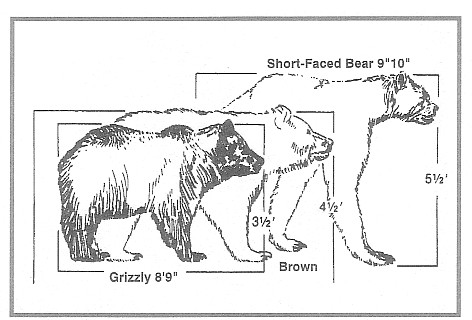
Arctodus is typically portrayed as a bear on stilts, in sharp contrast to other species, but is truly not that different. It is almost always shown with rather short hair, which does occur in the Sun Bear, but is highly unlikely to occur out of the tropics; see serchio25's Deviant Art for an intriguing portrayal of Arctodus with more probable hair. It also doesn't help that when Arctodus is compared with other bears or people, it is shown at maximum size. It is now known that Arctodus simus has legs that are not elongated in comparison with other bears, and that the appearance of long legs is probably an optical illusion caused by a rather short back (Figueirido et al. 2010). Arctodus does seem to be rather gracile in build, at least in comparison with Arctotherium angustidens. Grrrraaaahhhh of Shaggy God (citing Nelson and Madsen 1983) informed me of the A. simus specimen UVP 015 with a femur 72.3 (28.5") in length, 6.4 cm (2.5") in mid-shaft width and (as estimated by Figueirido et al. 2010) a weight of 957 kg (2110 lbs); the largest Arctotherium angustidens (see the prior post) has a humerus length* of 62 cm (24.5"), a mid-shaft width of 9 cm (3.5"), and an amazing weight of 1588-1749 kg (3500-3855 lbs). It seems strange that two closely related and similarly sized bears would differ so much in build, especially when bears in general seem conservative in their body plan variation, as demonstrated below.

* Bear humeri seem to be slightly shorter than femurs. UVP 015 is still certainly the tallest bear ever.


And now, bears, bears, bears!

Arctodus simus from Figueirido et al. 2010. Note the outline, which includes hair.

Ursus americanus (Black bear) (?) modified from Wikipedia Commons. It seems to be somewhat shorter-bodied and leggier than Arctodus - is it a juvenile?

Ursus spelaeus ("cave bear") from Wikipedia Commons. Note the long body relative to A. simus and the similar leg length.

Helarctos malayanus (Sun bear) modified from Wikipedia Commons. Note the very short fur.


So yeah, Arctodus simus is certainly not long-legged or feline-like. Did the originators of the claim even bother to compare it with other bears?


References: 

Cleland, H. F. (1916). Geology Part II. Historical. American Book Company: New York, Cincinnati, Chicago. Available.

Figueirido, B. Perez-Claros, J. A., Torregrosa, V., Martin-Serra, A., Palmqvist, P. (2010). Demythologizing Arctodus simus, the 'short-faced' long-legged and predaceous bear that never was. Journal of Vertebrate Paleontology 30(1), 262 - 275. Available.

Lydekker, R. (1894). The Royal Natural History: Mammals. Frederick Wayne and Co: London. Available.

Nelson, M. E. and Madsen, J. H. (1983). A Giant Short-Faced Bear (Arctodus simus) from the Pleistocene of Northern Utah. Transactions of the Kansas Academy of Science 86(1), 1-9.

Wednesday, March 12, 2008

Aquatic Stem-Group Synapsids?

Simply put, the stem-group synapsids are a fascinating group that has been incredibly overlooked by popular culture. We are synapsids, but it seems like the only stem-group species widely known is the early Permian pelycosaur Dimetrodon. As the Permian progressed, synapsids diversified into many groups ranging from carnivores to herbivores, the size of a rat to species over a ton. After the end-Permian extinction wiped out most groups and the archosaurs became the dominant land animals, a group of cynodonts evolved into us crown-group synapsids (mammals). While not as "spectacular" as the dinosaurs, archosaurs and other diapsids, they are relevant to our own evolution - and they're fairly bizarre looking to boot. Stem-group synapsids are unfamiliar enough that they're not even blessed with a halfway decent common name. They've been called "mammal-like reptiles", but this is deceptive since they didn't evolve from reptiles and don't have any of their derived characters. Some of the proposed names include "Protomammals", "Paramammals" and "Stem-Mammals"(a discussion is here), but the one I chose for the title is still the best in my opinion.

I've wanted to blog on this, dare I say, exotic group for some time, but it just never really worked out. When it was nebulously suggested that some marine cryptids were "transitional animal(s) with reptilian and mammalian characteristics" (ahem...), this got me wondering if any of these early mammal relatives took to the water. While mammals have evolved numerous semi and fully aquatic forms, earlier synapsids did not evolve fully marine forms. This certainly makes the notion of a living marine one pretty dang bizarre. So, how aquatic did stem-group synapsids manage to become?

Germain and Laurin 2005 studied the microstructure of extinct and extant amniotes at the mid-diaphyseal level in order to determine lifestyle (terrestrial, amphibious or aquatic). One taxa studied was Ophiacodon, a pelycosaur of the family Ophiacodontidae (which includes some of the earliest known amniotes). Their model predicted an aquatic lifestyle for this species, which others predicted from morphology and the fact that it was found with fish and amphibians or even marine deposits. However, the authors note that the limbs of this species show no adaptations to an aquatic lifestyle and due to the lack of animals at its size, clustering in the study could be considered ambiguous. This paper appears to be a warmup of sorts, the authors intend to determine the lifestyle of early amniotes (they obviously plump for an amphibious one) but only used three fossil species to do so! As early an amniote as Ophiacodon is, it is still probably far too derived to be of any use. Perhaps studying fossils like Casineria would be of more use. Hopefully with future studies the lifestyle of Ophiacodon would be made more clear, oh yeah, and determine how early amniotes lived.

Ophiacodon, from here (no copyright). Since this is a rather common species, we can assume this reconstruction is fairly accurate. Superficially it doesn't seem to have any features of an aquatic creature. The snout is noted as being long and narrow with a lot of teeth, and would be characteristic of a piscivore if it wasn't so high. It could be possible for bone density and microstructure to be artifacts of some other lifestyle. Still, if it was found in those deposits, I guess it could have hung around the water a little...


One of the most fascinating taxa suggested to be somewhat aquatic is Lystrosaurus, a herbivorous dicynodont genus which straddled the Permian and Triassic. This means that the genus survived an event which killed off 70% of terrestrial vertebrate families, although a few species did not locally survive (Botha & Smith 2007). A few (probably carnivorous) therocephalian genera also straddled the barrier but with nowhere near the abundance of Lystrosaurus (Botha & Smith 2007). It has been noted that the genus did not have elongated neural spines and an expanded chest with thick ribs compared to other genera; it was previously suggested that these features indicated enlarged lungs which helped them survive the extinction event (Botha & Smith 2007). Earlier workers suggested that Lystrosaurus had adaptations for burrowing and finds in scratch-digger burrows confirm this; presumably this could have aided their survival (Botha & Smith 2007). Germain and Laurin 2005 also studied this genera (the third was Pachypleurosaurus) and cautiously inferred that it was amphibious, and noted that fossorial activities have not been accounted for. However, they also suggested that a fossorial and amphibious lifestyle are not incompatible. The star-nosed mole (Condylura cristata) is less fossorial than other moles and an excellent swimmer (Petersen and Yates 1980), although given the vastly different sizes and niches I don't know how comparable the two are. Ray et al. 2005 also studied bone microstructure and noted cortical thickness (especially in the humerus) which could suggest either swimming or digging. However, there was some bone structure (medullary spongiosa) which is typical of semi to fully aquatic animals. Since Botha and Smith reference this paper and still suggest it was fossorial, I'd suggest the latter explanation is still the most plausible. While some features may suggest an aquatic nature, with everything taken into account it seems weakly supported. Perhaps like the thick-tailed opossum they spent some time in the water, but were in that apparent "semi-semi-aquatic" category.

L. murrayi from Wikipedia commons.


By now it seems pretty hopeless that there's a synapsid out there clearly demonstrating the traits of a semi-aquatic animal. Enter: the primitive cynodont Procynosuchus. It was a primitive member of the group (which gave rise to modern mammals) and lived in the upper Permian, and presumably went extinct in the P-Tr event. Kemp 1980 notes that Procynosuchus shows a suit of characters not found in any modern animals, and several unique to other therapsids as well. The zygapophyses (articular process) on the vertebrae are normally oriented (vertical) until the lumbar region where there is a sudden switch to a near-horizontal orientation. It appears that this allows for a great deal of lateral movement which was otherwise restricted in the other vertebrae. The tail had well-developed haemal arches and was also apparently flexible. Since this would not appear to help terrestrial locomotion at all, these features point to lateral anguilliform movement comparable to crocodilians and monitor lizards. Flattening of leg bones and well developed muscles suggest that it may have been used in locomotion. Oddly, the hindlimbs were capable of an erect gait when the forelimbs could only attain a sprawling gait. It is possible that it could attain two different gaits, also like a crocodilian.

Unfortunately, according to an article referenced at Palaeos (Hopson 1991) one author thought that all the traits thought to be related to a semi-aquatic lifestyle were artifacts of preservation. It's very hard discussing something that I don't have access to, were there other skeletons not showing traits? The flattening of the hindlimb bones and ribs could possibly be due to preservation, but really, all those other traits? I haven't seen any more discussion of this, and it seems like Kemp's analysis still stands (or is at least better known).


To answer my initial question: maybe? Presumably all of the taxa mentioned here interacted with water on some basis, but how adapted the first two are just isn't clear. I think that a skeleton getting deformed in a way that makes functional sense as an aquatic species is a bit hard to buy, and Procynosuchus seems to be the most aquatically adapted stem-group synapsid. The absence of many aquatically adapted species like the diapsids (and mammals) is conspicuous, and there really doesn't seem to be any anatomical reason for a whole radiation of animals to be incapable of adapting in such a way. Perhaps a few otter-like taxa will be found in the future, but I'm doubting any turtle mimics or long-necked whatzits.


Addendum:

Thanks to Christopher Taylor for pointing this out. Castorocauda lutrasimilis was a mid-Jurassic species often incorrectly called a mammal. It was a docodontan mammaliaform, which places it outside of Mammalia and makes it a stem-group synapsid. Confusingly, the term "mammal-like reptile" does not appear to be used for mammaliaformes and my replacement term was a bit more inclusive than I realized. Oh, and as far as adaptation goes it is supported by both skeletal and soft evidence and I have not seen any voices of dissent.


References:

Botha, Jennifer and Smith, Roger M. H. 2007. Lystrosaurus species composition across the Permo–Triassic boundary in the Karoo Basin of South Africa. Lethaia. 40, pp. 125-137.

Germain, Damien and Laurin, Michel. 2005. Microanatomy of the radius and lifestyle in amniotes (Vertebrata, Tetrapoda). Zoologica Scripta, 34, 4, July 2005, pp335–350

Kemp, T. S. 1980. The Primitive Cynodont Procynosuchus: Structure, Function and Evolution of the Postcranial Skeleton. Philosophical Transactions of the Royal Society of London. Series B, Biological Sciences, Vol. 288, No. 1027, pp. 217-258.

Petersen, Karen E. and Yates, Terry L. 1980. Condylura cristata. Mammalian Species, No. 129, pp. 1-4.

Ray, Sanghamitry et al. 2005. Lystrosaurus murrayi (Therapsida, Dicynodontia): Bone histology, growth and lifestyle adaptations. Palaeontology, Vol. 48, Part 6, pp. 1169–1185