Saturday, September 4, 2010

The Tiny Turtles of North America

Clemmys guttata (Spotted Turtle), a native of the Eastern United States and among the smallest turtles. Taken from my Flickr.

Thanks to Turtles of the United States and Canada, I wondered if North America has an unusually high diversity of small turtles. While Spotted Turtles have a maximum strait carapace length of only 14.25 cm (5.6"), there are 8 smaller species on the continent and several of similar size. But, what is "small" for a turtle? To find out - and possibly demonstrate an ascension from geek to nerd - I used the Turtles of the World website to obtain maximum size data for 305 species* and placed them in size categories at 5 cm intervals (e.g. 10-15 cm, 15-20 cm), rounding up. The number crunching resulted in this:

* I upgraded
Trachemys scripta subspecies to full species and used data from TotUSaC where available.

Minimum = 9.6 cm (Homopus signatus)
Maximum = 291 cm (Dermochelys coriacea)
The mode size category is 20-25 cm* (~19% of the total), although the average is 38.39 cm with a standard deviation of 32.44 cm. Since no turtles are less than a standard deviation from the average (thanks to seaturtles and island-dwelling tortoises) I'll consider the bottom 10% "small", which is just under 15.5 cm and roughly includes individuals in the 5-10 and 10-15 cm categories. As for how size varies within major clades:

* I apologize to any of my countrymen reading this, providing conversions from metric makes this even more unreadable. 

Kinosternidae range 12-37.9 cm. Mode 15-20 cm (52%). Average 17.01 cm (stdev = 5.5 cm).
Geoemydidae range 13-80 cm. Mode 20-25 cm (35%). Average 27.02 cm (stdev = 14.96 cm).
Emydidae range 11.5-60 cm. Mode 25-30 cm (25%). Average 28.47 cm (stdev = 9.38 cm).
Pleurodira range 12-89 cm. Mode 30-35 cm (22%). Average 29.99 cm (stdev = 11.29).
Testudinidae range 9.6-130 cm. Mode 20-25 cm (12.5%). Average 50.3 cm (stdev = 36.96 cm).
Trionychidae range 25-200 cm. Mode 60-65, 65-70% (25% total). Average 77.06 cm (stdev = 43.87 cm)

Including only these clades, one standard deviation less than the average is now about 18 cm, or 15 cm sans the freakishly big softshells. The remaining "family"-level clades have few species and extremely large body sizes (CheloniidaDermochelyidaeChelydridaeCarettochelyidaeDermatemydidae), with the notable exception of Platysternidae. So, let's consider turtles below 15 cm (6") small; I'll get back to this in a bit, but first, how do North America's turtles stack up against other continents*?

* This does not include seaturtles. 


Eurasia range 13-200 cm. Mode 20-25 cm (23%). Average 38.6 cm, stdev = 34.09 cm

North America range 11.6-80 cm. Mode 15-20, 20-25 cm (41% total). Average 26.84 cm, stdev = 12.66 cm
Central/South America range 12-89 cm. Mode 20-25 25-30 cm (33% total). Average 32.52 cm, stdev = 15.63 cm
Africa range 9.6-101.5 cm. Mode 20-25 cm (20%). Average 30.53 cm, stdev = 20.69 cm

It certainly appears that North America's turtles are smaller, and consistently so. It's worth noting that Turtles of the United States and Canada often had considerably larger figures than Turtles of the World, so it is possible that the maximum sizes for the other continents are understated. Now, to put that jumble of numbers into a more comprehensible form:

Note that these totals are percentages. Eurasia has 78 species, North America 68, Central/South America 55, and Africa 39. The patterns still occur with actual numbers, but are less apparent.
And now for that ever-trendy third dimension.
North America certainly does appear to have a trend towards smallness, although admittedly it isn't a strong one. Or is it. In accordance with action film tropes, there's a major aspect of this discussion I've suspiciously failed to mention - some turtles display the most extreme sexual size dimorphism of any tetrapod*. Barbour's Map Turtle (Graptemys barbouri) females are over twice the size of males (max strait carapace length of 33 cm vs. 13.5 cm) and Spiny Softshell (Apalone ferox) females display an even more pronounced dimorphism (54 cm vs. 21.6 cm) (Ernst and Lovich 2009); such linear differences imply females weigh at least 15 times as much as males. According to Turtles of the World, females from the geoemydid species Hardella thurjii reach an SCL of 61 cm while males only reach 17.5 cm - with females 3.5 times the linear dimensions of males, this implies a difference of at least 40 times in mass! For the most part it appears that North American emydids (i.e. most of them) have particularly pronounced sexual dimorphism, especially the numerous map turtles (Graptemys(Gibbons and Lovich 1990). Unfortunately, digging up data for the remaining 200+ species of turtle without readily available data on sexual size dimorphism is far too much for this already ludicrous blog post, so I'm going to assume that there aren't dozens of hyper-dimorphic geoemydids out there.


* The record is typically given to the Green Anaconda (
Eunectes murinus), although a survey of 177 males and 48 females found that in regards to means, females were 1.41 times longer and 4.68 times as massive; in regards to largest sizes, the female was 1.55 times longer and weighed 5.77 times as much. The study was found on Jesus Rivas's website, although I am not sure where it was published.

North American turtle sexual size dimorphism. Not every case involves females larger than males.

Counting males and females as separate "forms", suddenly a quarter of United States and Canada* turtles are in the 10-15 cm category, which seems unlikely for any other region to exceed. As to what conditions in North America would be ideal for small turtles - I have no idea. It seems unlikely to be predation (most of the species overlap in range with alligators, and all overlap with Chelydra) or climate... maybe it could just be a phylogenetic fluke?


* The data was not available for most Mexican turtles, hence I couldn't say "North American"

Glyptemys muhlenbergii, taken from Sophro's Flickr stream.

Stay tuned to follow-ups regarding the world's smallest turtle(s) and turtle sexual size dimorphism!


References:

Ernst, C. H., and Lovich, J. E. (2009). Turtles of the United States and Canada. John Hopkins University Press: Baltimore, Maryland. ISBN 13:978-0-8018-9121-2

Gibbons, J. W., and Lovich, J. E. (1990). Sexual Size Dimorphism in Turtles with Emphasis on the Slider Turtle (Trachemys scripta). Herpetological Monographs 4, 1-29. Available.

Monday, August 9, 2010

Sliders? In My Neighborhood?

Me with non-native Pond Slider (Trachemys scripta).
What exactly is Trachemys scripta? Most sources treat it as a 'megaspecies' composed of 15 subspecies ranging from Virginia to New Mexico to Colombia (e.g. Turtles of the World), however this notion is an unfortunate holdover from The Age of Lumping. Seidel (2002) argues that differences in breeding behavior, broadly non-overlapping distributions, and distinct morphology* imply many of the 'subspecies' are in fact full species; a phylogeny determined from 52 morphological traits placed United States Sliders (scripta, troostii, elegans) in a distinct clade, causing Seidel to restrict Trachemys scripta to the three subspecies and moving all others to new or previously existing species. The molecular phylogeny in Stephens and Wiens (2004) also supports a scripta/troostii/elegans clade and shows the traditional "Trachemys scripta" to be strongly polyphyletic; curiously "Trachemys" itself was shown to be paraphyletic, but this was not directly commented on. Bickham et al. (2007) used the taxonomy proposed by Seidel (2002), making it about as 'canonical' as a proposed taxonomy can get, so from here on out I will use Trachemys scripta in the strictest sense.

* According to Turtles of the World, some 'subspecies' barely reach an SCL of 20 cm (troostii, taylori, cataspila) while grayi reaches a colossal 60 cm (2 feet), and presumably weighs over 30 times as much. If the traditional Trachemys scripta species concept was valid, it would have to take the cake for size variation within a species.


T. scripta is the only Trachemys species with black markings on the plastron (Seidel 2002).
Trachemys scripta naturally ranges across a considerable portion of the United States east of the Continental Divide*, but thanks to human introductions, breeding colonies are now established on every continent except Antarctica, as well as several major island groups (Ernst and Lovich 2009). In addition to being the world's most widely distributed turtle species, Pond Sliders are also one of the most genetically variable vertebrates (Scribner et al. 1995). To demonstrate, here are three possibly related individuals:


The middle individual is the same one I'm holding at the top, approx SCL of 20 cm (8 inches).
The above turtles are residents of Wood Pond in Barrington, Rhode Island, a tiny body of water (0.16 hectares/0.4 acres) designed to collect highway runoff - note the unnatural sheen at the water's surface. Despite these factors, and undoubtedly thanks to people constantly throwing in bread, I've counted at least a dozen Sliders, a handful of Painted Turtles (Chrysemys picta picta), hundreds of Goldfish (Carassius auratus auratus), and a couple dozen Mallards (Anas platyrhynchos). Feeding waterfowl is a bad idea, so I decided to attract the turtles with a few pellets of old cat food. Sliders were present in the pond 7 years ago, and judging by how small some of them are, it seems possible this is a reproducing population. The turtle I am holding at the top of the page was stuck in a construction ditch and may have been on its way to deposit eggs. The presence of Painted Turtles raises the possibility that the Sliders can colonize local freshwater bodies of water - however the highway and brackish waterways will (hopefully) hinder their movements*. Still, if anyone wants some pet sliders, these are already fairly tame and easy to catch.

* They are occasionally present in brackish waters, but this has only been observed in Georgia and South Carolina (Ernst and Lovich 2009)


Introduced Trachemys scripta have had negative impacts on turtle populations in Europe and Western North America due to direct competition, including competition for basking sites (Ernst and Lovich 2009 - citing Cadi and Joly 2003, 2004, Spinks et al. 2003), however it is not clear what sort of impact they would have if present in areas with a multitude of other turtle species. Wild T. scripta prefers shallow freshwater habitats with plentiful basking sites and aquatic vegetation such as lakes, swamps, sloughs, and slow moving rivers where they feed on assorted plant and animal matter, shifting towards the former with maturity (Ernst and Lovich 2009, also citing various). While I though a density of about 30/hectare looked like a lot in Wood Pond, only one population density study cited by Ernst and Lovich (2009) was similar (28/hectare in a small pond) and several were much larger, the largest being 983/hectare! T. scripta also take up a large percentage of the total number of turtles in many areas, the studies cited in Ernst and Lovich (2009) generally observed over 50% T. scripta, with a low of 0.06% and a high of 87%. Despite the propensity towards invasiveness, anthropogenic influences (habitat destruction, pollution, roadways, over-collection) are causing decreases in wild populations (Ernst and Lovich 2009). I don't think there's a species of turtle out there that can't be described by the previous sentence.


References:

Bickham, J.W., Iverson, J.B., Parham, J.F., Philippen, H-D, Rhodin, A.G.J., Shaffer, H.B., Spinks, P.Q., van Dijk, P.P. (2007). An Annotated List of Modern Turtle Terminal Taxa with Comments on Areas of Taxonomic Instability and Recent Change. Chelonian Research Monographs 4, 173-199. Available.

Ernst, C.H., and Lovich, J.E. (2009). Turtles of the United States and Canada. John Hopkins University Press: Baltimore, Maryland. ISBN 13:978-0-8018-9121-2

Ernst, C.H., Altenburg, R.G.M., and Barbour, R.W. Turtles of the World. World Biodiversity Database.

Scribner, K.T., Morreale, S., Smith, M.H., Gibbons, J.W. (1995). Factors contributing to temporal and age-specific genetic variation in the freshwater turtle Trachemys scripta. Copeia. 1995, 970-977.

Seidel, M.E. (2002). Taxonomic Observations on Extant Species and Subspecies of Slider Turtles, Genus TrachemysJournal of Herpetology 36(2), 285-292. Available.

Stephens, P.R., and Wiens, J.J. (2004). Convergence, Divergence, and Homogenization in the Ecological Structure of Emydid Turtle Communities: The Effects of Phylogeny and Dispersal. The American Naturalist 164(2), 244-254. Available.


Secondary References:

Cadi, A. and Joly, P. (2004). Impact of the introduction of the red-eared slider (Trachemys scripta elegans) on survival rates of the European pond turtle (Emys orbicularis). Biodiversity and Conservation 13, 2511-2518.

Cadi, A., and Joly, P. (2003). Competition for basking places between the endangered European pond turtle (Emys orbicularis galloitalica) and the introduced red-eared slider (Trachemys scripta elegans). Canadian Journal of Zoology 81(1), 392-398.

Spinks, P.Q., Pauly, G.B., Crayon, J.J., Shaffer, H.B. (2003). Survival of the western pond turtle (Emys marmorata) in an urban California environment. Biological Conservation 113, 257,267

Friday, July 16, 2010

Giant Snappers, Take 3

There aren't many pictures of very large Common Snapping Turtles (Chelydra serpentina) - let alone with decent angles or objects that can be used for scale - so I feel obliged to share a series of photos taken in Rhode Island's Blackstone River in May, 1986:


I have no prior experience with gun identification, but this appears to be a Ruger MK II with a 4 in (10 cm) bull barrel; this scale gives realistic measurements of the man in the photograph, who is roughly the same size I am. Thus, the strait carapace length is approximately 16.5 inches (42 cm), which isn't record size (49.4 cm/19.4 inches), but then, the same body of water reportedly holds numerous other individuals which are even larger. The weight was estimated to be around 80 pounds (36 kg).


The carapace appears to have three low keels, which seems remarkable for a turtle of this size. Supramarginals are obviously not present, so this cannot be an out of place Alligator Snapping Turtle (Macrochelys temminckii). The head:carapace ratio is difficult to determine, but appears to be larger than 1:3, judging by the last photo. The tail is rather short and slender for a snapping turtle - could this individual be female? The record for that gender is an SCL of only 36.6 cm (14.4 inches) - in which case this individual would be quite remarkable (Ernst and Lovich 2009 - citing Gibbons and Lovich 1990)


Small (8 inch/20 cm SCL) female Snapping Turtle finishing up a nest. Photo by me.


Snapping turtle with ~40 cm (15.7 inch) SCL - note how the tail has a post-carapace 'bulge' and is overall much thicker than that of the Blackstone Specimen. Taken from Flickr user Karim Rezk. Similar photos can be found here and here.


Males snappers have an anal vent past the carapace rim and a pre-anal tail length of over 120% the length of the posterior lobe; females have a vent beneath or slightly under the rim and have a pre-anal tail length under 110% of the lobe (Ernst and Lovich 2009 - illustrated here). Males also have longer and thicker tails, a smaller plastron, and narrower bridge (see Chelydra.org). Unfortunately, most of these traits are not observable in the specimen and I am uncertain if the tail morphology is within the range of variation for males.  Still, it is a remarkable animal, and it certainly isn't every day that a turtle has a shell the size of a human torso.

Since this is such an interesting topic, I will start on a sub-page of this blog that focuses on snappers which are potentially larger than record size. If anyone reading has any stories, I will be highly interested.

Many thanks to the source for the photograph!


References:

Ernst, C. H., and Lovich, J. E. (2009). Turtles of the United States and Canada. John Hopkins University Press: Baltimore, Maryland. ISBN 13:978-0-8018-9121-2

Gibbons, J., and Lovich, J. (1990). Sexual dimorphism in turtles with emphasis on the slider turtle (Trachemys scripta). Herpetol. Monogr. 4, 1-29.

Wednesday, July 14, 2010

Giant Snappers, Take 2

At the Audubon Society of Rhode Island's Environmental Education Center, I couldn't help but notice an enormous Common Snapping Turtle (Chelydra serpentina) skull when I was placing a complete Corn Snake shed into a specimen drawer. All I could determine about this specimen is that it's from Auburn, Maine and rivals my prior giant snapper in size.


Ventral view of the skull. Using ImageJ, I calculated the distance from the tip of the premaxilla (i.e., the beak) to the end of the supraoccipital to be 14.74 cm or 5.8 inches. The currency - which refused to smoothen out - is there to establish rough scale.


Dorsal view of skull. These measurements slightly exceed the ventral view, probably due to the highly raised supraoccipital. The bill has somehow become even more crinkled.


Note the enormous temporal/otic notches and damage to the prefrontal.


Frontal view. The posterior portion of the head was probably considerably wider in life.


Data from Herrel and O'Reilly (2006) indicates their largest Chelydra had a 11.8 cm (4.65") head corresponding with a carapace length of 38.6 cm (15.6"), giving a head:SCL ratio of 1:3.27. This implies that the Auburn Specimen (head length ~14.7 cm) has an SCL of at least 48 cm (19") - as snapping turtle heads appear to get proportionally smaller with increased SCL. So how does Gamera stack up?


The specimens appear to be nearly identical in size - and somehow, angle. 


The official maximum size* of Chelydra serpentina, as given by Ernst and Lovich (2009), is an SCL of 49.4 cm (19.4") (Ernst and Lovich 2009) - a length both of these specimens appear to have approached, or slightly exceeded. Considering just about everybody has a story about giant snappers, this seems to imply that such lengths are not uncommon; the ease in which I found the two very large specimens appears to support this. Ferri (2002) claims the "normal" maximum for Chelydra is 47 cm SCL, but specimens may reach 60 cm (2 feet); while this claim was not substantiated as far as I can tell, it seems plausible.

* One wild specimen with a 47 cm (18.5") SCL weighed 34 kg (75 pounds)... and was known for attacking horses! (Ernst and Lovich 2009) - presumably the specimens I ran across are/were similarly massive and potentially traumatogenic.


More on this subject soon.


References:


Ernst, C. H., and Lovich, J. E. (2009). Turtles of the United States and Canada. John Hopkins University Press: Baltimore, Maryland. ISBN 13:978-0-8018-9121-2

Ferri, Vincenzo. (2002). Turtles and Tortoises. Firefly Books: Buffalo, New York. ISBN 978-1552096314

Herrel, A. and O'Reilly, J. (2006). Ontogenetic Scaling of Bite Force in Lizards and Turtles. Physiological and Biochemical Zoology 79(1), 31–42. DOI: 10.1086/498193

Tuesday, June 29, 2010

A Most Peculiar Turtle

Shortly after 8 a.m. on June 20th, 2010, at approximately this location, I happened across a melanistic turtle with an ~8 inch/20 cm carapace which had just successfully crossed the East Bay Bike Path. It appeared to be an emydid, but somehow I was unable to pin down the identification. Could it be a variant, or something more unusual? Or am I just crazy?


My best approximation of a dorsal view. The fourth vertebral scute has been damaged (and patched up by people?) and some of the costal ('rib') scutes appear to be abnormally shaped. Traits relevant for classification include the 'sculpted' appearance of the scutes, the vertebral ridge, and patternless dark brown coloration.  


The jaws appear to be particularly thick and are the widest point of the head - which is brown/black/white and distinct from the otherwise greyish skin. The ventral surface of the carapace is orange and black, and the plastron is orange-ish and unpatterned.


A lateral view demonstrating that the lower margin of the upper jaw is rimmed with ivory white, the same shade as the lower jaw.


This specimen is clearly not an Eastern Box Turtle, Spotted Turtle, Painted Turtle, or Slider, which leaves two remaining candidates... assuming an exotic isn't involved.


Wood Turtle?
Wood turtles (Glyptemys insculpta) doing their thing. Note the difference in shell pattern (and lack thereof). From Flickr user man of mud. Original.


Wood Turtles frequently reach an SCL of 20 cm (Walde et al. 2003) have a dark sculpted carapace, subtle vertebral ridge, a primarily orange plastron, and somewhat similar facial coloration as the Warren turtle. However, the Warren turtle only had access to brackish water, which Wood Turtles apparently avoid, and lacked extensive orange or red pigmentation. That in itself is not conclusive, but facial morphology is:


From Flickr user ajschu. Original.


Wood Turtles lack the massive jaws of the Warren turtle, and have two projections on the upper beak clearly not present in that specimen. There's a possibility that a Wood x Blanding's Turtle hybrid could have head morphology more similar to the Warren turtle, but as the Blanding's half of such an individual is not native to Rhode Island*, such an individual would be an extreme oddity. 

While we can dismiss the species as a candidate, this Wood Turtle site is still worth checking out. I should probably give them proper coverage at some point.

* They are, however, present in nearby Massachusetts.


Diamondback Terrapin?
Northern Diamondback Terrapin, Malaclemys terrapin terrapin from Flickr user nicoleym. Original.


I had seen (and removed) a road-killed terrapin two days before the Warren turtle, which looked comparable to the above individual, and at the local Audubon I occasionally fed some hatchlings (which were getting a 'jump start'). While the coloration pattern is very different from the Warren turtle, the shell and head morphology looks very similar. Northern Terrapins in particular are highly variable, so do any out there resemble the Warren turtle? Yes they do:


From Flickr user sandy richard. Original.


So there you have it, the Warren turtle in unambiguously a dark-morph Northern Diamondback Terrapin and not some bizarre exotic. Terrapins are only known to lay eggs at one site - two miles away - so the individual I observed may have been attempted re-colonization. Increased melanin in turtles may protect sexual organs from ultraviolet radiation and is correlated with territoriality and aggression (see abstract by Dominy) - although of course the study has yet to take place. More on terrapins soon...


References:

Walde, A., Bider, J., Daigle, C., Masse, D., Bourgeois, J.-C., Jutras, J., and Titman, R. (2003). Ecological Aspects of a Wood Turtle, Glyptemys insculpta, Population at the Northern Limit of its Range in Québec. Canadian Field-Naturalist 117: 377-388. Available.

Wednesday, May 19, 2010

Deirochelys: A Short-Lived, Long-Necked, Highly Carnivorous Little Turtle

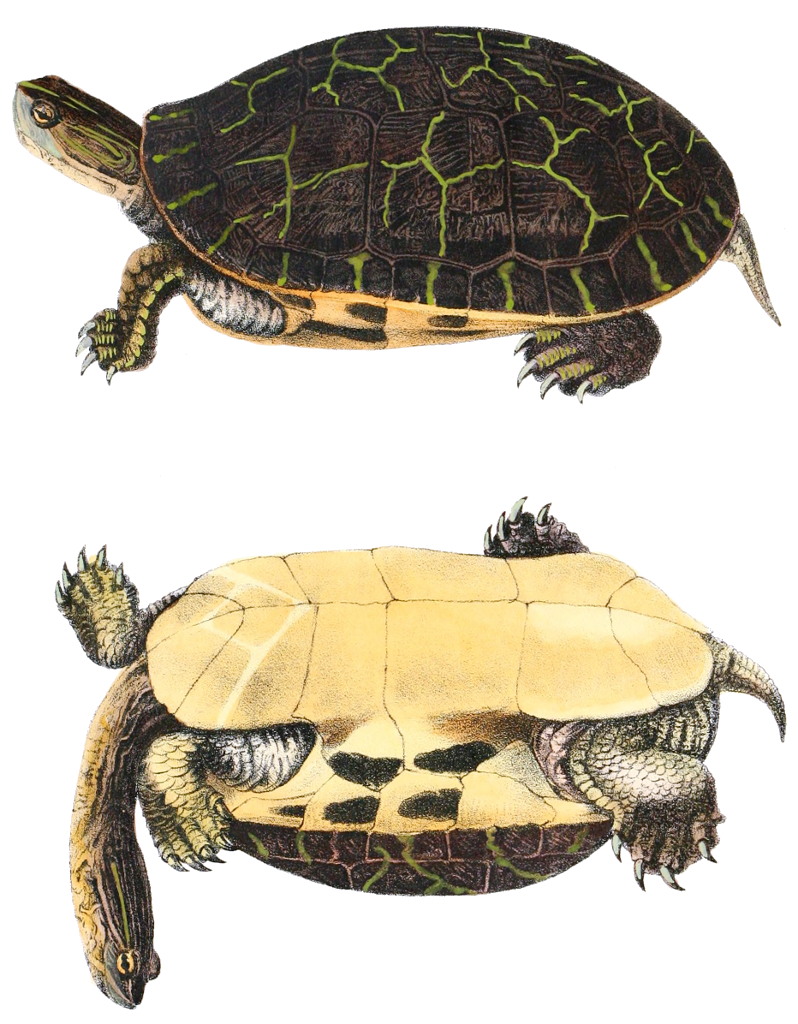
Deirochelys reticularia, an emydid with the unfortunate common name 'Chicken Turtle'. This public domain illustration was taken from the Wikipedia Commons.

The 1994 edition of Turtles of the United States and Canada speculated that Deirochelys are carnivorous as juveniles and take increasing plant matter with maturity - a typical emydid trait - and avoid competition by utilizing an unusual feeding strategy (Ernst et al. 1994). By the next edition it became clear that Deirochelys are highly carnivorous at all stages in life, feeding on aquatic invertebrates and tadpoles in ephemeral habitats (Ernst and Lovich 2009). It seems shocking that the basic biology of an animal exploited by humans (hence the common name) could be so poorly understood even in recent years, although this is probably not at all unusual for uncommon and uncharismatic fauna.

Deirochelys are small to medium-sized turtles, with males reaching a strait carapace length of 16.5 cm (6.5") and females reaching 25.4 cm (10") (Ernst and Lovich 2009). The head/neck length is 75-80% of the SCL (about the length of the plastron), much longer than those of similar emydids (Ernst and Lovich 2009). The elongated neck, flat and narrow skull, elongate thoracic rib heads, and highly developed hyoid of Deirochelys are traits shared with another emydid, the Blanding's Turtle, and it appears both species use pharyngeal suction in conjunction with movement from their long necks to capture fast moving prey (Ernst and Lovich 2009 - citing Jackson 1996, Demuth and Buhlmann 1997 also Stephen and Wiens 2003 - citing Loveridge & Williams 1957, Bramble 1974). Here is feeding in an artificial setting courtesy of YouTube:

Deirochelys does not normally encounter fish.

Despite the similarities with Blanding's turtle, Deirochelys is placed in the emydid sub-clade Deirochelyinae along with ChrysemysPseudemysTrachemysMalaclemys, and Graptemys - while the other species, semi- or fully terrestrial as opposed to aquatic, are placed in the clade Emydinae (e.g. Ernst and Lovich 2009). A topology of Deirochelyinae where Deirochelys is the most basal species has been supported by a study of morphological and mtDNA data (Stephens and Wiens 2003) and one of mitochondrial and nuclear DNA (which were otherwise quite discordant) (Wiens et al. 2010). While Stephen and Wiens (2003) erroneously classify Deirochelys as omnivorous, it still appears likely that the ancestral deirochelyin and emydid were.

As Deirochelys inhabits ephemeral wetlands generally unoccupied by other turtles, it has a number of unique adaptations to deal with the pressures. Seasonal drying forces turtles into terrestrial refuges, where survivorship is higher than the aquatic period of spring to early summer (Buhlman et al. 2009). However, extended droughts can be devastating - one lasting over a year in a 5.1 hectare Carolina Bay killed all mature females, hatchlings, and yearlings (Buhlman et al. 2009). Deirochelys has a thin shell that offers little protection from predators, and a single otter can enormously impact a population (Buhlman et al. 2009). All mature females in one population reproduced (60% raised two clutches), maturity can be reached shortly after a drought, and the minimum age of maturity (and implied lifespan) is very low for a turtle - 5 years for females and 2 for males (Buhlman et al. 2009).

And on a more trivial note, it appears Deirochelys is quite the adept climber:

The ability to climb vertical surfaces is surprisingly common amongst turtles... but that's a story for another day.


References:

Buhlman, K., Congdon, J., Gibbons, J., Greene, J. (2009). Ecology of Chicken Turtles (Deirochelys reticularia) in a Seasonal Wetland Ecosystem: Exploiting Resource and Refuge Environments. Herpetologica 65(1) 39-53. Available

Ernst, C., Lovich, J., and Barbour, R. (1994) Turtles of the United States and Canada. Smithsonian Institution Press: Washington.

Ernst, C., and Lovich, J. (2009). Turtles of the United States and Canada. John Hopkins University Press: Baltimore, Maryland. Partially Available.

Stephens, P., and Wiens, J. (2003). Ecological diversification and phylogeny of emydid turtles. Biological Journal of the Linnean Society 79, 577-610. Available.

Wiens, J., Kuczynski, K., and Stephens, P. (2010). Discordant mitochondrial and nuclear gene phylogenies in emydid turtles: implications for speciation and conservation. Biological Journal of the Linnean Society 99, 445-461. Available.

Thursday, April 15, 2010

Lord Geekington In The Field: Giant Snappers

From Hell's heart, I photograph thee!

I've had big turtles on the mind after writing posts about Mega-Turtles and editing an article on a speculative giant snapping turtle; the last thing I expected was to casually stumble across a giant individual. Whilst surveying the damage caused by the recent Hundred Year Flood, I impulsively explored the coastline of a ~100 acre (40 hectare) pond. I had previously seen painted, red-eared slider, and wood turtles in the locale, so I admit that I was expecting to see turtles of some sort. Heading back, I noticed that what I initially assumed to be a large rock was covered in scutes. I actually said "Holy shit!" out loud for the first and only time that I can recall. Having plenty experience seeing car tires in the water, I estimated the length of the shell to be about 2 feet (60 cm) long. The size and flatness of the shell, coupled with Narragansett Bay only being a mile away, made we wonder if this was a sea turtle that had gotten very lost. However no flippers were visible and as I got closer (about 5-6 feet away at the closest) I realized that I was staring at an alarmingly large snapping turtle. Only having a cell phone at the time, here is the only photo I could manage before the turtle disappeared:


This Cryptozoology-caliber photograph is clearly too prone to pareidolia to be of any analytical value. The next day I came back with a DSLR in a desperate gambit to get a clearer photograph, and somehow succeeded:


Sort of. The turtle caught me off guard by being on the different side of a small peninsula and once again it managed to disappear before I could photograph it further. While still blurry (as auto-focus doesn't work well on submerged objects) there's no doubt the object in question is a snapping turtle. I wasn't sure if I saw subtle keels in the photo, so that coupled with the outrageous size made me wonder about species identification. Common Snapping Turtles (Chelydra serpentina) are native to my region, have keels that effectively disappear with age, and have a maximum SCL (strait carapace length) of 49.4 cm (1'7") (Ernst and Lovich 2009). Since the turtle I observed appeared to be around (or exceeding) the record size, I wondered if the prospect of running into an accidentally introduced species would be more likely. Alligator Snapping Turtles (Macrochelys temminckii) can reach an SCL of 80 cm (2'7" - typically 40-50 cm or 1'3" to 1'7"), but have prominent keels on the carapace, and only occupies river systems flowing into the Gulf of Mexico (Ernst and Lovich 2009). I noticed that some specimens have keels that are surprisingly subtle, so I can't discount them based on that trait.

I set out once again with a friend in tow - partially to ensure that I was not insane - to try and figure out the size and identification of the turtle once and for all.


TJ's photograph. The bright red/orange coloration seems rather odd - is it indicative of a disease or is it within the range of variation?


My photograph of the head. Red/orange coloration is also present. The turtle must be a sight to behold out of the water... if it ever leaves the water.

I revisited the area after the water levels went down...


Photo-montage of an ISO/IEC 7810 ID-1 card (8.56 x 5.4 cm or 3.37" x 2.13") in relation to the turtle's head. 


These photos unambiguously show a Common Snapping Turtle (Chelydra serpentina) and the landmarks support the notion of considerable size. Using an 8.5 cm figure for my outdated Blood Bank card yields a head length of 14.5 cm (5.7") and width of 13.5 cm (5.3") - but I also shaved off 0.5 cm "just in case" to get lower bounds of 13.5 cm (5.3") and 12.5 cm (4.9"). Herrel and O'Reilly (2006) have a table of measurement data from 11 Chelydra individuals and I assumed that minimum and maximum measurements correspond to singular individuals. Using those figures I estimate the carapace to be 44-47 cm (1'5"-1'6.5") using the head length and 47-51 cm (1'6.5"-1'8") using width. The head length/carapace length proportions in Herrel and O'Reilly (2006) are about 1:2.5 (minimum - 2.7 cm/6.7 cm), 1:3.0 (average - 6.5 cm/19.7 cm), 1:3.25 (maximum - 11.8 cm/38.6 cm) - so the given carapace length estimates may be a bit low. The head width/carapace length proportions are about 1:3.5 (minimum - 1.9 cm/6.7 cm), 1:3.8 (average - 5.1/19.7), 1:3.8 (maximum - 10 cm/38.6 cm) - so the given estimate is probably reasonable. Scaling up from the 38.6 cm/16.65 kg maximum in Herrel and O'Reilly gives estimated masses of 25 kg (55 pounds - 44 cm SCL), 30 kg (66 pounds - 47 cm SCL), and 38 kg (83 pounds - 51 cm SCL).

Clearly there is no substitute for actually measuring the turtle! Such a feat would be nigh-impossible to do safely as the turtle appeared rather suspicious of humans and even their food (chicken and ham... my intended lunch), it was right next to a tunnel in which it could casually escape, the water was close to waist-deep right off the bank, lots of branches were in the way, oh, and the turtle looked like it could swallow and severely mangle my hand. I must note that you should NEVER NEVER NEVER pick up a snapping turtle by its tail as it can cause severe injury - I cannot emphasize that enough - NOBODY gets it right. Well actually TJ knew better, but that appears to be a rare exception. Chelydra.org illustrates how you should pick up a turtle, unsurprisingly none of these methods look plausible for an animal close to the size of the Alligator Snapper in their photograph. Curious as I am about the turtle, it is not worth risking the life and well-being of a potentially decades-old animal just to find out how large it is.

While my friend and I were walking back from photographing the snapping turtle (waiting for it to re-emerge), unbelievably, we saw a second individual which appeared to be almost the same size about 50 m (160 feet) away. It lacked the conspicuous orange coloration and dwarfed a painted turtle right next to it (which looked plausibly bite-sized). I am certainly curious as to how many large turtles are living in the pond. If there is a potential way of getting the vital stats of the turtles and to be involved in some sort of official program, I certainly wouldn't mind spending a summer tracking them down...


Oh, and I'm just getting started with snapping turtle posts.


References:

Ernst, C. H., and Lovich, J. E. (2009). Turtles of the United States and Canada. John Hopkins University Press: Baltimore, Maryland.

Herrel, A. and O'Reilly, J. (2006). Ontogenetic Scaling of Bite Force in Lizards and Turtles. Physiological and Biochemical Zoology 79(1), 31–42. DOI: 10.1086/498193