Tuesday, February 10, 2009

Fossil Octopods Part 2: Pre-K/T

The first post of this series looked at fossil cephalopods whose inclusion in the order Octopoda (= Octobrachia) is a matter of debate. Pohlsepia mazonensis is an early Carboniferous coleoid with 10 appendages (including 2 tentacles!) which was interpreted as an octopod because of its sac-like body and lack of an apparent shell; the presence of fins indicates that it must have had some internal support and it is currently ignored in phylogenetic analyses because of its dubious preservation. Proteroctopus ribeti was a mid-Jurassic coleoid with 8 limbs, but it also curiously lacked a gladius despite having fins; it could be a stem-octopod, but affiliations with vampyromorphs are just as probable with the available evidence. Trachyteuthids are a mid-Jurassic to late Cretaceous family currently thought to be vampyromorphs (previously squids) but their beak and gladius morphology implies that the squid-like coleoids with eight cirrated appendages and four fins are in fact stem-octopods. Hopefully healthy debate in the future will solidify the phylogenetic positions of these organisms, but there are fossils with undoubted affinities to Octopoda.


Octopods

Palaeoctopus

First described in 1896 from Lebanon, the gladius vestiges of these Cretaceous cephalopods unambiguously indicate that they are octopods (Fuchs et al. 2008). Preservation of soft tissue shows that Palaeoctopus had fins; interestingly the gladius remnants do not resemble the clasp or butterfly-shaped structures of the finned cirrates, but the paired remnants of incirrates (Fuchs et al. 2008). The gladius remnants of Palaeoctopus differ from modern incirrates in being proportionally large, close-set, and stiffened - likely adaptations for providing muscle attachment for the fins (Fuchs et al. 2008). Fuchs et al. (2008) suggest that similarities in curvature in the lateral field of the gladius remnants/gladius of Palaeoctopus and teudopseids further demonstrates their theory about the derivation of the former from the latter... but keep reading.

P. newboldi was the only known species of Palaeoctopus for well over a hundred years, but recently Fuchs et al. (2008) described another species, P. pelagicus, from the early Turonian (~93 mya) of Mexico which differs from P. newboldi in the form and structure of the reinforcements and fields of their gladius remnants. The soft body morphology of P. newboldi indicates that it was probably capable of some benthic locomotion; this data is lacking for the earlier P. pelagicus, but the low oxygen of the sea floor and the distance from coasts strongly suggests that this species was entirely pelagic (hence the name) (Fuchs et al. 2008). I can't help but wonder if Palaeoctopus is paraphyletic or polyphyletic, considering the millions of years between the species and the possible lifestyle differences.


Palaeoctopus newboldi holotype. The soft body morphology of P. pelagicus is unknown, but likely to show more evidence of a pelagic lifestyle.


Keuppia

Palaeoctopus pelagicus was briefly the oldest unambiguous incirrate octopod until Fuchs et al. (2009) described five specimens from two genera and three species from the slightly older Upper Cenomanian (~95 mya). Keuppia was placed in the same family as Palaeoctopus, Palaeoctopodidae, on the basis of sharing blade-like medially isolated bipartite gladius vestiges (Fuchs et al. 2009). Unlike Palaeoctopus, the Keuppia species have a gladius vestige complex with a sub-triangular/semi-circular shape and linear growth patterns instead of concentric (Fuchs et al. 2009). The shape of their gladii remnants are more reminiscent of loligosepiid Octopodiformes, leading the authors to greatly revise their "teudopseid pathway" phylogeny proposed in earlier articles (Fuchs et al. 2009). Curiously, none of the three Keuppia specimens showed preserved fins (they did show suckers, ink sacs, gill lamellae, etc) - however circular encrustations imply that they had basal fin cartilage and were powerful swimmers (Fuchs et al. 2009). Palaeoctopus did not have preserved basal fin cartilage but it did have fins, Fuchs et al. (2009) suggest that it was a less powerful swimmer than Keuppia. I'd like to suggest the possibility that Keuppia recently lost its fins and still possessed a swimmer-like gladius - but I'm not the palaeontologist here. When more fossils turn up, it seems likely that they'll possess some bewildering array of characteristics that leads to more phylogenetic upheaval. The concept of morphological plasticity in early evolutionary "stages" is beginning to sound more plausible to me...


Styletoctopus

Another undoubted incirrate octopod from the Upper Cenomanian of Lebanon, incredibly this species already possesses stylets and appears to be a member of the extant family Octopodidae (Fuchs et al. 2009). Stylets (or rods) are gladius vestiges even more reduced and separated than those of the Palaeoctopodidae*; Fuchs et al. (2009) state that the stylets of Styletoctopus resemble those of Enteroctopus, Benthoctopus and Eledone in the possession of anterior and posterior "shoulders"**. Despite its otherwise modern morphology, Styletoctopus has circular structures which may be interpreted as small globular fins - rather unexpected for a cephalopod with such a reduced gladius (Fuchs et al. 2009). If fins were present (and that's a big "if"), it would seem to indicate that fins were lost multiple times within the incirrate octopods. Styletoctopus implies that Octopoda first derived at least in the Early Cretaceous and possibly the Jurassic (Fuchs et al. 2009).

* Interestingly, Keuppia has posterior shell sacs (remnants) while Palaeoctopus had more laterally placed ones transitional in placement between Keuppia and Styletoctopus; Fuchs et al. (2009) suggest there is some sort of functional difference associated with these placements.

** Strugnell et al. (2005) found Benthoctopus and Enteroctopus to form a clade despite being classified in different subfamilies. Strugnell and Nishiguchi (2007) noted that some previous authors considered Eledone basal - unfortunately Benthoctopus and Enteroctopus were not included in the analysis but Eledone tended to group with other octopods with one row of suckers.


Campanian Cirrate?

Fuchs et al. (2009) mentions a publication which described an unpaired saddle-shaped shell vestige possibly belonging to a cirrate Octopod. I cannot find this:

Fuchs, Dirk et al. 2007. Coleoid cephalopods from the Late Cretaceous North eastern Pacific. 131. In 7th International Symposium ‘Cephalopods – Present & Past’, abstract volume. Sapporo.


"Octopodida" (= Octopoda) Incertae sedis

Tanabe et al. (2008) describe a medium-sized lower jaw from the Santonian which shows the characteristic posteriorly expanded wings and ventrally projected inner lamella with a narrowly rounded crest typical of Octopoda - however it was not well preserved enough to determine any further relations.


Paleocirroteuthis

Two species, P. pacifica and P. haggarti, have lower jaws with a similar shape to modern cirrates, albeit with a posteriorly expanded lateral wall and greater size (Tanabe et al. 2008). P. haggarti has been found in the Santonian and Lower Campanian of Vancouver Island while P. pacifica is known from the Lower Campanian of Hokkaido and Vancouver Island, they are similar in size and morphology although the P. pacifica specimens were not as well-preserved (Tanabe et al. 2008). Since the authors also found a similarly sized vampyromorph from the Lower Campanian of Vancouver, Nanaimoteuthis jeletzkyi, they used a negative allometric equation scaled up from modern Vampyroteuthis to estimate that all of these species ranged between 11-57 kg (24-126 lbs) in weight and 24-37 cm (9.5" - 14.5") in mantle length. A Cirroteuthis magna with a 33 cm mantle length (13") and total length of 1.7 m (5'7") has been reported - but unfortunately not weighed (Collins et al. 2001). Judging from the photo, it probably weighed less than 10 kg - but then again, I'm not a teuthologist.


That's about it for interesting fossil octopods, no offense to the Argonauts. Considering how much this topic can change in a couple years I might as well start preparing for the re-reboot... if I didn't have a lot of other things to do.


References:

Collins, Martin A. et al. 2001. A large Cirroteuthis magna (Cephalopoda: Cirroctopoda) caught on the Cape Verde Terrace (North Atlantic). J. Mar. Biol. Ass. UK. 81, 357-358.

Fuchs, Dirk and Schultze, Hans-Peter. 2008. Trachyteuthis covacevichi n. sp., a Late Jurassic Palaeopacific coleoid cephalopod. Fossil Record 11, 39-49.

Fuchs, Dirk et al. 2008. A new Palaeoctopus (Cephalopoda: Coleoida) from the Late Cretaceous of Vallecillo, North-Eastern Mexico, and implications for the evolution of Octopoda. Palaeontology 51, 1129-1139.

Fuchs, Dirk et al. 2009. New Octopods (Cephalopoda: Coleoida) from the Late Cretaceous (Upper Cenomanian) of Hakel and Hadjoula, Lebanon. Palaeontology 52, 65-81.

Kluessendorf, Joanne and Doyle, Peter. 2000. Pohlsepia mazonensis, and early 'Octopus' from the Carboniferous of Illinois, USA. Palaeontology 43, 919-926.

Klug, Christian et al. 2005. Coleoid beaks from the Nusplingen Lithographic Limestone (Upper Kimmeridgian, SW Germany). Lethaia 38, 173–192

Strugnell, Jan and Nishiguchi, Michelle K. 2007. Molecular phylogeny of coleoid cephalopods (Mollusca: Cephalopoda) inferred from three mitochondrial and six nuclear loci: a comparison of alignment, implied alignment and analysis methods. Journal of Molluscan Studies 73, 399-410.

Strugnell, Jan et al. 2005. Molecular phylogeny of coleoid cephalopods (Mollusca: Cephalopoda) using a multigene approach; the effect of data partitioning on resolving phylogenies in a Bayesian framework. Molecular Phylogenetics and Evolution 37, 426-441.

Tanabe, Kazushige, et al. 2008. Late Cretaceous Octobrachiate Coleoid lower jaws from the North Pacific regions. J. Paleont. 82, 398-408.

Monday, February 9, 2009

Fossil Octopods Part 1: Possible Octopods

If this topic looks familiar, that's because it was covered back in 2007. Since those dark ages, much more information has become available and I realized a reboot was in order. Looking back at that old page was like watching Batman & Robin after Batman Begins.

So what is an "octopod"? For this post, I will consider an "octopod" to be everything more closely related to Octopus than Vampyroteuthis; this includes the cirrate and incirrate octopuses in Octopoda plus whatever stem-octopods are out there. Unfortunately, there is little consistency in the naming of major cephalopod taxonomic rankings in some recent literature. Mikko's phylogeny calls the order "Octopoida", but still refers to the animals as "octopods" instead of "octopoids". Fuchs et al. (2008) calls the order Octobrachia, the suborder containing incirrates Octopoda, and the suborder containing cirrates Cirroctopoda. The systematics used by Tanabe et al. (2008) have a superorder Octobrachia containing the orders Cirroctopodida, Octopodida, and Vampyromorphida. Young and Vecchione (2008) argue that cirrates and incirrates are well-supported sister taxa and this reorganization is not valid. So I'll stick with the more traditional naming scheme, but we'll see how this holds up with the re-reboot in a couple years.


Possible Octopods

Early cephalopod evolution was apparently rife with "morphological plasticity"; Carboniferous coleoid shells exhibited character recombinations not observed in Mesozoic individuals and previously thought to be impossible (Doguzhaeva et al. 2007). Assuming that this phenomenon effected parts of the cephalopod aside from the shell, caution should be used when assigning very early coleoids to groups.


Pohlsepia mazonensis

An upper Carboniferous fossil from the Mazon Creek Lagerstätte of Illinois, this "exceptionally well preserved" fossil in ventral view is interpreted to have a sub-circular and dorso-ventrally flattened sac-like body; two narrow posterior fins with a narrow, symmetric shape; a head indistinct from the body with mandibular architecture, eyes, and a funnel; an arm crown which is indistinct with no hooks or suckers visible, there appear to be short arms and long modified arms (tentacles) (Kluessendorf and Doyle 2000).


Stolen from Wikipedia. Abbreviations: e, eye; ef, expressed fluid; f, fin; fu, funnel; is?, ink sac (or gut trace); m, mandibles; ma, modified arm (tentacle); r, radula.


Kluessendorf and Doyle (2000) modify another author's figure to show Pohlsepia on the stem-line leading to the Vampyromorpha/Octopoda clade (text-fig 2); bizarrely they regard it as a possible member of Cirrata (= Cirroctopoda) - a group which the figure shows deriving more than a couple hundred million years after Pohlsepia. Since Pohlsepia reportedly lacks a shell, the authors compare it to octopods (cirrates and incirrates) which "lack any form of shell" - this is not true as shells are present in cirrates in the form of cartilaginous fin supports and in some incirrates as stylets. The presence of fins indicates that a shell-like structure must be present as a site of muscle attachment, so clearly either this fossil was not interpreted correctly or not everything fossilized. Klug et al. (2005) call this a poorly preserved fossil and suggest that the structures interpreted as fins could very well be the remnants of an internal shell. Considering the eight arms, two tentacles, dorso-ventral compression and possible shell remnant, could this be a decapodiform that was deformed (squished) during fossilization? Additional specimens will be needed to clear up all of these ambiguities since right now the absence of hard parts is viewed as a diagenetic artifact and Pohlsepia is ignored in phylogenetic analyses (Fuchs et al. 2008).


Proteroctopus ribeti

Very little literature on this species is available to me, but it is fortunately discussed by Fuchs et al. (2008). This mid-Jurassic coleoid has been viewed as an incirrate octopod by some, but its lack of a gladius us probably due to the deposit it was found in (where no gladii have preserved) (Fuchs et al. 2008). The presence of a pair of fins strongly supports the notion that the gladius failed to preserve. It is possible that the lack of cirri on the fossil is also an artifact of preservation (Fuchs et al. 2008). This article notes that the species has a sac-like body, two fins, eight equal arms and no indication of a modified appendage pair - but is it a stem-octopod? Fuchs et al. (2008) suggest that it could be a stem-line member of either "Octobrachia" (=Octopoda) or Vampyromorpha, since it has a vampyromorph-like body outline.


Proteroctopus ribeti, stem-octopod or stem-vampyromorph? Compare with Vampyronassa rhodanica, a contemporary vampyromorph and possible relative.


Teudopseina

I mentioned the peculiar coleoid Trachyteuthis hastiformis in a previous post - although not the one on fossil octopods. Although trachyteuthids have been assigned to a number of groups, the presence of two pairs of fins, eight arms, cirri, arm webbing, and the absence of a phragmocone has led to classification as a vampyromorph (Fuchs and Schultze 2008). However, the beak morphology bears a stronger resemblance to Octopus than Vampyroteuthis (Klug et al. 2005). Klug et al. (2005) note that beak morphology is not the most important character in coleoid phylogeny and suggest that more beaks from vampyromorphs will be needed to determine if other members of the group could exhibit Octopus-like beak morphology. Interestingly, Fuchs and Schultze (2008) place Trachyteuthis in the order Octobrachia (= Octopoda) and the suborder Teudopseina; they cited obscure sources which claimed that the gladius remnants of cirrate and incirrates derived from a teudopseid gladius. If this classification is correct (and it will certainly be debated in the future, then Trachyteuthis, Teudopsis, Glyphiteuthis and relatives are stem-octopods.


From Klug et al. (2005). This reconstruction presumes a close relation with Vampyroteuthis, although if Trachyteuthis is an octopod I doubt it looked much different. This looks a lot better than my effort.


Loligosepiidae

A group I forgot to add when I originally published this post, loligosepiids are another family of coleoids currently classified as vampyromorphs which may have octopod affinities. I unfortunately can't access this paper to give more of a background, but newly described octopod species hint that they may be derived from this family and not Teudopsidae (Fuchs et al. 2009). It is possible that loligosepiids are members of both the Octopoda and Vampyromorpha stem groups (Fuchs et al. 2009).


That's it for now, part 2 tomorrow will cover fossils that are without a doubt actual octopods.


References:

Doguzhaeva, Larisa et al. 2007. A Late Carboniferous Coleoid Cephalopod from the Mazon Creek Lagerstätte (USA), with a Radula, Arm Hooks, Mantle Tissues, and Ink. IN: N. H. Landman et al. (eds.) , Cephalopods Past and Present: New Insights and Fresh Perspectives, 121-143

Fuchs, Dirk et al. 2009. New Octopods (Cephalopoda: Coleoida) from the Late Cretaceous (Upper Cenomanian) of Hakel and Hadjoula, Lebanon. Palaeontology 52, 65-81.

Fuchs, Dirk et al. 2008. A new Palaeoctopus (Cephalopoda: Coleoida) from the Late Cretaceous of Vallecillo, North-Eastern Mexico, and implications for the evolution of Octopoda. Palaeontology 51, 1129-1139.

Kluessendorf, Joanne and Doyle, Peter. 2000. Pohlsepia mazonensis, and early 'Octopus' from the Carboniferous of Illinois, USA. Palaeontology 43, 919-926.

Tanabe, Kazushige, et al. 2008. Late Cretaceous Octobrachiate Coleoid lower jaws from the North Pacific regions. J. Paleont. 82, 398-408.

Young, Richard E. and Michael Vecchione. 2008. Octopodiformes Berthold and Engeser, 1987. Vampire Squid and Octopods. Version 21 April 2008 (under construction). http://tolweb.org/Octopodiformes/19405/2008.04.21 in The Tree of Life Web Project, http://tolweb.org/

Tuesday, January 20, 2009

Cephalopod Ageing and Gigantism

I was under the impression that just about every (non-Nautilus) cephalopod has a life history which involves growing at a blazing speed, reproducing, and then dying in about a year or two. The implications of such an ephemeral lifestyle on the growth of giant cephalopods is staggering, although it is possible that giants have a considerably longer lifespan than the norm. While the terminal "spawning once" strategy (formerly known as semelparity) is common amongst coleoids, intermittent terminal, multiple, and continuous spawnings are known to occur across various taxa (Rocha et al. 2001). An iteroparous strategy does not guarantee a longer lifespan, but they are generally thought of as longer lived (Rocha et al. 2001). With the abnormally long-lived and continuously spawning Nautilus excluded from data, degree-days to maturity and size are strongly correlated for coleoids (Wood and O'Dor 2000). The taxa used by Wood and O'Dor (2000) appeared to be simultaneous terminal and intermittent terminal spawning strategists; it could be potentially interesting to look at strategy and degree-days to maturity together, as nobody seems to have done it yet.


One of the "great mysteries of cephalopod biology" is the growth rate and lifespan of the giant squid Architeuthis (Grist and Jackson 2007). Architeuthis may no longer be considered the largest living cephalopod, but it is still a huge animal with average weights of 150 kg (330 lbs) for males and 275 kg (605 lbs) for females* (Grist and Jackson 2007). Cadmium concentrations in its digestive gland suggest that Architeuthis either feeds intensely while growing rapidly or is longer lived than most other cephalopods (Bustamante et al. 2008). 14C analysis of Architeuthis statoliths (inner-ear analogues) gave variable age estimates due to the assumed depths; depth calculations from 18O gave 95% confidence intervals of 0-37, 27-51, and 20-46 for 3 different specimens, depths estimated from captures gave figures of 0-33, 0-21, and 0-31 for the same specimens (Landman et al. 2004). The authors suggest that future studies should research the physical and chemical characteristics of the squids' environment and use more specimens in varying stages of growth (Landman et al. 2004). Steve O'Shea has an excellent article online on Architeuthis age determination from morphology; one squid with a 1.68 m mantle was estimated to be between ~1.5-4.8 years in age judging by daily(?)** growth rings on the statolith. O'Shea notes that layers on the eye lens and gladius both give ages close to 6 years, so clearly something here isn't being deposited on a daily basis.

* Wikipedia claims that these figures are maximums, but the source it cited has deleted these claims (figure 7).
** Deposits are known to be daily in at least some squids, but it is possible that others may do things differently. Landman et al. (2004) suggest that if their upper-bound estimates are correct, the rings could be formed from increased feeding in shallow water during a new or full moon.


Since none of the aforementioned methods provided a clear solution to this great mystery, Grist and Jackson (2007) applied growth models with energy balance taken into consideration. Cephalopod growth has two distinct stages, an exponential one for larvae and a linear one for adults (Grist and Jackson 2007). The various models gave a very wide estimate of lifespan (89 days to 753 years) but the authors used size-at-age data (from statoliths) in conjunction with this to estimate that females took 3 years to reach 275 kg and males took 6 years to reach 150 kg (Grist and Jackson 2007). In light of this, the authors suggest that there are behavioral (and presumably ecological) differences between the sexes (Grist and Jackson 2007).

This is certainly not the last we'll hear of this great mystery, more data will surely lead to a great deal of revision. If the average weights are found to be different, it could considerably alter the results of Grist and Jackson (2007), for instance. In all likelihood, it seems that Architeuthis does have a rather long lifespan for a cephalopod, but probably not one measured in decades. It would certainly help if at least juveniles could be raised in a lab, but perhaps I'm just partial to the idea of a captive Architeuthis...


So what about the other giant squids? If the "jumbo" ommastrephid Dosidicus gigas truly adds one layer a day to its gladius and statoliths, then it has an annual life-cycle in which it can reach a mantle length of 0.7 to 0.75 m (Nigmatullin et al. 2001). Particularly large specimens have been found up to 1.5-2 years in age with a
mantle length of 1-1.2 meters (3'3"-3'11") and a weight of 30-50 kg (66-110 lbs) (Nigmatullin et al. 2001). Interestingly, the larger females show exponential growth while males have a slightly sigmoid growth pattern (Nigmatullin et al. 2001). D. gigas is of course an active, nektonic species with a monocyclic breeding strategy, so it probably isn't that comparable to Architeuthis.


I was originally going to talk about cirrate octopuses and the possible relation of their continuous spawning strategy and occasional gigantism, but I accidentally deleted it and realized it was rather nebulous at best. Rather than dote on it, I decided to at least get one thing posted this month.


References:

Grist, Eric P. M. and Jackson, George D. 2007. How long does it take to grow a giant squid? Rev Fish Biol Fisheries 17, 385-399

Landman, N. H. et al. 2004. Habitat and age of the giant squid (Architeuthis sanctipauli) inferred from isotope analysis. Marine Biology 144, 685-691.

Nigmatullin, Ch.M. et al. 2001. A review of the biology of the jumbo squid Dosidicus gigas (Cephalopoda: Ommastrephidae). Fisheries Research 54, 9-19

Rocha, Francisco et al. 2001. A review of reproductive strategies in cephalopods. Biol. Rev. 76, 291-304.

Wood, J. B and O'Dor R. K. 2000. Do larger cephalopods live longer? Effects of temperature and phylogeny on interspecific comparisons of age and size at maturity. Marine Biology 136, 91-99.

Sunday, December 28, 2008

Strange Little Spirula

We can safely say that Spirula is an unusual coleoid cephalopod with a ventrally curved ("endogastric") planispiral shell, a vestigial radula, a photophore on the tip of the mantle, and oegopsid (cornea lacking) eyes (Warnke and Keupp 2005, Warnke 2007, Young 1996). That's about the limit of what can be said concisely...


The internal planispiral shell of Spirula, taken from scamazine's flickr. While this shell looks similar to those of the extinct ammonites, it curves ventrally rather than dorsally. This illustration shows how the shell fits into the animal.


Spirula was formerly considered to contain several species (see here) but now only S. spirula is valid. Spirula has two disjunct populations in the Atlantic and Indo-West Pacific Oceans; a molecular study of intraspecific variation suggests that individuals from Fuerteventura and New Caledonia are distinguished to a degree typical of separate species (Warnke 2007). The lifespan of the species is only ~20 months, making gene flow appear to be unlikely between the populations, but individuals closer geographically have not been investigated yet (Warnke 2007). With the sparse molecular and morphological data on Spirula variation, much more work needs to be done in order to (re-)establish multiple species.

So now that we haven't resolved the number of Spirula species, what exactly is it? Spirula certainly is a unique looking cephalopod and many sources (e.g. Wikipedia) place it in a monotypic order. Warnke and Keupp (2005) suggested that Spirula is the most basal decapodiform and further suggest that it can be used to study ammonite development! There are prominent morphological distinctions between the groups - ammonites tend to have shells with exogastric coils (heteromorphs are of course exceptions) and four prismatic layers while Spirula has a shell with endogastric coiling and two prismatic layers (Warnke and Keupp 2005). However, the initial chambers (protoconch) of ammonites and Spirula show morphological similarities and the mode of mineralization appears to be the same (Warnke and Keupp 2005). Warnke and Keupp (2005) cite prior preliminary molecular evidence to support the notion of Spirula being the most basal decapodiform and imply that similarities are plesiomorphies. Later molecular studies contradict the placement used by Warnke and Keupp (2005) but the issue of Spirula/ammonite similarities being homologies or homoplasies is still unclear. Spirula development will certainly be an interesting topic to investigate regardless.

More recent molecular analyses suggests that Decapodiformes consists of two orders (rather than 4) - Sepioidea (containing Sepiidae, Myopsida, Sepiolidae, Idiosepiidae, Spirula) and Teuthoidea (Strugnell et al. 2006). Spirula consistently grouped with Sepiidae and it should be noted that the proposed clade has the synapomorphies of sperm placement in females and the structure of the statoliths and tentacle clubs (Lindgren and Daly 2007, Strugnell et al. 2005). Their next nearest relative is either Myopsida or Sepiolidae, but either way Spirula is fairly nestled within the Decapodiformes (Lindgren and Daly 2007, Strugnell et al. 2005). The earliest probable member of Sepioidea is the early Carboniferous Shimanskya which is either a member of the Spirula-lineage or another taxa that convergently lost the nacreous layer (Strugnell et al. 2006). This fossil and the molecular clocks suggest that many clades are far older than previously thought, e.g. Sepiidae was previously thought to have originated in the Oligocene but apparently diverged around a couple hundred million years earlier (Strugnell et al. 2006)! Supporters of the Spirula-is-basal camp could argue that this incredible revision suggests that Spirula is not placed correctly, but other evidence in Strugnell et al. (2006) implies that many decapodiform lineages are similarly ancient. Undoubtedly this will undergo further revision, but it seems very unlikely that Spirula is the most basal of the Decapodiformes.

Despite apparently existing in large numbers, much of the life history of Spirula remains poorly known (Lukeneder et al. 2008). Study of shell isotopes suggests that the juveniles are born in waters >1000 m deep, migrate to warmer waters from 400-600 m as adults, and then migrate back down into deep and cold waters (Lukeneder et at. 2008). It's worth pointing out that Lukeneder et al. (2008) suggest that future studies of the Spirula life history can be applied to ammonites...


References:

Lindgren, Annie R. and Daly, Marymegan. 2007. The impact of length-variable data and alignment criterion on the phylogeny of Decapodiformes (Mollusca: Cephalopoda). Cladistics 23, 464-476.

Lukeneder, Alexander et al. 2008. Stable isotopes (18O and 13C) in Spirula spirula shells from three major oceans indicate developmental changes paralleling depth distribution. Marine Biology 154, 175-182.

Strugnell, Jan et al. 2006. Divergence time estimates for major cephalopod groups: evidence from multiple genes. Cladistics 22, 89-96.

Strugnell, Jan et al. 2005. Molecular phylogeny of coleoid cephalopods (Mollusca:Cephalopoda) using a multigene approach; the effect of data partitioning on resolving phylogenies in a Bayesian framework. Molecular Phylogenetics and Evolution 37, 426-441.

Warnke, Kerstin. 2007. On the Species Status of Spirula spirula (Linne, 1758) (Cephalopoda): A New Approach Based on Divergence of Amino Acid Sequences Between the Canaries and New Caledonia. IN: N. H. Landman et al. (eds.). 2007. Cephalopods Present and Past: New Insights and Fresh Perspectives, 144-155. Springer.

Warnke, Kerstin and Keupp, Helmut. 2005. Spirula—a window to the embryonic development of ammonoids? Morphological and molecular indications for a palaeontological hypothesis. Facies 51, 60-65.

Young, Richard E. 1996. Spirulida Haeckel, 1896, Spirulidae Owen, 1836. Spirula spirula Linnaeus, 1758. Version 01 January 1996. http://tolweb.org/Spirula_spirula/19989/1996.01.01 in The Tree of Life Web Project, http://tolweb.org/


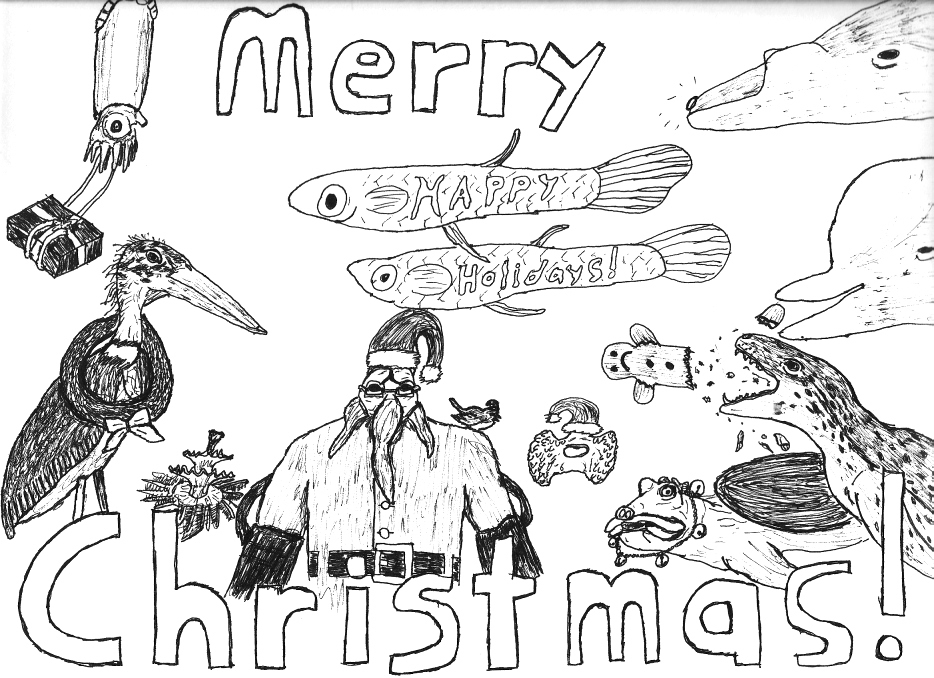
Spirula can also be seen bearing gifts on my Christmas card. Unusually among cephalopods, the buoyant shell puts the animal in a head-down orientation (presumably because it had bottom-based ancestors?). I accidentally depicted it without skin of the mantle.

Saturday, November 29, 2008

The Leopard Seal

It was twelve feet long, of slender and graceful build, with a cruel, thin-lipped muzzle and formidable fangs in the front of the jaws; a curiously prehistoric looking beast, despite its beautiful coat. That it was a dangerous animal was proved by the fact that we found in its stomach large balls of hair, three inches in diameter - the remains of crab-eating seals that it had devoured. As these balls were of hair and not fur, it was evident that the sea-leopard's victims were not mere babies. I can well imagine that such a beast would give rise to sea-serpent stories, for, seen from a little distance rearing two or three feet out of the water, shooting forwards and retracting its head (a characteristic movement) it would resemble a serpent more than a mammal.

The sporadic media appearances of Hydrurga leptonyx cast them as fearsome, penguin-eviscerating, reptilian monsters. I don't believe in monsters - behind reputations like these are animals which are not fully or properly understood. Hydrurga and other Antarctic pack-ice seals happen to be the most poorly known phocids for obvious logistic reasons (van den Hoff et al. 2005). I wouldn't say that there's a dearth of information on Hydrurga compared with some taxa, but it is a rather cryptic species and a lot of its basic biology needs clarification.

I feel obliged to add how annoyed I am by lazy statements like "such and such taxa is behind sea serpent reports" - I can't recall any southern hemisphere "sea serpents" sounding anything like Hydrurga.


A Creative Commons photo of a leopard seal, from Crouchy69's Flickr


Hydrurga is a phocid ("earless seal") and a member of the clade Monachinae; molecular evidence suggest that monk seals (Monachini) are basal members of the clade which also includes a sister group of elephant seals (Miroungini) and other southern seals (Lobodontini) (Arnason et al. 2006, Higdon et al. 2007). The relations within Lobodontini are more contentious, cranial morphology (e.g. those bizarre teeth) suggests a close relation between Hydrurga and Lobodon ("crabeater" seals) but molecular evidence suggests Hydrurga is allied with Leptonychotes (Weddell seal) instead (Davis et al. 2004, Arnason et al. 2006, Higdon et al. 2007). Lobodontini seems to have undergone a rapid radiation, perhaps a mere 7 million years ago, which may have caused this phylogenetic confusion (Higdon et al. 2007, Davis et al. 2004). With fossils taken into account, it appears that the bizarre late Miocene/early Pliocene Acrophoca is the closest relative of Hydrurga (Walsh and Naish 2002) - more information on the bizarre "swan-necked seal" can be found on Darren's old blog.

Animalian size is an inevitable topic for this blog and I feel obliged to note that Hydrurga is probably* the largest lobodontin and is certainly among the larger pinnipeds. It is common for sources to claim that Hydrurga is sexually dimorphic and typical figures for maximum size are 3.4 m (11') and 450 kg (990 lbs) for males and 3.6 m (12') and 590 kg (1300 lbs)** for females (Reeves et al. 2002). I'm of the opinion that maximum measurements are highly misleading outside the context of averages and cannot justifiably be used except in the most dire of data-deficient situation, e.g. with some ziphiids. Furthermore, sexual dimorphism was not observed in the 77 individuals measured by van der Hoff et al. (2005) and the previously reported "dimorphism" is probably insignificant enough to have been an artifact. It's unfortunate that van der Hoff et al. (2005) do not establish an average STL with their data - however we do know that Cave and Bonner (1987) consider a 2.52 m (8'3") STL specimen immature and Visser et al. (2008) use 3 m (~10' - EL?) as an average. van der Hoff et al. (2005) do establish equations and methods for assessing body condition and mass of Hydrurga, which comes in handy since this species has a rather high mortality rate when anesthetized.

* van der Hoff et al. (2005) state that among Antarctic seals only Mirounga reaches larger sizes, but I'm not completely sure if Leptonychotes weighs more on average.
** Bizarrely, these maximum figures are understatements rather than exaggerations - Higgens et al. (2005) state that the maximum weight is 650 kg (1432 lbs). Muir et al. (2006) note that the leopard seal which killed Kirsty Brown in 2003 was estimated to be a staggering 4.5 m (14'9") in length. Assuming that the STL was something like 4 m, the seal would have been ~825 kg (1800 lbs) in good condition. Muir et al. (2006) assume this animal was female, but there is no strong evidence for sexual dimorphism.


Skull of "Ogmorhinus" (= Hydrurga) leptonyx from The Royal Natural History by Richard Lydekker and Philip Lutley Sclater.


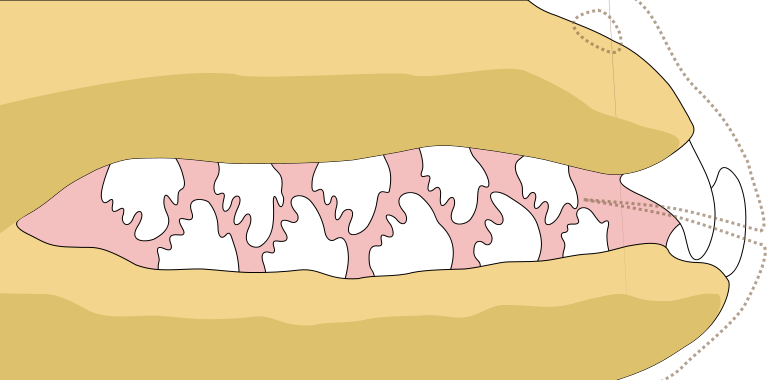
As illustrated above, Hydrurga has post-canine teeth with cusp complexity second only to Lobodon. While the cusp development may not be homologous*, both genera use their teeth to strain krill from the water (Nowak 1999). While Nowak (1999) stated that krill takes up 45% of Hydrurga's prey biomass, this has been contradicted; Walker (1998) found krill from only one scat in 45, Hall-Aspland and Rogers (2004) reported krill in 4% of scats and some male leopard seal stomachs, unpublished isotope data from Hall-Aspland further suggested krill is not a major food item and diving data from Kuhn et al. (2006) suggests that krill is not consumed by juveniles in winter (as was previously thought). It doesn't make sense for Hydrurga to have highly specialized dental morphology for capturing krill on rare occasions, so there must be instances where euphausiids play a critical role in the diet of the species...

* Since neither Leptonychotes or Acrophoca has these accessory cusps. Alternately, the cusps could have been lost several times.


Leopard seals are well known for taking large, homeothermic and occasionally human-sympathetic prey. In one recorded instance, Hydrurga exhibited predatory behavior on a human who was ultimately killed (Muir et al. 2006). Evidence of Hydrurga predation can be found physically in the form of scars on many adult Lobodon (Nowak 1999) - the number of predation attempts must be staggering since there are millions of Lobodon. Hall-Aspland and Rogers (2004) looked at the summer diet of east Antarctic Hydrurga and found that it mostly consisted of Adelie penguins (Pygoscelis adeliae) with Lobodon, fish, amphipods and krill as supplements. Prior studies cited by that paper of Antarctic peninsula Hydrurga found that gentoo penguins (Pygoscelis papua), macaroni penguins (Eudyptes chrysolophus), Antarctic fur seals (Arctocephalus gazella), fish, squid and krill were taken during summer but only krill and fish were consumed during winter. So it looks like krill is important for at least some populations, or individuals in certain locations. Even with a dentition having specializations for taking krill, Hydrurga is capable of an impressively broad diet which probably capitalizes on local abundances. One article cited by Forcada and Robinson (2006) hypothesized that the catholic diet of the leopard seals allow them to have a flexible breeding strategy with less seasonality and a shorter breeding cycle.

While Hydrurga occupies a rather high trophic position and can even prey on other pinnipeds (normally as juveniles), it is not immune from predation. One abstract mentions a tiger shark (Galeocerdo cuvier) caught off Rio de Janeiro with a Hydrurga in its stomach, but an individual from that far north was probably a juvenile in poor condition*. Authors in the past have suggested that Orcinus can prey on Hydrurga and this has been observed by Visser et al. (2007). Since Hydrurga is a rather cryptic species that spends far less time on ice floes than Lobodon, it seems likely that this is a rather rare event.

* Hydrurga observed in N. Argentina were juveniles 2-2.5 m in length and were in poor conditions, if not as corpses (Rodriguez et al. 2003). The presence of juveniles in these areas may be due to food competition from adults in winter (Rodriguez et al. 2003).


Understanding the ecological significance of Hydrurga is complicated by the difficulty of estimating how many individuals there are. Recent aerial surveys between 64 E and 150 E off east Antarctica observed only 29 Hydrurga individuals and extrapolated a populations of 3700-23,400 (Southwell et al. 2008). A previous survey in a somewhat comparable area (90 E to 160 E) estimated 68,000 animals and Southwell et al. (2008) noted a concurrent acoustic survey which detected Hydrurga in 98% of 54 acoustic sites yet only saw in 2%. Southwell et al. (2008) appear to conclude that Hydrurga is cryptic rather than very rare and it looks like a more robust survey method is needed. Somehow, prior sources came up with population figures in the hundreds of thousands, e.g. 400,000 in Nowak 1999. Hydrurga in Tasmania were assumed to be vagrants in the past, but sightings between July and November (i.e. winter and spring) have included animals in good condition so they're a natural part of the fauna (Rounsevell and Pemberton 1994). Other temperate areas should be investigated to determine if Hydrurga is a cryptic resident rather than an occasional straggler.


I think that's about it for Hydrurga; while this isn't a poorly known species, many basic aspects of its biology need clarification. The species does lend itself to some interesting videos:


References

Arnason, Ulfur et al. 2006. Pinniped phylogeny and a new hypothesis for their origin and dispersal. Molecular Phylogenetics and Evolution 41, 45–354

Cave, A. J. E. and Bonner, W. N. 1987. Facial asymmetry in a leopard seal. Br. Antarct. Surr. Bull. 75, 67-71. Available

Davis, Corey S. et al. 2004. A phylogeny of the extant Phocidae inferred from complete mitochondrial DNA coding regions. Molecular Phylogenetics and Evolution 33, 363–377

Forcada, Jaume and Robinson, Sarah L. 2006. Population abundance, structure and turnover estimates for leopard seals during winter dispersal combining tagging and photo-identification data. Polar Biol 29, 1052–1062

Hall-Aspland, S. A. and Rogers T. L. 2004. Summer diet of leopard seals (Hydrurga leptonyx) in Prydz Bay, Eastern Antarctica. Polar Biol 27, 729–734

Higdon, Jeff W et al. 2007. Phylogeny and divergence of the pinnipeds (Carnivora: Mammalia) assessed using a multigene dataset. BMC Evolutionary Biology 7:216

van den Hoff, John et al. 2005. Estimating body mass and condition of leopard seals by allometrics. Journal of Wildlife Management 69, 1015-1023

Kuhn, Carey E. et al. 2006. Diving physiology and winter foraging behavior of a juvenile leopard seal (Hydrurga leptonyx). Polar Biol 29, 303–307

Muir, Shona F. et al. 2006. Interactions between humans and leopard seals. Antarctic Science 18, 61-74.

Nowak, Ronald M. 1999. Walker's Mammals of the World, Sixth Edition. John Hopkins University Press.

Reeves, Randall R. et al. 2002. National Audubon Society Guide to Marine Mammals of the World. Alfred A. Knopf, New York.

Rodriguez, Diego et al. 2003. Occurrence of Leopard Seals in Northern Argentina. LJAM 2, 51-54

Rounsevell, D. and Pemberton, D. 1994. The Status and Seasonal Occurrences of Leopard Seals, Hydrurga leptonyx, in Tasmanian waters. In: Australian Mammalogy

Southwell, Colin et al. 2008. Uncommon or cryptic? Challenges in estimating leopard seal abundance by conventional but state-of-the-art methods. Deep-Sea Research I 55, 519–531

Visser, Ingrid N. et al. 2008. Antarctic peninsula killer whales (Orcinus orca) hunt seals and a penguin on floating ice. Marine Mammal Science 24, 225–234

Walker, T. R. et al. 1998. Seasonal occurrence and diet of leopard seals (Hydrurga leptonyx) at Bird Island, South Georgia. Antarctic Science 10, 75-81

Walsh, Stig and Naish, Darren. 2002. Fossil seals from the late Neogene deposits in South America: A new Pinniped (Carnivora, Mammalia) assemblage from Chile. Palaeontology 45, 821-842


No wonder this took me so long to write...

Saturday, November 15, 2008

What is Gigantosaurus?

It is not Giganotosaurus, a late Cretaceous carcharodontosaurid theropod rivaling Tyrannosaurus for size. As Google shows us, the confusion is widespread.


My interest in Gigantosaurus stemmed from this illustration:


From the 1932 edition of the Meyers Blitz-Lexikon

It is one of the more ridiculous I've seen, just look at those hind limbs! But hey, at least it isn't wallowing in water. I'm not sure how long that locomotive is (I'll have to ask my dad)* but if we assume the human is 1.8 m tall, the dinosaur's head is 4 m long (13'), the length of the forefoot is 2.3 m (7.5'), the highest part of the body is 12 m (40') off the ground and the total length is probably over 60 meters (200'). This is even bigger than Amphicoelias fragillimus according to Carpenter (2006) and it could be the largest sauropod ever depicted. From the original German source I was able to discern that this was an East African sauropod and it was apparently larger than Diplodocus.

*About 36.5 feet long and 15 feet high. This puts the guy in the 1.7's somewhere and makes the dinosaur somewhat smaller but, it's still crazily oversized!


There is currently no valid dinosaur species named "Gigantosaurus", so what does this illustration depict? The mention of East Africa directs us to the German Tendaguru expedition of 1909-1913 where Fraas described Gigantosaurus africanus and G. robustus. "Gigantosaurus" was argued to be occupied by a later author who moved the dinosaurs into the genus Tornieria and changed their specific names (T. africana, T. robusta); later T. africana got moved to the genus Barosaurus and T. robusta became Janenschia robusta (Remes 2006). A third member of the genus (G. dixeyi) was named 20 years after the others and now occupies the genus Malawisaurus (Jacobs et al. 1993). The illustration did not mention a species but I don't think it's so much a composite of the different genera as it is a product of active imagination and limited understanding of sauropod morphology. And probably scaling as well.


A 1912 (cropped?) drawing of "Gigantosaurus" by Heinrich Harder, taken from here. Note the tail stretching into the horizon and the very wrong hands. That link does specifically address Janenschia, by the way


As for the former members of "Gigantosaurus", Tornieria is now a valid genus of diplodocine diplodocid diplodocoid once again, it appears to be the sister group to Barosaurus + Diplodocus (Remes 2006). Contrary to the scale the drawing suggests this was not a mega-sauropod or super-sauropod, femoral length suggests a similar length as Diplodocus (Remes 2006). As far as the shape of the animal, it had elongated cervicals like Barosaurus but retained the trait of proportionally short hindlimbs with a tibia:femur ratio similar to Apatosaurus (Remes 2006). From a biogeographical perspective, Tornieria is unusual since it is the only diplodocid from the upper Jurassic of Gondwanaland (aside from other "Barosaurus" remains) and suggests that other species remain to be discovered (Remes 2006).


A 1930 illustration of "Gigantosaurus africanus" (= Tornieria africana) and Diplodocus. Note that in real life, the two dinosaurs are actually about the same size! The Hairy Museum of Natural History alerted me to the existence of this photo, which was put online by LIFE and Google.


The other two genera are quite distinctive from the diplodocid as they appear to be titanosaurids. Janenschia is from either the late Jurassic or early Cretaceous and while it has been classified as a basal titanosaurid in the past (and sometimes camarasaurid), it has not been subjected to recent phylogenetic analyses (O'Leary et al. 2004). Whatever it is, Janenschia appears to grow at a blazing 663-993 kg/year (titanosaurids seem to have been fast growers) and could have reached its adult size of ~14 tonnes in 20-30 years (Lehman and Woodward 2008). That's probably slightly more than Diplodocus (or Tornieria?) weighed, but come on, terrestrial mammals have attained similar sizes. Malawisaurus is from the late Cretaceous and is clearly a titanosaurid (based on strongly procoelous anterior caudals), and is in fact a relatively basal one (Jacobs et al 1993, Wilson 2006). One cervical vertebrae as described by Jacobs et al. (1993) was 41 cm tall (with spine and all) and I'm not thinking that belonged to a very large sauropod. Some pages claim a length of 9 m, but didn't explain where they got their figure from.


So what is the original "Gigantosaurus" which caused the name changing? Gigantosaurus megalonyx was described by Seeley in 1869, quite early in our knowledge of sauropods since Astrodon was first described in 1865. From the scraps of information I've gathered, it was described from sacrals, a radius, tibia and fibula and unsurprisingly was not given a sufficient description. It is currently listed as indeterminant and probably the same as other sauropods from the area. So while it was unfortunate that a nomen dubium did not allow for the use of Gigantosaurus, the genus would have split up anyways - plus, it wasn't the most appropriate name in the world.


I also found that the name "Gigantosaurus" has been attached to this illustration:


It was taken from the Copyright Expired page and was apparently drawn by Vincent Lynch in 1914 and published in Scientific American. It looks like a scene from the Lost World, which was allegedly filmed over a decade after this was drawn. Could these be an early instance of the dinosaur-running-amok-in-a-city theme? Whatever the case, it also seems to be drawn horribly out of scale. Interestingly, this image (and its less exciting cousin) has also been labeled as the brachiosaurid Pelorosaurus. That genus has no known synonymy with Gigantosaurus, and is presumably either an informal nickname or a mistake of the website author.


This post originated from a comment at The World We Don't Live In. It was originally intended to be a "picture of the day"-type post but quickly spun out of control.


References:

Carpenter, Kenneth. 2006. Biggest of the big: A critical re-evaluation of the mega-sauropod Amphicoelias fragillimus Cope, 1878. Paleontology and Geology of the Upper Jurassic Morrison Formation. New Mexico Museum of Natural History and Science Bulletin 36, 131-138. Available

Jacobs, Louis L. et al. 1993. New material of an early Cretaceous titanosaurid sauropod dinosaur from Malawi. Palaeontology 36, 523-524.

Lehman, Thomas M. and Woodward, Holly N. 2008. Modeling growth rates for sauropod dinosaurs. Paleobiology 34, 264-281.

O'Leary, Maureen A. et al. 2004. Titanosaurian (Dinosauria: Sauropoda) remains from the continental intercalaire" of Malawi. Journal of Vertebrate Paleontology 24, 923-930.

Remes, Kristian. 2006. Revision of the Tendaguru sauropod Tornieria africana (Fraas) and its relevance for sauropod paleobiogeography. Journal of Vertebrate Paleontology 26, 651–669

Wilson, J. A. 2006. An Overview of Titanosaur Evolution and Phylogeny. Actas de las III Jornadas sobre Dinosaurios y su Entorno. 169-190. Available

Monday, November 10, 2008

Remipedia

One of my classes assigns write-ups on invertebrate peer-reviewed literature, so I figured that I might as well cannibalize and extend my original report to post it here. I also gave a short talk on Remipedia that a "lucky" few were subjected to - let's hope this is a more coherent format.


I have an inexplicable intellectual attraction to relictual organisms, making remipedes fascinating to me despite my relative unfamiliarity with Crustacea. I should point out that the popular conception of a "crustacean" is essentially synonymous with Decapoda (shrimp, lobsters, crabs, etc.) and excludes all of the other various clades of mandible-bearing arthropods with two pairs of antennae, two maxillae pairs and division into tagma (e.g. cephalothorax, pereon, pleon). Remipedes are the exception to the latter trait and simply possess a head with a long, homonomously segmented trunk somewhat reminiscent of myriapods (especially chilopods = centipedes), onychophorans and some polychaete annelids. It was long assumed that arthropods evolved from a long-bodied annelid-like ancestor so early remipede morphological workers (i.e. those in the 80's and 90's!) assumed that remipedes lay at the base of the crustacean phylogenetic tree; one worker even used remipedes to root the crustacean phylogenetic tree and placed them in a more basal position than Burgess Shale arthropods (Odaraia, Canadaspis) (Schram and Koenemann 2004). As we'll see later, the only modern consensus about remipede relations is that they aren't at the base of the "crustacean" family tree...

The unpigmented, eyeless, marine cave-dwelling members of class Remipedia were first discovered off the Bahamas in 1979* and were described by Yeager (1981). Remipedes were later found in other Caribbean locales such as the Yucatan peninsula, the Turks and Caicos, Cuba, and the Canary islands - incredibly they've also been found in roughly antipodal Western Australia as well (Yager and Humphreys 1996). Yager (1981) suggested that a remipede had in fact been described before: the enigmatic Carboniferous Tesnusocaris (described in 1955) which also possessed homonomous segments with paddle-like appendages. Emerson and Schram (1990) re-described Tesnusocaris with both a pair of uniramous ventrolateral appendages used for swimming and a midventral pair used for sculling; the authors hypothesized that this two appendage pair state is a "missing link" between uniramous and biramous appendages. Koenemann et al. (2007a) found some aspects of the authors' reconstruction questionable** (the two limb pairs per segment?) but still used their description of Tesnusocaris as an outgroup for their phylogeny of modern remipedes (Nectiopoda) - despite potential weirdness Tesnusocaris still did have distinctively remipedian head appendages. The Mazon Creek assemblage of Illinois (home of Pohlsepia and Tullimonstrum) yielded the remipede Cryptocaris which also has the three pairs of prehensile cephalic appendages (maxillule, maxilla and maxilliped), but was not complete enough for analysis by Koenemann et al. (2007a). So, it looks like Remipedia has an even worse ghost lineage syndrome than octopuses.

* Another class of possibly primitive crustaceans, Cephalocarida, was discovered off Long Island Sound in 1953. Granted, remipedes are ~1.5-4.5 cm in length and cephalocarids are 4 mm, but discovering new classes still sounds like a major surprise.
** They cite a later paper from the same authors in 1991 from the Proceedings of the San Diego Society of Natural History. I'm assuming that it's a more thorough version of their Science article.


Not much is known about the reproduction, life history and behavior of remipedes; what is known is fascinating, if somewhat contradictory. Being blind, remipedes have a gigantic olfactory apparatus and use their second pair of antennae to drive currents past the "fields of aesthetascs" on their first antennae pair; their ability to detect low odor concentrations has been confirmed by observations of their quick attraction to dead fish (Fanenbruck et al. 2004). Remipedes have been observed to be slow swimmers but they are not strict scavengers, they have raptorial mouthparts including a fang-like first maxillae and have been observed engaging in predatory behavior (Kohlhage and Yager 1994, Fanenbruck et al. 2004). The maxillule fangs connect to glands which are presumably involved in injecting prey; while empirical evidence of injection doesn't exist, the probable mechanics of injection have been worked out (van der Ham and Felgenhauer 2007). The potentially injected substance is apparently an oxygen-carrying respiratory pigment (!) - another substance capable of turning the hemocyanin-like compound into a harmful phenoloxidase has yet to be discovered (van der Ham and Felgenhauer 2007). In case you're diving in obscure marine caves, don't worry about remipede bites as they apparently have no adverse affect on people (Koenemann et al. 2007b). While the aforementioned evidence seemingly suggests that remipedes are sluggish marine centipede analogues - lab observations of Speleonectes indicate that they spend almost all of their time (>99%) filter feeding (Koenemann et al. 2007b). Koenemann's website has a video summary (warning, 50 megabytes) of 2-3 months of observed behavior, including some of the rare instances of predation (3!). From the video, it can be noted that the thoracic appendages are always moving (even at rest) and remipedes are capable of a fast "snake-like" strikes and coiling (Koenemann et al. 2007b). Even though these remipedes aren't very big animals (~4 cm), I would hesitate in calling them sluggish (note that some parts of the video are at 5x). It seems likely that remipedes spend most of their time filter feeding in the wild as well and engage in facultative predation/scavenging whenever something comes their way - the lack of these behaviors in the lab could be artifacts due to the environment and/or the (relatively) high abundance of potential prey.


So, what are remipedes?

Despite looking like hypothetical ancestral arthropods, remipedes are obviously quite specialized. If we ignore their confusing mosaic of morphological traits for the time being, molecular evidence gives us a wide range of opinions on their placement. Regier et al. (2005) suggested close kinship with cephalocarids and a somewhat more distant relation with branchiopods (both viewed as morphologically "primitive"), oh and all of those groups were in a clade containing hexapods, i.e. insects and kin! The authors note that all of the members probably had ancestors either near-shore or in marginal (read: really weird) marine habitats, possibly the result of competition from other crustaceans, myriapods and chelicerates (Regier 2005). Cook et al. (2005) used mtDNA to place remipedes in a derived clade with Collembola (hexapods!) - mind you in thus study both hexapods and crustaceans were paraphyletic! Since none of the other studies reach any consistent placement, let's look at morphology.

Unexpectedly, remipedes have an order of magnitude more neurons than other taxa like branchiopods and maxillopods and their complex brains resemble those of malacostracans and hexapods (Fanenbruck et al. 2004). Also unexpected are the recently discovered larvae of remipedes, which happen to be non-feeding (lecithotrophic) in a manner similar to malacostracans such as euphausiaceans and dendrobranchiates (Koenemann et al. 2007c). Remipedes larvae share many traits with the lecithotrophic malacostracans but differ in having three pairs of uniramous cephalic limbs, biramous trunk limbs and caudal rami developing on an anal somite rather than a teslon (Koenemann et al. 2007c). The first trait is especially odd since you would expect a maxilliped to resemble a trunk appendage during development, but this somehow is not the case. Convergence can't be ruled out of course, but the coincidence of similar brain morphology and occasionally similar development is interesting (unless the two are somehow connected). Koenemann et al. (2007c) echo a previous study which tenuously concluded that remipedes, cephalocarids and "most of the maxillopodans and malacostracans" form a clade to the exclusion of other crustaceans.

The previous study Koenemann et al. (2007c) are referencing (Schram and Koenemann 2004) used extinct and extant arthropods (including Tesnusocaris) in their analysis. One of the characters united remipedes with Eucrustacea was gonopore placement on the 6th through 8th thoracic segments - I'm not sure how this was coded in for remipedes. Interestingly, even this analysis found insects to lay within the group traditionally known as "crustaceans" - could it be that molecular and morphological camps are finally starting to agree?


This of course isn't everything on remipedes, but it should at least give an idea of the pioneering work being done on this fascinating group. Well, this took far too long to write, I've got obligations to fulfill like crazy...


References:

Cook, Charles E. et al. 2005. Mitochondrial genomes suggest that hexapods and crustaceans are mutually paraphyletic. Proc Biol Sci. 272, 1295–1304

Emerson, Michael J. and Schram, Frederick R. 1990. The Origin of Crustacean Biramous Appendages and the Evolution of Arthropoda. Science 250, 667-669

Fanenbruck, Martin et al. 2004. The brain of the Remipedia (Crustacea) and an alternative hypothesis on their phylogenetic relationships. PNAS 101, 3868-3873.

van der Ham, Joris L. and Felgenhauer, Bruce E. 2007. The functional morphology of the putative injecting apparatus of Speleonectes tanumekes (Remipedia). Journal of Crustacean Biology 27, 1-9

Koenemann, Stefan et al. 2007a. Phylogenetic analysis of Remipedia (Crustacea). Diversity & Evolution 7, 33–51

Koenemann, Stefan et al. 2007b. Behavior of Remipedia in the Laboratory, with supporting Field Observations. 2007. Journal of Crustacean Biology 27, 534-542

Koenemann, Stefan et al. 2007c. Post-embryonic development of remipede crustaceans. Evolution & Development 9, 117-121

Kohlhage, Klaus and Yager, Jill. 1994. An Analysis of Swimming in Remipede Crustaceans. Philosophical Transactions: Biological Sciences 346, 213-221

Regier, Jerome C. et al. 2005. Pancrustacean phylogeny: hexapods are terrestrial crustaceans and maxillopods are not monophyletic. Proc Biol Sci. 272, 395-401.

Ruppert, Edward E. et al. 2004. Invertebrate Zoology: A Functional Evolutionary Approach. Seventh Edition. Thomson, Brooks/Cole, United States.

Schram, F. R. and Koenemann, S. 2004. Are crustaceans monophyletic? In J. Cracraft and M. J. Donaghue (eds.). Assembling the Tree of Life. Oxford University Press, Oxford, pp. 319-329.

Yager, Jill and Humphreys, W. F. 1996. Lasionectes exleyi, sp. nov., the First Remipede Crustacean Recorded from Australia and the Indian Ocean, with a Key to the World Species. Invertebrate Taxonomy 10, 171-187.

Yager, Jill. 1981. Remipedia, a new class of Crustacea from a marine cave in the Bahamas. Journal of Crustacean Biology 1, 328-333.