Wednesday, June 18, 2008

Berardius

As is the case of all beaked and bottlenose whales, exactly where Berardius fits into Ziphiidae is currently not clear. Morphological analysis of Cetacea by Geisler and Sanders 2003 placed Berardius and Mesoplodon into a clade - nobody else seems to have gotten this result and it is worth noting that Hyperoodon and Indopacetus were not included. Lambert et al. 2005 studied the morphology of extinct and extant ziphiids and placed Berardius in a basal position and possibly in a clade with Tasmacetus on the basis of one apomorphy (nasals wider than frontals on the vertex). Bianucci et al. 2007 defined the subfamily Berardiinae as an outgroup to other ziphiids mostly on the basis of symplesiomorphies such as a low vertex, a narrow and thin premaxillary crest and a supraoccipital lower than frontals; the only apomorphy shared by all the taxa* was a nodular protuberance formed by either the interparietals or frontals on the vertex. Dalebout et al. 2004 noted previous morphological and molecular studies that placed Berardius as the basal-most species and used it to root their tree but molecular studies of Cetacea by May-Collado and Agnarsson 2006 did not place it basally and noted that positions in the family are unresolved.

*Other members of the subfamily include the middle Miocene Archaeziphius from Belgium (Lambert and Louwye 2006), Microberardius from South Africa (Bianucci et al. 2007), an indeterminate species (Berardiinae indet. - Bianucci et al. 2007) from the same locale and a possible member of Berardius from Japan. Archaeziphius was only estimated at 3.5-4 m and Microberardius seemed similarly sized.

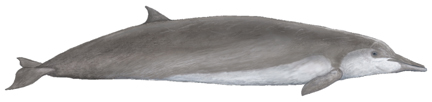
The osteological characters and genetic analyses don't really convey how much of a derived oddball Berardius is. Male ziphiids of other species have on pair of enlarged teeth (even many-toothed Tasmacetus and M. grayi) but Berardius* has both an apical and sub-apical pair on the mandible (Bianucci et al. 2007). The fossil genera did not have mandibles so we can't tell if they had the extra teeth - and I'll admit that I'm not quite sure what the smaller posterior pair do. Enlarged teeth in ziphiids are used in intraspecific combat and create parallel scars (except in M. ginkgodens?) which the cetacean delays pigmenting so they can accumulate and give a signal of "quality" so unnecessary aggressive behavior between unevenly matched males can be avoided (MacLeod 2003). If attaining scars as a status symbol seems odd, it should be pointed out that a Homo sapiens fad at Heidelberg University involved fencing duels for the sole purpose of getting scars. Back in the day when Berardius was still quite mysterious, Pike 1953 noted scars on both males and females of the species - but for some reason thought that neither had erupted teeth and the most parsimonious explanation was that the long parallel scars were caused by squid beaks (not squid hooks?). That aside, it is now established that both genders of both species have "battle teeth" (to use Connor et al. 1998's terminology) when mature. MacLeod et al. 2003 suggest that the teeth may be important in social interactions for females and could indicate dominance, but it remains to be studies how much scarring exactly occurs in females relative to males. MacLeod et al. also speculate that females may retain teeth due to "ontological constraint" - but Risso's dolphin and sperm whales were also being mentioned in the paragraph and the statement was probably directed more towards them since other ziphiids showed no signs of such a restraint.

*Heuvelmans claims that B. arnuxii has "teeth which no mammalogist would have believed in had they been described by a layman, for they are embedded in cartilaginous sacs, and it seems that they can be erected at will". Heuvelmans does not make clear whom he is citing and Mead 2007 notes that morphology and osteology in B. bairdii and B. arnuxii are similar enough to possible be considered conspecific.


The social system of Berardius bairdii is described as "alien" to those more familiar with large terrestrial mammals (Connor et al. 1998). Connor et al. summarized a paper by Kasuya and Brownell using data from Japanese whalers (which I can't access) which suggest that adult males are much more common, mature 4 years earlier and live up to 30 years longer. To them, this indicates that the male plays a large role in parental care and/or for the young of a close female relative. The former scenario makes evolution sense because you always know that a sister and her offspring are related to you, but you can never be sure about "your own" kid. What doesn't make sense is how exactly female mortality fits into this scenario - unless they're the ones doing most of the fighting. It seems that all female ziphiids are larger than males judging by record sizes (Reeves et al. 2002) despite the aggressive intraspecific behavior of males and the fact that the males have a coloration pattern whereas females are nondescript. Kinda reminds me of frigatebirds. Berardius still retains larger females, but these ones have tusks and a similarly nondescript coloration (as far as I can tell) - the significance of which is totally beyond me. Reeves et al. 2002 noted that B. bairdii remains have been found in Orcas (Orcinus orca) and scars from Orcas have been found on B. bairdii as well. Could the enlarged teeth on female B. bairdii be used as a defense mechanism against orcas? More data would be nice, but again, it'll probably come from "scientific" whaling...


That's right, a species of ziphiid was and is still being hunted. B. bairdii is the largest ziphiid at 10 m average (MacLeod 2005)* and is apparently more approachable by boat than other species (Barlowe et al. 2006)** which is not a good trait for a cetacean occurring off the coast of Japan. It is likely that the species is below historical levels (Barlowe et al. 2006) and the Japanese killed 4000 between 1948 and 1986 with a peak of 300 per year in 1952 (Reeves et al. 2002). The IUCN considers this species as "Lower risk conservation dependent" (and not data deficient!) but suggests that more surveys are needed to make sure the Japanese quota of 62 animals per annum isn't depleting any local populations. Barlowe et al. 2006 note that in some "hot spots" the density of B. bairdii off Japan can reach 40-68 animals per 1000 Kilometers2 - but in other areas surveyed in the Pacific it ranged from 0.1 to 1.2. It still appears that overall abundance is somewhere in the thousands and being a species with a multi-tonne average weight***, Berardius has a significant biomass and is likely important ecologically.

* Lengths of 22 individuals indicated an average of 10.5 m (~34') for females and 9.6 m (~31'). MacLeod did not have sufficient evidence to give an average for B. arnuxii and from the 7 individuals measured the longest was 9.3 m (~30') as compared to the longest B. bairdii which measured 11 m (36'). Morisaka and Connor 2007 cite something I cannot locate which gives a length of 8.61 (~28') for the average B. arnuxii and this seems proportionally correct. Wikipedia claims that sightings of B. arnuxii included 12 m animals, but it is Wikipedia. Such lengths are probably unusual even for B. bairdii.

** Reeves et al. 2002 and Minamikawa et al. 2007 say that they are shy and difficult to approach. The latter study approached 35 of 63 pods sighted and were able to approach 3 pods within 30 m and 10 within 100 m. Maybe the species is more approachable relative to other ziphiids since it is so much more conspicuous.

***Minamikawa et al. 2007 and others apparently estimate the weight of these ziphiids by assuming 1 m of body length equals 1 tonne. They're going to need to be re-estimated.


MacLeod et al. 2003 commented that while a lot of B. bairdii specimens have been taken, information on stomach contents was rather limited. Previous studies cited by them suggested that B. bairdii migrated north in spring to feed on deep water fish and squid were primarily consumed while migrating south in fall. Ohizumi et al. 2003 studies diet more in depth and determined that B. bairdii was not dependent on vertical migration in deep water fish (i.e. upwards at night and vice versa) since the mass of consumed prey peaked during the day (but stomachs were empty in some). Data logging by Minamikawa et al. 2007 indicated that there were both dives that followed the bottom topography in very deep water (>1000 m) and others that did not appear to reach the bottom. Ohizumi et al. 2003 recorded mesopelagic squid in the stomach contents but Minamikawa et al. could not find indication of a feeding event (a zigzag pattern) and further acoustic study needs to be done. While most sources state that squid are the preferred prey of ziphiids, Ohizumi et al. 2003 suggest that desmeral fish (particularly hake and rat-tail) are important in their diet and may possibly be the reason for their migration.

Tying in with the previously mentioned notion that Berardius is an oddball, Mead 2007 first described the apomorphy of a derived stomach anatomy in B. bairdii. The main chamber of the stomach has a valvular closure which divides it into another compartment. After a complex of connecting chambers is a pyloric stomach of similar size to the main stomach which communicates freely with a much smaller pyloric stomach chamber. Mead noted that functional anatomy of multiple stomachs even in familiar ungulates (cows, sheep) is not yet conclusive, so how exactly this relates to diet cannot yet be known. Interestingly, he predicts that the stomach anatomy of B. arnuxii will be very similar...

So what exactly should the status of Berardius species be? Judging by distribution data (in MacLeod et al. 2006) it seems that B. bairdii and B. arnuxii are separated by 60-70 degrees of latitude so they can be considered species by the biological species concept. Bianucci et al. 2007 note that a bone interpreted as the interparietal is in a plesiomorphic (?) position in B. arnuxii, but apparently not always. Aside from the reported size difference between species (maybe - this isn't really a character anyways) some very early authorities reported a difference in body length relative to head length, but this has been discounted as variation since Slipp and Wilke 1953. Mead 2007 simply states that the osteology and morphology between species is extremely similar and externally it is stated that the species are indistinguishable (Reeves et al. 2002). Molecular analysis by Dalebout et al. 1998 revealed that the interspecific variation in Berardius spp. is somewhat less than variation within Hyperoodon planifrons - and presumably variation between H. planifrons and H. ampullatus (the other antitropical giant whales) is a whole lot greater (Mead mentions that they are in different subgenera). Regardless of what species placement may be in the future, for conservation purposes they should most certainly be treated as separate entities. I couldn't help but be a little curious that the IUCN gave the species the same conservation status - is B. arnuxii really not data deficient?


Anyways, more ziphiids coming at some point. I'm not sure which ones.


References:

Barlowe, Jay et al. 2006. Abundance and densities of beaked and bottlenose whales (family Ziphiidae). J. Cetacean Res. Manage. 7(3):263–270

Bianucci, Giovanni et al. 2007. A high diversity in fossil beaked whales (Mammalia, Odontoceti, Ziphiidae) recovered by trawling from the sea floor off South Africa. A high diversity in fossil beaked whales (Mammalia, Odontoceti, Ziphiidae) recovered by trawling from the sea floor off South Africa. Geodiversitas 29 (4) : 561-618.

Connor, Richard C. et al. 1998. Social evolution in toothed whales. TREE vol. 13, no. 6.

Dalebout, Merel L. et al. 2004. A Comprehensive and Validated Molecular Taxonomy of Beaked
Whales, Family Ziphiidae. Journal of Heredity 95(6): 459–473. Available

Dalebout, Merel L. et al. 1998. Molecular genetic identification of southern hemisphere beaked whales (Cetacea: Ziphiidae). Molecular ecology 7, 687-694.

Geisler, Jonathan H. and Sanders, Albert E. 2003. Morphological Evidence for the Phylogeny of Cetacea. Journal of Mammalian Evolution, Vol. 10, Nos. 1/2,

Heuvelmans, Bernard. In the Wake of the Sea-Serpents. Hill and Wang, New York, 1968.

Lambert, Oliver and Louwye, Stephen. 2006. Archaeoziphius microglenoideus, a new primitive beaked whale (Mammalia, Cetacea, Odontoceti) from the middle Miocene of Belgium. Journal of Vertebrate Paleontology 26(1):182–191

MacLeod, Colin D et al. 2006. Known and inferred distributions of beaked whale species
(Cetacea: Ziphiidae). J. Cetacean Res. Manage. 7(3):271–286,

MacLeod, Colin D. 2005. Niche Partitioning, Distribution And Competition In North Atlantic Beaked Whales. Doctoral Thesis. Available

MacLeod, Colin D. 2003. Intraspecific scarring in odontocete cetaceans: an indicator of
male `quality' in aggressive social interactions? J. Zool., Lond., (244) 71-77

May-Collado, Laura and Agnarsson, Ingi. 2006. Cytochrome b and Bayesian inference of whale phylogeny. Molecular Phylogenetics and Evolution 38, 344–354

Mead, James G. 2007. Stomach Anatomy and Use in Defining Systemic Relationships of the Cetacean Family Ziphiidae (Beaked Whales). The Anatomical Record 290:581–595

Minamikawa, Shingo et al. 2007. Diving behaviour of a Baird’s beaked whale, Berardius bairdii,
in the slope water region of the western North Pacific: first dive records using a data logger. Fish. Oceanogr. 16:6, 573–577,

Morisaka, T and Connor, R. C. 2007. Predation by killer whales (Orcinus orca) and the evolution of whistle loss and narrow-band high frequency clicks in odontocetes. Journal of Evolutionary Biology. Vol. 20, No. 4, pp. 1439-1458.

Ohizumi, Hiroshi et al. 2003. Feeding habits of Baird’s beaked whale Berardius bairdii, in the western North Pacific and Sea of Okhotsk off Japan. Fisheries Science 69: 11-20

Pike, Gordon S. 1953. Two records of Berardius bairdi from the coast of British Columbia. Journal of Mammalogy. Vol. 34, No. 1, pp. 98-104.

Reeves, Randall R. et al. 2002. National Audubon Society Guide to Marine Mammals, Alfred A. Knopf, New York.

Slipp, T. W. and Wilke, Ford. 1953. The Beaked Whale Berardius on the Washington Coast. Journal of Mammalogy, Vol. 34, No. 1, pp. 105-113

Friday, June 13, 2008

Indopacetus

The Mystery of the Tropical Bottlenose Whale

As you can see, this isn't going to be much of a mystery, but determining the identity of what probably was the largest animal with an unknown external appearance is certainly not an everyday occurrence. At times the situation resembled - dare I say it? - cryptozoology, well, aside from the fact that nobody doubted the existence of the animal, evidence was presented in the peer review by experienced observers and it wasn't a monster (or "prehistoric survivor") so naturally nobody calling them self a "cryptozoologist" payed much attention. But I guess there is a sort of spiritual similarity.

Our story begins with Morzer Bruyns in 1971, who brought attention to sightings of what appeared to be bottlenose whales in tropical waters. One the basis of two large skulls, occasionally assigned to the rather un-Hyperoodon-like genus Mesoplodon (well, externally at least), Bruyns speculated that the whales were Indopacetus pacificus (Pitman et al. 1999). Photographs of bottlenose whales taken near the equator were actually used to portray H. planifrons in a couple sources despite that genus having an antitropical distribution (Pitman et al. 1999) so it was quite understandable how that hypothesis did not catch on. Pitman et al. 1999 documented 45 sightings of good quality from experienced observers (the authors has 12 of them) and while some do outright identify the whales as H. planifrons, others classified it as Hyperoodon sp., Hyperoodon-like or as an unidentified beaked whale. Why the uncertainty? While also a large (~7 m max?) and robust beaked whale with a similar coloration, the tropical bottlenose whale occurred about 20-30 degrees farther north than H. planifrons, had a less stubby beak, a smaller and less bulbous melon and possesses the largest dorsal fin (relatively and absolutely) amongst ziphiids (Pitman et al. 1999). While nothing more was known about Indopacetus, Pitman et al. 1999 reconsidered the hypothesis and seemed to prefer it.


And suddenly, certainly without any warning, Indopacetus went from being the most poorly known ziphiids (which is saying something) to one of the better known ones - as an article by Pitman claims.


The range of H. ampullatus is in green, the range of H. planifrons is blue (after Reeves et al. 2002). "Tropical bottlenose whale" sightings are closed squares and Indopacetus strandings are open ones (Perrin et al. 1999, Dalebout et al. 2003, Watson et al. 2008). Potential range in yellow is speculative. I unfortunately can't access this recent article on distribution in the Western Indian. Perrin et al. mention a possible sighting in the Gulf of Mexico, which would greatly expand the range of the species. If anybody has Jefferson et al. 1993's Marine Mammals of the World, how certain is it that the sighting was not of H. ampullatus? Perrin joked that if it is a subspecies it should be named Indopacetus pacificus atlanticus.


Indopacetus Revealed!

Indopacetus showed up alive in July 2002 in Kagoshima, Japan. The specimen never made it into a journal and was apparently covered in a conference I can't access (Watson et al. 2008). Fortunately, a web page giving preliminary morphological and genetic data for this specimen reveals that it indeed was Indopacetus. The authors were not convinced it was the tropical beaked whale and thought yet another species was out there. The pictures provided didn't show much morphology reminiscent of Hyperoodon, the melon wasn't bulbous and the beak was long - for some reason the ADW page keeps on comparing Indopacetus to Berardius and this may be why. This actually isn't too much of a problem since larger observed tropical bottlenose whales were described as being "nondescript brown or gray-brown" and the melon is variable and varies from moderately bulbous to near-perpendicular (i.e. Hyperoodon-like) (Pitman et al. 1999).

It turns out that this was not the third known specimen of Indopacetus, but the seventh. This specimen was described as Dalebout et al. 2003 were in press with an article that gave an unprecedented amount of information on the species. Specimens four and five were juvenile males from Natal, South Africa (from 1976 and 1992) which were initially identified as H. planifrons until Dalebout et al. demonstrated their affinity with Indopacetus with genetic tests. Both specimens were similar to but distinct from H. planifrons and had such features as: a slimmer build, black coloration dorsally fading to white ventrally posterior from the blowhole, a "flipper stripe" (a delphinid-like character also in Tasmacetus), a patch of white pigment in the "ear" region, a mostly black upper jaw, white lower jaw and a lightly colored melon. This matches the photographs of calf tropical bottlenose whales taken and was used by Dalebout et al. to cement the identity of Indopacetus. Judging by photographs, it seems that adult males (i.e. the ones with linear scars) have many of the same coloration patterns as the juvenile - but Reeves et al. 2002 noted that the coloration was apparently variable and dominated by grayish-brown tones, apparently in adults. A 5.73 m male washed up in the Philippines and was discussed at yet another conference I can't access (Watson et al. 2008) and can theoretically answer any questions we have about adult coloration (if it was an adult).


Juvenile Indopacetus (~3.6 m). H. planifrons juveniles look similar but have a more robust body, lack a flipper stripe and have a more robust melon. The portrayal of an adult male Indopacetus (7m?) by Reeves et al. 2002 (based off of Pitman et al. 1999) is similar, but with a medium-brown coloration that occurs lower on the flanks and dark coloration around the large dorsal fin. Adult females, or at least the senile one pictured here, are fairly nondescript. The white circular marks are from cookiecutter sharks (linear scars also occur on adult males).


So now that we know what Indopacetus looks like and where it lives, what exactly is it? While suggested to be either Mesoplodon or Hyperoodon in the past, morphological studies by Lambert 2005 and Bianucci et al. 2007 put them in a clade with the other genera. Bianucci et al. also put Indopacetus close to 5 newly described fossil genera - oh, and their tree places Hyperoodon in a paraphyletic Mesoplodon. Autapomorphies of Indopacetus include a distinctive vertex with larger nasal than frontal and premaxillaries, a deep groove above the orbit, an antorbital tubercle and a width/depth ratio of the rostrum ranging higher than other ziphiids (Dalebout et al. 2003). Aside from concave curves from the cranium to the tip of the rostrum possibly there to strengthen it (Dalebout et al. 2003) - not much has been mentioned on the functional significance (and thus evolutionary significance) of these features.

While Perrin was certainly right about this bottlenose whale being well known compared to others in a morphological sense, ecologically nothing is known. MacLeod et al. 2003 proposed that since Ziphius and Hyperoodon preyed on relatively large fish and cephalopods (0.5-1 kg+) and never coexisted geographically and/or temporally they formed a niche. Indopacetus coexists with Ziphius for a great portion of its range (all of it?) and it would be interesting to find out how a Hyperoodon-like animal avoids competition with one that apparently feeds like Hyperoodon.

Actually, it would be interesting to find out more basic information like how common or rare Indopacetus is and how humans are affecting them. Watson et al. 2008 noted that specimens 9 and 10 from Taiwan in 2005 beached along with numerous other odontocetes after local Naval sonar testing. Pods of this species appear to get fairly large and I certainly hope that the beached specimens were not just a fragment from a larger group. Finally knowing what a species looks like and having complete specimens just seems to be the beginning in understanding them and who knows how much effort will get Indopacetus listed as something other than "data deficient".


With 2 out of 21 species down there are still many ziphiids to come.


-Cameron


References:

Bianucci, Giovanni et al. 2007. A high diversity in fossil beaked whales (Mammalia, Odontoceti, Ziphiidae) recovered by trawling from the sea floor off South Africa. A high diversity in fossil beaked whales (Mammalia, Odontoceti, Ziphiidae) recovered by trawling from the sea floor off South Africa. Geodiversitas 29 (4) : 561-618.

Dalebout, Merel L. et al. 2003. Appearance, distribution, and genetic distinctiveness of Longman's beaked whale, Indopacetus pacificus. Marine Mammal Science 19 (3) 421-461

Lambert, Olivier. 2005. Systematics and phylogeny of the fossil beaked whales Ziphirostrum du Bus, 1868 and Choneziphius Duvernoy, 1851 (Mammalia, Cetacea, Odontoceti), from the Neogene of Antwerp (North of Belgium) Geodiversitas 27 (3) : 443-497.

MacLeod, C. D. et al. 2003. Review of data on diets of beaked whales: evidence of niche separation and geographic segregation. J. Mar. Biol. Ass. U.K. , 83, 651-665

Pitman, Robert L. et al. 1999. Sightings and possible identity of a bottlenose whale in the tropical Indo-Pacific: Indopacetus pacificus? Marine Mammal Science, 15(2):531-549

Pitman, Robert L. 2002. Alive and whale: a missing cetacean resurfaces in the Tropics - Findings. Natural History. Available

Reeves, Randall R. et al. 2002. National Audubon Society Guide to Marine Mammals, Alfred A. Knopf, New York.

Watson, Alastair et al. 2008. Distinctive osteology of distal flipper bones of tropical bottlenose whales, Indopacetus pacificus, from Taiwan: Mother and calf, calf with polydactyly. Marine Mammal Science 24 (2): 398-410

Monday, June 9, 2008

Tasmacetus

For the latest on Tasmacetus


The introductory post mentioned how the family Ziphiidae was the most poorly known amongst cetaceans, and this monotypic genus is certainly no exception. While 42 strandings have been documented, depictions of the coloration were erroneous (and quite variable) prior to Reeves et al. 2002 - although the textual description still seemed outdated. Pitman et al. 2006 were the first to describe the coloration and established four definitive sightings*. The lightly colored melon and long dark beak are distinctive features, but particularly noteworthy are a dorsal "cape" on a light background, a "flipper stripe" and no apparent difference in the coloration of males and females. These coloration characteristics are typical of delphinids and Pitman et al. note that the presence of teeth in both jaws may be of some significance. The authors also point out that there is a superficial similarity to the more northernly Indopacetus which is something of a tropical Hyperoodon planifrons doppelgänger....

*Five prior sightings did not mention the coloration and are therefore suspect. Videotape of one indicated an "unidentified but distinctively patterned species of Mesoplodon". The authors later state that the coloration of several mesoplodonts is unknown.


This all begs the question of where exactly Tasmacetus fits into ziphiid phylogeny. Lambert 2005 places it as a basal taxa, possibly in a clade with Berardius while Bianucci et al. 2007 notes that a mix of archaic characters and derived characters puts it in an unresolved position. Since the most prominent archaic trait is the teeth in both jaws it is worth pointing out that Ninoziphius (a relative of Berardius and/or Tasmacetus? - Bianucci et al. 2007), Messapicetus and Ziphirostrum (members of Ziphiinae e.g. relatives of extant Ziphius - Bianucci et al. 2007) all appear to have teeth in the upper and lower jaws (Lambert 2005) and the extant Mesoplodon grayi has teeth in the upper jaw only (Reeves et al. 2002) suggesting multiple tooth loss events or reversals (or both?) in ziphiids. It should be noted that male Tasmacetus still have a pair of enlarged anterior teeth in addition to 72-96 others (Mead and Payne 1975). Geisler and Sanders 2003 place Tasmacetus as the sister group to other ziphiids which share nine synapomorphies (2 deal with teeth) and it is noteworthy that the molecular phylogeny of May-Collado and Agnarsson 2005 is in agreement with this. Mead 2007 notes that Tasmacetus has a non-derived stomach anatomy - but so do Hyperoodon, Ziphius and some mesoplodonts.

The range of Tasmacetus. Numbers indicate strandings - two were from Juan Fernandez Islands and six were from Tristan da Cunha. Dots indicate sightings, the dot from Tristan da Cunha indicates two sightings. So far it is known from about 33 to 50 degrees South. After fig. 1 of Pitman et al. 2006


Tasmacetus lives in an area with notoriously bad weather and small amounts of landmass so it is not clear if it (along with the pygmy right whale, hourglass dolphin and mesoplodonts) are rare or rarely encountered. MacLeod et al. 2003 theorize (on the basis of one example and the teeth) that Tasmacetus is a specialist on bottom-dwelling fish but Pitman et al. 2006 mention another example which had a stomach entirely filled with cephalopods. The specimens were from Argentina and Tristan de Cunha, respectively. We are going to need a lot more data to make any conclusions on the physiology of this genus, but at least we know how to identify it at sea!

The following is modified from Pitman et al. 2006:

Length: The largest accurately recorded specimen was a 6.6 m (21'8") female. Their Table 1 has 7 m (23') and 7.35 m (24') "bulls" - but these are unconfirmed. It is comparable in size to Ziphius and larger than mesoplodonts (judging from Reeve et al. 2002).

Head: The dark beak lengthens with age and is proportionally similar to Indopacetus and some mesoplodonts; it is longer than those of Hyperoodon or Ziphius. The pale melon is prominent (unlike in mesoplodonts) to a degree that resembles Indopacetus or Ziphius. It does not seem to become more prominent with age in males. Aerial observations reported a "blow" whereas those on ships did not (it may just be inconspicuous).

Body: According to Reeves et al. 2002 it is cigar-shaped and thus Mesoplodon-like. The pale shoulder "patch" is considered a diagnostic feature (in addition to the long dark beak and pale melon). Aerial observations should find the black "cape" from the blowhole to mid-dorsal fin and pale gray afterwards (in contrast to the pale melon) diagnostic. The dorsal fin is smaller than Hyperoodon and Indopacetus and falcate - but similar to Ziphius and some mesoplodonts.

School Size: The four observations gave schools of 3-6, higher than the usual 1-3 for mesoplodonts and Ziphius. According to Reeve et al. 2002, school size for Indopacetus is 15-20 average (and up to 100).


An adult male Tasmacetus - the coloration is described as blue-gray/brown in adults and olive brown in younger specimens. Aerial observations show a distinctly light melon, dark ("black") cape and light gray behind the dorsal fin.


Pitman et al. 2006 is available online for free, by the way and I couldn't help but notice that every website out there on the genus was in need of an update.


Coming up next, more ziphiids of course.


References:


Bianucci, Giovanni et al. 2007. A high diversity in fossil beaked whales (Mammalia, Odontoceti, Ziphiidae) recovered by trawling from the sea floor off South Africa. A high diversity in fossil beaked whales (Mammalia, Odontoceti, Ziphiidae) recovered by trawling from the sea floor off South Africa. Geodiversitas 29 (4) : 561-618.

Geisler, Jonathan H. and Sanders, Albert E. 2003. Morphological Evidence for the Phylogeny of Cetacea. Journal of Mammalian Evolution, Vol. 10, Nos. 1/2

Lambert, Olivier. 2005. Systematics and phylogeny of the fossil beaked whales Ziphirostrum du Bus, 1868 and Choneziphius Duvernoy, 1851 (Mammalia, Cetacea, Odontoceti), from the Neogene of Antwerp (North of Belgium). Geodiversitas 27 (3) : 443-497.

MacLeod, C. D. et al. 2003. Review of data on diets of beaked whales: evidence of niche separation and geographic segregation. J. Mar. Biol. Ass. U.K. , 83, 651-665

May-Collado, Laura and Agnarsson, Ingi. 2006. Cytochrome b and Bayesian inference of whale phylogeny. Molecular Phylogenetics and Evolution 38, 344–354

Mead, James G. 2007. Stomach Anatomy and Use in Defining Systemic Relationships of the Cetacean Family Ziphiidae (Beaked Whales). The Anatomical Record 290:581–595

Mead, James G. and Payne, Roger S. 1975. A specimen of the Tasman Beaked Whale, Tasmacetus shepherdi, from Argentina. Journal of Mammalogy, Vol. 56, No. 1, pp. 213-218
Pitman, Robert L. et al. 2006. Shepherd's Beaked Whale (Tasmacetus shepherdi): Information on appearance and biology based on strandings and at-sea observations. Marine Mammal Science 22 (3) 744-755

Reeves, Randall R. et al. 2002. National Audubon Society Guide to Marine Mammals, Alfred A. Knopf, New York.

Thursday, June 5, 2008

Ziphiidae: An Introduction

Finally: It was stated at the outset, that this system would not be here, and at once, perfected. You cannot but plainly see that I have kept my word. But I now leave my cetological System standing thus unfinished, even as the great Cathedral of Cologne was left, with the cranes still standing upon the top of the uncompleted tower. For small erections may be finished by their first architects; grand ones, true ones, ever leave the copestone to posterity. God keep me from ever completing anything. This whole book is but a draught—nay, but the draught of a draught. Oh, Time, Strength, Cash, and Patience!

- Herman Melville, Moby-Dick (or The Whale). Chapter 32: Cetology


Understanding of family Ziphiidae is still very much an emerging picture. At the time of Moby-Dick's publication in 1851 there were five documented species of beaked and bottlenose whale, now there are 6 genera with 21 species (around a quarter of all cetacean species) and possibly more. Melville's narrator Ishmael seemed aware of bottlenose and beaked whales in name only* and today Ziphiidae is the most poorly known of the cetacean families. They seem far from being marginalized weirdos or relics but are prominent apex predators in the Antarctic (Kasamatsu & Joyce 1995) and quite likely elsewhere. Species in the family tend to be difficult to observe: their blow is poorly visible, they have a low profile on the surface and behaviorally they are shy and spend a great deal of time diving (Watson et al. 2008). Some species have been observed rarely and others have yet to receive a confirmed sighting (Reeves et al. 2002). Curiously, some ziphiids known through observations (and not particularly rare ones either) have only been recently attached to physically described species. Fossil species are also fairly numerous and are in true ziphiid fashion regarded as being poorly known (Bianucci et al. 2007).

*He confusingly classified beaked whales as "whalebone whales". Bottlenose whales were likely Hyperoodon ampullatus. Wikipedia has an abnormally extensive article on Melville's strange chapter.


Reeves et al. 2002 (a field guide) notes that ziphiids can be distinguished from other cetaceans by the presence of grooves on the underside of their throats, "flipper pockets", flukes without a median notch and their diverse tooth/tusk morphology. Lambert et al. 2005, dealing with fossil species, states that the apomorphies of the clade include such features as an elevated vertex, wide transverse premaxillary crests, strong development of the hamular lobe of the pterygoid sinus and so forth. I will readily admit that I do not know how these characters feature into the functional anatomy of this suction feeder. Even more unfortunately, a paper discussing the mechanics of suction feeding in ziphiids (Heyning & Mead 1996) is unavailable to me; suction feeding seems to be facultative in many odontocetes with a small gape, short snout and blunt head generating the greatest pressures (Werth 2006). Ziphiids only have the first feature (outrageously so in the strap-toothed whale Mesoplodon layardii) and I'm guessing the retention of the beak offers some advantage at the expense of power.


Modified from Fig. 4 of Rommel et al. 2006. In lateral view, the delphinid Tursiops is on the left, the Ziphiid Ziphius is on the right (not to scale). Red = Premaxilla, Yellow = Maxilla, Purple = Nasal, Dark Blue = Frontal, Light Blue = Pterygoid, Turquoise = Palatine, Gray = Jugal, Orange = Squama, Pink = Exo. Rommel et al. note the more massive pterygoid, prominent nasal bones extended from the skull apex and lack of maxillary teeth in Ziphius as particularly notable.


Ziphiids appear to be generalized predators of desmeral and benthic fish and squid on the continental slope (200-2000 m down) with body size apparently determining niche, at least for the proposed mesoplodont and Ziphius/Hyperoodon niches (MacLeod et al. 2003). Exactly how the other genera fit in niche-wise is an open question and I for one am curious how so many species of mesoplodont are capable of co-existing (I'm guessing habitat use). The stomach anatomy of ziphiids is surprisingly variable, particularly in the mesoplodonts examined, but patterns between diet and stomach anatomy are not apparent - oh, and there's the problem of functional conclusions on stomach anatomy in animals like cows and sheep not being drawn yet (Mead 2007).

The IUCN Red List regards the whole of Ziphiidae as "insufficiently known" as far as conservation concerns, but there known threats. Some species are killed (only Berardius bairdii is hunted) and fatal entanglement in fishing gear may be substantial for some species (Reeves et al. 2002). Ziphiids are have longer and deeper average dives than any other air-breather recorded, and it appears that Naval sonar testing causes abnormal diving behavior (repeated shallow dives) which may lead to embolisms and strandings (Tyack et al. 2006). The 9th and 10th specimens of Indopacetus beached after sonar tests in 2005 (Watson et al. 2008) illustrating yet another way of killing animals we hardly understand anything about.


This only marks the beginning for the ziphiids; while they have been frequent subjects of this blog, more complete coverage should be appearing in the upcoming weeks. I can't pretend the posts will be some grand cathedral-like undertaking (yeesh), but hopefully they can at least lay out the basic foundations for a group which we are still beginning to understand.


References:

Bianucci, Giovanni et al. 2007. A high diversity in fossil beaked whales (Mammalia, Odontoceti, Ziphiidae) recovered by trawling from the sea floor off South Africa. A high diversity in fossil beaked whales (Mammalia, Odontoceti, Ziphiidae) recovered by trawling from the sea floor off South Africa. Geodiversitas 29 (4) : 561-618.

Kasamatsu, J. & Joyce, G.G., 1995. Current status of odontocete in the Antarctic. Antarctic Science, 7, 365-379.

Lambert, Oliver and Louwye, Stephen. 2006. Archaeoziphius microglenoideus, a new primitive beaked whale (Mammalia, Cetacea, Odontoceti) from the middle Miocene of Belgium. Journal of Vertebrate Paleontology 26(1):182–191

MacLeod, C. D. et al. 2003. Review of data on diets of beaked whales: evidence of niche separation and geographic segregation. J. Mar. Biol. Ass. U.K. , 83, 651-665

Mead, James G. 2007. Stomach Anatomy and Use in Defining Systemic Relationships of the Cetacean Family Ziphiidae (Beaked Whales). The Anatomical Record 290:581–595

Tyack, Peter L. et al. 2006. Extreme diving of beaked whales. The Journal of Experimental Biology 209, 4238-4253.

Reeves, Randall R. et al. 2002. National Audubon Society Guide to Marine Mammals, Alfred A. Knopf, New York.

Rommel, S. A. et al. 2006. Elements of beaked whale anatomy and diving physiology and
some hypothetical causes of sonar-related stranding. J. Cetacean Res. Manage. 7(3):189–209

van Helden, Anton L. et al. 2002. Resurrection of Mesoplodon traversii (Gray, 1874), senior synonym of M. bahamondi Reyes, van Waerebeek, Cardenas and Yanez, 1995 (Cetacea: Ziphiidae). Marine Mammal Science 18 (3): 609-621

Watson, Alastair et al. 2008. Distinctive osteology of distal flipper bones of tropical bottlenose
whales, Indopacetus pacificus, from Taiwan: Mother and calf, calf with polydactyly. Marine Mammal Science 24 (2): 398-410

Werth, Alexander J. 2006. Odontocete Suction Feeding: Experimental Analysis of Water Flow and Head Shape. Journal of Morphology 267:1415–1428


Things That I Couldn't Quite Fit In:

Already having outlined a lot of my upcoming posts (I intended it to be one mega-post...that didn't quite work out) some information got orphaned. Here are their stories:

In Lambert 2005, Squaloziphius forms a clade with the beaked whales but lacks certain key traits (vertex height, trans. premaxillary crests width and hamular process development similar to some eurhinodelphinids). It appears that Squaloziphius is the only non-Ziphiid member of the superfamily Ziphoidea* although this is not explicitly stated anywhere.

* For some reason Fuller and Godfrey put it in Physeteroidea, i.e. a clade with sperm whales. Likewise, the Paleobiology Database puts it in the slightly more inclusive Physeterida (and Ziphoidea). Molecular phylogenetics suggests that such groupings would by paraphyletic.

Lambert, Olivier. 2005. Systematics and phylogeny of the fossil beaked whales Ziphirostrum du Bus, 1868 and Choneziphius Duvernoy, 1851 (Mammalia, Cetacea, Odontoceti), from the Neogene of Antwerp (North of Belgium)

Fuller, Anna J. and Godfrey, Stephen J. 2007. A Late Miocene Ziphiid (Messapicetus sp.: Odontoceti: Cetacea) from the St. Mary's formation of Calvert Cliffs, Maryland. Journal of Vertebrate Paleontology 27(2):535–540


It has been recently suggested that ziphiids have a unusual "gular pathway" for sound reception. The authors suggest this may further help us understand why Naval tests are so detrimental - but at the same time suggest a healthy dose of skepticism.

Cranford, Ted W. et al. 2008. Acoustic pathways revealed: simulated sound transmission and reception in Cuvier’s beaked whale (Ziphius cavirostris). Bioinsp. Biomim. 3

Saturday, May 24, 2008

Oscars

As this post indicates, oscars (Astronotus ocellatus) are held in fairly high regard by me, banner-worthy in fact. I've owned two as pets (thus far) and I have fond memories of them eating a Siamese fighting fish, breaking heaters, flopping around outside the tank, getting scared by earthworms and so forth. Having owned goldfish previously, I was amazed that fish could be so active, intelligent and destructive.


A. ocellatus from the Wikipedia commons


A. ocellatus is a member of the enormous family Cichlidae and is a member of the Neotropical radiation comprising over 407 species (Musilova et al. 2008). The subfamily Astronotinae is regarded as being a sister group to most of the Neotropical radiation (Lopez-Fernandez et al. 2005) and is composed of only three genera. Unfortunately, it doesn't seem that any species aside from A. ocellatus is very well known. Chaetobranchus consists of two species specialized for planktivory; C. semifasciatus has a superficially oscar-like appearance and coloration but specimens attributed to C. flavescens look remarkably different (see here). The Guide to South American Cichlidae notes particular resemblance to the genus Acaronia, a member of a different (and more derived) subfamily. I can't help but wonder if Chaetobranchus is paraphyletic or if C. flavescens reverted to a more ancestral coloration and body shape. Chaetobranchopsis is a closely related genus with two species that are even more rarely discussed. Fishbase indicates that C. australis is non-predatory and likely and micro- and planktophagous feeder and C. orbicularis is probably a filter feeder. Unfortunately, I can't talk much more about these species without rampant speculation.

Then there's the other oscar A. crassipinnis which is mainly distinguished by an overall darker coloration, different position of light and dark bars and different scale and fin ray count. Kullander mentions that the syntypes are either from A. ocellatus or some other species. Astronotus ocellatus is distinguished by having multiple ocelli near the dorsal and caudal fin, although this feature does not show up in every specimen (A. crassipinnis and C. semifasciatus also have a single ocelli) and is believed to be anomalous (Winemiller 1990). Since oscars and similar relatives are large, slow-moving fish they have large fins and the ocelli appear to be an eye mimic that dissuades fin-nipping piranhas from feeding on them (Winemiller 1990).

I recall one instance of a broken heater raised the temperature in an aquarium to perilous levels and forced one of my oscars to attempt breathing air. Astronotus ocellatus is actually one of the most hypoxia tolerant fish in the Amazon, capable of tolerating 6 hours of anoxia at 28 degrees C (82 F) (Almeida-Val et al. 2000). Chippari-Gomes et al. studied A. crassipinnis (and another cichlid less hypoxia tolerant) and noted that higher glycogen concentration in the liver and muscles were partially responsible for maintaining metabolism in very low oxygen. Almeida-Val et al. discovered that while smaller fish are typically better at dealing with hypoxia, the anaerobic potential of oscars actually increases with growth. Sloman et al. 2006 investigated the matter further and noted that the younger animals tended to stay in oxygen deficient waters longer than the adults, likely since they would be more vulnerable to predators on the water surface. Smaller individuals will also remain fairly active in hypoxic waters (likely searching for areas with higher oxygen levels) whereas larger individuals will limit their activities to suppress their metabolism - although aggression levels are not affected until very low oxygen levels (this is also rather atypical). Chippari-Gomez et al. theorize that the hypoxia tolerance of A. crassipinnis allows it to exploit a larger ecological scope than other species (this is undoubtedly applies to A. ocellatus as well); Sloman et al. point out the little is known about the distribution of the fish in the wild and that the ecological context of their remarkable hypoxia and anoxia tolerance needs investigating.


There's a great deal of information on the web about Astronotus ocellatus: ADW is always a good source, Fishbase is a must and there's even a forum.


My lack of output thus far was due to me getting rather tied up on some very long posts which should hopefully make it out sometime this summer. Stay tuned...


-Cameron


References:

Almeida-Val, V.M.F. et al. 2000. Scaling effects on hypoxia tolerance in the Amazon fish Astronotus ocellatus (Perciformes: Cichlidae): contribution of tissue enzyme levels. Comparative Biochemistry and Physiology Part B 125, 219–226.

Chippari-Gomes, A. R. et al. 2005. Metabolic adjustments in two Amazonian cichlids exposed
to hypoxia and anoxia. Comparative Biochemistry and Physiology, Part B 141, 347 – 355

Lopez-Fernandez, Hernan et al. 2005. Molecular phylogeny and evidence for an adaptive radiation of geophagine cichlids from South America (Perciformes: Labroidei). Molecular Phylogenetics and Evolution 34, 227–244

Musilova, Zuzana et al. 2008. Molecular phylogeny and biogeography of the Neotropical cichlid
fish tribe Cichlasomatini (Teleostei: Cichlidae: Cichlasomatinae). Molecular Phylogenetics and Evolution 46, 659–672.

Sloman, Katherine A. et al. 2006. Tribute to R. G. Boutilier: The effect of size on the physiological and behavioural responses of oscar, Astronotus ocellatus, to hypoxia. The Journal of Experimental Biology 209, 1197-1205

Winemiller, Kirk O. 1990. Caudal Eyespots as Deterrents against Fin Predation in the Neoptropical Cichlid Astronotus ocellatus. Copeia, Vol. 1990, No. 3, pp. 665-673

Wednesday, May 14, 2008

Teratorns

I had previously mentioned teratorns all the way back here, noting that family Teratornithidae is grouped with the New World vultures (Cathartidae) - possibly in the order Cathartiformes. The "possibly" is partially due to the fact that traditional grouping in Falconiformes or Ciconiiformes has been challenged and cathartids may require their own order. It should be mentioned that some workers feel that they may be more closely related to storks or Pelicaniformes, but unfortunately there seems to be a lack of available information. Welcome to the world of teratorns!

Teratornis merriami was a Pleistocene teratorn of North America that recently had isotopes from its collagen analyzed by Fox-Dobbs et al. 2006. 2H isotope levels possibly suggested a marine diet in one specimen, but 13C and 15N isotope levels suggest teratorns fed in a terrestrial c3 environment (i.e. the non-arid plants). The 15N isotope levels suggested a mixed diet of browsers and grazers, and the authors suggested the teratorn was a scavenger with wide dietary flexibility due to its size. The authors appear to have assumed that teratorns were obligate scavengers by their large numbers in the tar pits, but of course carnivorous birds will engage in facultative scavenging. If teratorns were large enough to require a broad diet, then perhaps they exploited the tar pits in great numbers despite usually preying on something else. I say preying because two morphological studies cited by Fox-Dobbs et al. strongly suggest just that.

Campbell and Toni 1983 mention a 1981 study by them (which I can't access) documenting the plane of rotation of the quadrates, maxillary rostrum and mandible structures and concluded that the birds swallowed prey whole and could not tear pieces off a carcass like a vulture. Hertel 1995 used a number of indices to classify avian skulls into ecomorphs; scavenging species were well separated from other ecomorphs with fairly high confidence (caracaras were somewhat hard to determine) and were marked by such distinctive features as smaller orbits, greater occipital distance, a deep and narrow ramus, large foramen magnum angle and other features related to twisting food off from a carcass and eating it quickly (and apparently less need for acute vision). Teratorns did not show these vulture-like features and in many features it was classified as a piscivore - except for mandibular and maxillary indices (which apparently classified it as a scavenger and mammalivore/generalist, respectively). Hertel speculates that it could have fed from fish from the surface (the feet were not strongly raptorial), but the isotopes from Fox-Dobbs et al. suggest this was either rare or not the case. I think that the mandibular and maxillary features interpreted by Campbell and Toni as being from a predator and the other features resembling a piscivore (and the facultative scavenging) indicate that this was either a generalized species or occupied an ecomorph with no modern counterparts. Fox-Dobbs et al.'s implication that teratorns went extinct directly because of the loss of megafauna is thus probably not correct. Even if it was fairly generalized, it was still fairly large (12.5-15 kg or 27-33 lbs - Campbell and Toni 1983), presumably had fairly large home ranges and was probably more prone to extinction.

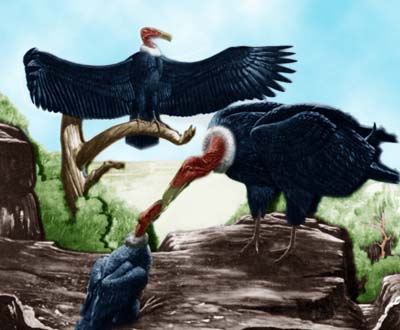
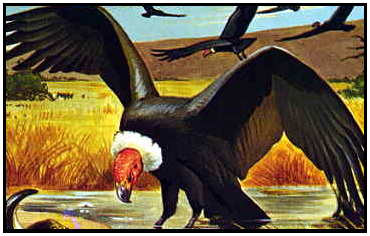
Campbell and Toni 1983 further noted that T. merriami* has always been portrayed as a super-condor (this is still true 25 years later) despite the fact that we now know that the skull indices indicated a much different niche. And since when do birds in different families look identical down to the coloration? The post-cranial skeleton apparently shows a mosaic of cathartid, ciconiid and unique features; the flight was apparently condor-like, the pelvis was stork-like and indicated that sustained walking was possible and the stout legs indicated that running was not likely. I'm guessing that this teratorn could have hunted mammals, reptiles and amphibians on the ground and possibly fish in freshwater, although the short legs would have been a hindrance. However it "earned a living", relatives with similar bauplans existed for millions of years.

*Some material from Cuba may indicate that there is another species in the genus, or that there is yet another genus of teratorn (Olson and Alvarenga 2002). This article mentions a "Teratornis" olsoni. Nothing has been published to my knowledge.


The Incredible teratorn (Aiolornis incredibilis) was one of three teratorn species that lived in North America in the late Pleistocene (from the early Pliocene) and was primarily differentiated from T. merriami by its size. Where T. merriami had a 3.5 to 4 m (11-13') wingspan, A. incredibilis was more along the lines of 5-5.5 m (16.5 to 18') and it presumably weighed around 36 kg (80 lbs) or more. Campbell et al. 1999 examined new and old specimens and determined there were enough characteristics to establish a new genus (it was originally in Teratornis) and suggested that Pliocene specimens may actually belong to other species and/or genera. Clearly a lot remains to be discovered and written about this species, Campbell et al. thought that it had distinctive flight capabilities but didn't (probably couldn't) expand upon that. The beak was deeper than Teratornis, although without much skull material nothing about potential ecomorphology has been written. I doubt it was a "super condor" as alleged by some, and presumably it shared the same walking abilities (since Argentavis did...) and specialized on some other food source. It seems dubious that three large generalists could have co-existed in the North American southwest in the late Pleistocene.

As I've been hinting at, the third species in question is Cathartornis gracilis which is very rarely discussed (it is known from two tarsometatarsi). Campbell et al. 1999 discuss it briefly; it is comparable in size to Teratornis but more gracile, although Campbell et al are not convinced it belongs in its own genus. Olson and Alvarenga 2002 mention that more material has apparently been found and Campbell now thinks it is worthy of genus-level distinction. Like the Cuban material, I haven't heard of any publications.

Teratorns aside from Merriam's aren't discussed too frequently, with the exception of the gigantic Miocene Argentavis magnificens from South America. This was the largest flying species of bird with a span of around 7 meters (23 feet) and a mass of around 70 kg (150 lbs) (The azhdarchid pterosaur Hatzegopteryx dwarfed this) and so has received a lot of attention. Campbell and Toni 1983 stated that Argentavis was simply a larger version of the Teratornis morphotype on the basis of wing and leg bone similarities (i.e. condor-like flight and stork-like walking); apparently the 1981 paper by the authors documented features of the 55 cm+ skull which indicated it was predatory (Chatterjee et al. 2007). Palmqvist and Vizcaino 2003 determined that a falconiform the size of Argentavis would have a territory of about 542 square kilometers (~200 sq. miles) and would take about three days to patrol its territory and would eat around 5-10 kg of meat per day. The authors feel that since scavenging birds do not have defined territories and can exist at higher densities that predatory ones - and they suggest that predatory sabertoothed marsupials opened up a new niche for giant vultures (they seemed to imply that Argentavis ate bones). Most recently, Chatterjee et al. 2007 stuck with the morphological implications that this was a predatory species capable of eating rabbit-size animals whole. So why gigantism? Palmqvist and Vizcaino note that while giant species have low populations, low population density, small clutch size and long breeding cycles they are resilient against predation (maybe even engaging in kleptoparasitism) and can withstand famine.

Very seldom discussed is the earliest teratorn Taubatornis (with 6 Google hits) from the late Oligocene of Brazil that had not reached the proportions of later species (the distal width of the tibiotarsus was about 70% that of Teratornis). This fossil also demonstrates that South America is likely the place of origin for this family and that teratorns in North America (and Cuba?) were a fairly recent phenomenon. Olson and Alvarenga also mention the curious fact that teratorns and cathartids are almost always found together, which would support frequent scavenging habits (the authors are neutral).


That about ends the story for teratorns thus far, and as usual there are more questions than answers. For birds with no obvious adaptations for eating carrion, teratorns sure did hang out with vultures and get stuck in tar pits a lot. Teratorns also seem very different from living birds of prey that hunt on the ground, and exactly how a short-legged bird unable to run well hunts a sufficient number of small animals per day is beyond me. Perhaps Teratornis was somewhat like a marabou stork or adjutant (Leptoptilos sp.) in that it was a presence at kills but otherwise occupied a different niche it was morphologically adapted towards. The presence of three sympatric genera (and their extinction) certainly hints that these were not all generalists. It is increasingly clear that teratorns were not "super condors", but what exactly they were is still rather unclear. Hopefully some of the unpublished material will come to light and new discoveries will be made to clear up the basic life histories of this enigmatic group.


References:

Campbell, Kenneth E. and Tonni, Eduardo P. 1983. Size and locomotion in teratorns (Aves: Teratornithidae). The Auk 100: 390-403.

Campbell, Kenneth E. et al. 1999. A New Genus for the Incredible Teratorn. Smithsonian Contributions to Paleobiology No. 89: 169–175. Available (Huge file)

Chatterjee, Sankar et al. 2007. The aerodynamics of Argentavis, the world’s largest
flying bird from the Miocene of Argentina. PNAS. Published online (for free)

Fox-Dobbs, Kena. 2006. Dietary controls on extinction versus survival among avian
megafauna in the late Pleistocene. Geology V. 34, No. 8 pp. 685-689

Hertel, Fritz. 1995. Ecomorphological indicators of feeding behavior in Recent and fossil raptors. The Auk 112(4): 890-903

Olson, Storrs. L and Alvarenga, Herculano M. F. 2002. A new genus of small teratorn from the Middle Tertiary of Taubate Basin, Brazil (Aves: Teratornithidae). Proceedings of the Biological Society of Washington 115 (4) pp. 701-705

Palmqvist, Paul and Vizcaino, Sergio F. 2003. Ecological and reproductive constraints of body
size in the gigantic Argentavis magnificens(Aves, Teratornithidae) from the Miocene of Argentina. Ameghiniana 40 (30) pp. 379-385

Monday, May 12, 2008

Like a Child's Bad Drawing...

Well, I've survived another round of finals, on with the blogging!


Unexpectedly, fishes in the deepest parts of the oceans (Hadal zone) have rather conservative bauplans (like Abyssobrotula) and only in the bathy- and abyssalpelagic species do the truly bizarre forms exist. I'm guessing that while such divergent forms are efficient at capturing prey/food particles, they can only be practical up to a certain point. Recently I discussed a denizen from the Zone of Bizarre Fishes, the stoplight loosejaw, which had odd characters such as a mouth with no floor that could somehow capture copepods and modified chlorophyll (from the copepods) that was used to detect red light emitted in order to see prey (like...copepods). Even with these peculiar features, the stoplight loosejaw is still recognizably a dragonfish, albeit a rather extreme one.

The genus Lasiognathus ("Wolftrap anglers") is a member of the order Lophiiformes (anglerfish) and the suborder Ceratioidei (Deep sea anglers), although this is rather hard to recognize at first. I was wondering if the artists who drew these species screwed up horribly - until I saw a photograph:


L. amphirhamphus from Pietsch 2005, used with permission.


Lasiognathus is recognizable as a lophiiform due to the presence of a modified first dorsal fin or illicium and bioluminescent "bait" or an esca at the end. The lack of pelvic fins unites this with other ceratioids and the characteristic dwarfed males have yet to be found (which would hint at them being small of course). Along with the sister taxa Thaumatichthys* (in the family Thaumatichthyidae) Lasiognathus has denticles on the esca and a bizarre premaxillary that can flip down to form a venus flytrap-like cage. The features of the esca have established 5 species of Lasiognathus (Pietsch 2005) known from only 27 adult female specimens (Pietsch 2005a).

*Pietsch and Orr 2007 mention some possible morphological and preliminary genetic evidence that may suggest otherwise. Support for maintaining the family is still convincing. Also, if you have access check out the Lasiognathus skeleton on page 14.


While the esca is key to differentiating species, the genus is still riddled with apomorphies. Thaumatichthys shares the massive overbite and premaxillary cage - but it has an esca in the roof of its mouth (how does a fin ray wind up there?) and looks broadly different. The head is extremely long (>60% standard length) and narrow (Pietsch 2005); the pterygiophore is 85% of the SL and can slide back and forth in a deep cranial trough, forming a tentacle when retracted(!); the illicium supported by the pterygiophore is 50% of the SL (Bertelsen and Pietsch 1996); illustrations of the flipped-down premaxillaries can be found here and here.

Unfortunately, that about wraps it up for Lasiognathus. Anatomically it seems pretty well known (particularly the esca), but there still are a great deal of unanswered questions for this taxa. Several of the species co-exist and I can't help but wonder if the different esca shape can attract different prey items. And who knows what genetic tests will do to the species count (some specimens lacked the critical esca) and the monophyly of Thaumatichthyidae. With only 27 specimens known, there undoubtedly is a great deal more to learn about this bizarre taxa.


I guess this was some sort of bloated picture-of-the-day post. I have no idea what to do next, but fortunately I have a lot of time to do it.


References:

Bertelsen, E. and Pietsch, Theodore W. 1996. Revision of the Ceratioid Anglerfish Genus Lasiognathus (Lophiiformes: Thaumatichthyidae). Copeia, Vol. 1996, No. 2, pp. 401-409

Pietsch, Theodore W. and Orr, James Wilder. 2007. Phylogenetic Relationships of Deep-sea Anglerfishes of the Suborder Ceratioidei (Teleostei: Lophiiformes) Based on Morphology. Copeia, Vol. 2007, No. 1, pp. 1-34.

Pietsch, Theodore W. 2005. New Species of the Ceratioid Anglerfish Genus Lasiognathus Regan
(Lophiiformes: Thaumatichthyidae) from the Eastern North Atlantic off Madeira. Copeia, 2005(1), pp. 77–81

Pietsch, Theodore W. 2005a. Thaumatichthyidae. Wolftrap Seadevils. Version 06 November 2005 (under construction). http://tolweb.org/Thaumatichthyidae/22007/2005.11.06 in The Tree of Life Web Project, http://tolweb.org/

Pietsch, Theodore W. and Kenaley, Christopher P. 2007. Ceratioidei. Seadevils, Devilfishes, Deep-sea Anglerfishes. Version 02 October 2007 (under construction). http://tolweb.org/Ceratioidei/22000/2007.10.02 in The Tree of Life Web Project, http://tolweb.org/