Showing posts sorted by relevance for query meme. Sort by date Show all posts

Sunday, January 23, 2011

Arctotherium angustidens: Biggest Bear Ever?

I have a bit of an obsession with animal size superlatives, and megabears* are among my favorites - that's right, I have interests beyond testudines. Anyways, in this blog's even more poorly-written past, I discussed purported giant hypercarnivores wherein I argued that the One-Ton(ne)-Hyperpredatory-Arctodus meme is unsubstantiated Godzillafication which somehow managed to infect even some peer-reviewed literature. Brian Switek wrote an article at the old Laelaps covering newer research which further demolished the mythology of the Giant Short-Faced Bear: it didn't have a short face (it did have a deep snout), or particularly long legs (somewhat of an optical illusion caused by a short back), and was probably a generalist omnivore like extant bears (presumably with some differences in niche, of course). Just as it seemed that speculations about One-Ton(ne)-Hyperpredatory-Bears would be a thing of the past, this happened:

* Definition pending.


Figure 2(1) from Soibelzon and Schubert (2011). The bear's height is ~ 3.3 meters (10' 10") and note how the legs are realistically flexed.

Arctotherium is composed of 5 South American species - of which A. angustidens is the earliest, largest, and apparently most predatory - and is the sister clade of Arctodus; the two are in turn part of the clade Tremarctinae which further includes Tremarctos (spectacled bear and kin) and Plionarctos (Soibelzon and Schubert 2011). The Arctotherium angustidens specimen of concern is not a new discovery, as it was found prior to 1935 during construction of a hospital in La Plata, Argentina (Soibelzon and Schubert 2011). It is presently composed of radii, ulnae, and humeri from both forelimbs; metacarpals, phalanges, and a scapula fragment were also recovered but unfortunately lost (Soibelzon and Schubert 2011). The dimensions of the bones* are incredible, the humerus has a length of 62 cm (2' 0.4") and the mid-shaft humerus width is 9 cm (3.5"); comparable maximum measurements of other giants bears are: Arctodus simus - 59.4 cm/6.4 cm; Ursus spelaeus - 44.8 cm/5.6 cm; and Ursus maritimus - 38.5 cm/4.65 cm (Soibelzon and Schubert 2011). For those who would prefer a more graphical comparison:

* The limbs had somewhat different measurements - the left was shorter and wider and the right vice versa. See below for why.


Humerus length in cm:
The number of specimens is in parenthesis. This does not include both limbs from the Arctotherium specimen in question, subsequently the average was re-calculated from Table 3.
Humerus mid-shaft width in cm:
Table 5 figures kept the specimens in question separate (unlike the prior example) so the range and average have been re-calculated. Even without the newly measured specimen, the average for Arctotherium was substantial (5.88 cm).

Using humerus greatest length, humerus mid shaft circumference, humerus greatest distance of distal epiphysis, and radius proximal epiphysis greatest diameter, the estimated weight for the giant Arctotherium angustidens specimen ranged from 983-2042 kg (2,167-4,502 lbs), with the value likely around the mean and median of 1588 and 1749 kg (3501-3856 lbs), respectively (Soibelzon and Schubert 2011). The other known specimens were given the same treatment (when possible), and a couple of them appeared to mass around a tonne (Soibelzon and Schubert 2011). This would seem to suggest that the giant Arctotherium angustidens specimen was not an outsized freak, and could represent a "normal" maximum size for the species. Before too many conclusions can be made, some more discussion of the specimen is in order.


Left humerus in caudal view. The scale bar is 10 cm (~ 4 inches) and the arrow points to a pathology.  Taken from Figure 3(1), Soibelzon and Schubert (2011). Compare with the humerus of Arctodus: here.

The most striking aspect of this specimen are the osteogenic changes to the deltoid crests of both humeri - more apparent in the left humerus pictured above, see arrow - and the distal third of the left radius shaft, which suggest a deep injury followed by infection and then new vascular growth over a long period of time (Soibelzon and Schubert 2011). Judging by the high degree of epiphyseal fusion, the specimen managed to become an old adult (Soibelzon and Schubert 2011). Humeral mid-shaft measurements gave on average larger estimated masses (Soibelzon and Schubert 2011 - Table 3), which makes me wonder if the measurements were artificially inflated by the injury and subsequent pathological growth. However, the limited data on Table 3 shows similar proportions with a somewhat smaller specimen:


HMSC HGL HMSC/HGL
MLP 35-IX-26-5 26.5 61.5 43%
MLP 35-IX-26-6 26.2 62 42%
MACN 5132 22 54 41%
MLP 82-X-22-2 16 49.5 32%

Measurements in cm: HMSC = Humerus mid shaft circumference; HGL = Humerus greatest length. The first two rows are from the specimen in question.


Curiously, specimens of Arctotherium angustidens appear to differ considerably in limb proportions, for instance, two specimens have the same humeral circumference (22 cm) but the greatest diameter of the distal humeral epiphysis differs considerably (20.5 vs. 18 cm), one of which is larger than the giant specimen's maximum measurements (18.5 cm) (Soibelzon and Schubert 2011)... this is certainly confusing, and the value of compiling median and mean figures is readily apparent. While the mass of the giant Arctotherium angustidens cannot be precisely pinned down, the available evidence suggests it exceeded all other bears in size.

... or does it?

Incredibly, one mass regression of Indarctos atticus exceeded 3 metric tonnes, although predictably it was found to be highly improbable (Finarelli and Flynn 2006) and, along with fellow Mio-Pliocene bear Agriotherium, they are not believed to have reached the same size as Arctodus simus or Arctotherium angustidens (Soibelzon and Schubert 2011). Polar bears (U. maritimus) can get extremely large*, with one specimen shot in Alaska in 1960 purportedly standing 3.39 m (11' 1.5") and weighing 1002 kg (2210 lbs); the whereabouts are apparently unknown and the skull was never submitted for measurement (Wood 1981). Assuming the record is genuine, I'm wondering if the height included unnaturally straitened legs or was in fact the length lying down and outstretched, which would certainly be easier to take. Considering the largest Arctotherium angustidens humeral length is about 160% as large as the largest polar bear measurement included in Soibelzon and Schubert (2011), it would take one freakish polar bear to get that tall, and it would probably weigh a lot more than a tonne. Polar bears reached their largest sizes in the late Pleistocene (Soibelzon and Schubert 2011) and Ursus maritimus "tyrannus" apparently had an ulna 44 cm in length (see Markus Bühler's Bestiarium, comment #5), which is of course smaller than that of the specimen in question's (57 cm), but still surprisingly large for a single specimen. Information on these giant polar bears is unfortunately quite hard to come by, but I think it's safe to assume it didn't exceed Arctotherium angustidens in size, at least regularly.

* DeMaster and Stirling (1981) give maximum figures of: mass 800 kg (1764 lbs), nose-tail length 2.5 m (8' 2"), and shoulder height 1.6 m (5'3").


Exactly how the average sizes of the giant bears compare is difficult to determine at the present time - particularly when gender isn't obvious. However, as weights of a tonne or more appear to have been reached by Arctotherium angustidens regularly, the average must have considerably exceeded that of other giant bears, which have only been demonstrated to exceed a tonne in one instance. The authors' assertion that Arctotherium angustidens was the biggest bear ever is well-supported, until something bigger turns up.

---

This post has run long enough, I'll write a followup on the proposed ecology of Arctotherium angustidens shortly.


References:

DeMaster, D. P., and Stirling, I. (1981). Ursus maritimus. Mammalian Species 145, 1-7. Available.

Finarelli, J. A., and Flynn, J. J. (2006). Ancestral State Reconstruction of Body Size in the Caniformia (Carnivora, Mammalia): The Effects of Incorporating Data from the Fossil Record. Systematic Biology 55(2), 301-313. doi: 10.1080/10635150500541698. Available.

Soibelzon, L. H., and Schubert, B. W. (2011). The Largest Known Bear, Arctotherium angustidens, from the Early Pleistocene Pampean Region of Argentina: With a Discussion of Size and Diet Trends in Bears. Journal of Paleontology 85(1), 69-75. doi: 10.1666/10-037.1

Wood, G. L. (1981). The Guinness Book of Animal Records. Guinness Superlatives: Middlesex, Great Britain.

Sunday, July 15, 2007

Horrendously Antiquated Illustrations

Dear Constant Readers,

I've always had a fondness for those archaic illustrations done by individuals who speculated on poorly known, extinct, or outright fictional beasties. Having nothing to compare them to and often having less than reliable sources, they imagined them as bizarre monstrosities with inconceivable features. Perhaps one of the most famous was Dürer's Rhinoceros, which is iconic enough to get its own fairly detailed Wikipedia article. Even though it was replaced as the stereotypical image for a rhinoceros in Europe, its likeness was still replicated into modern times. It's a good meme in other words. For those Lord Geekington trivia buffs out there, the Dürer's Horn is my favorite fictional anatomical feature. Re-railing here, these depictions are now often rather silly in an endearing sort of way. Early Science or proto-science was rather preliminary and simple, and we clearly have come a long way. Looking back, I can't help but wonder if some of our reconstructions and beliefs will be looked upon as being rather silly themselves in the future. I could get into posterity but I'll spare you, for now.

I have covered at least one illustration in this vein before: the surreal Cetacean Centipede of Rondelet. You can read the full blog here. This appears to be a chimera of sorts combining a perciform fish, shark, whale, polychaete worm and perhaps lobster. This is almost certainly an obscure mythological animal, although there have been vague and sporadic reports of "sea-serpents" with a plethora of appendages. It is quite possible, but unproven, that the less vague reports were inspired by memories of this image or even hoaxes based upon it. This also reminds me that surrealism-like images from the Medieval/Renaissance periods may get written upon soon enough.


Aquatic animals always seem prone to really odd depictions. This here is an imaginative illustration from Harper's Weekly in 1868. The encircling gill slits, giant mouth and size make it probable this was a basking shark. But, umm, what on earth is up with those mammalian legs that make it look ready to pounce? Did the illustrator imagine this fish bounding majestically along the sea floor? The Stronsay "beast" of six decades earlier was perhaps another instance of fins (and claspers?) getting confused for limbs on a basking shark. The vertebrae size was smaller than (but otherwise identical to) that of an above average 25 foot (7.6 m) basking shark despite the reported length of 55 feet (16.8 m). Thank you Guinness Book of Animal Facts and Feats. This was probably just exaggeration, but there is the remote possibility of some freak basking shark that doubled its vertebral count that somehow lived to maturity.


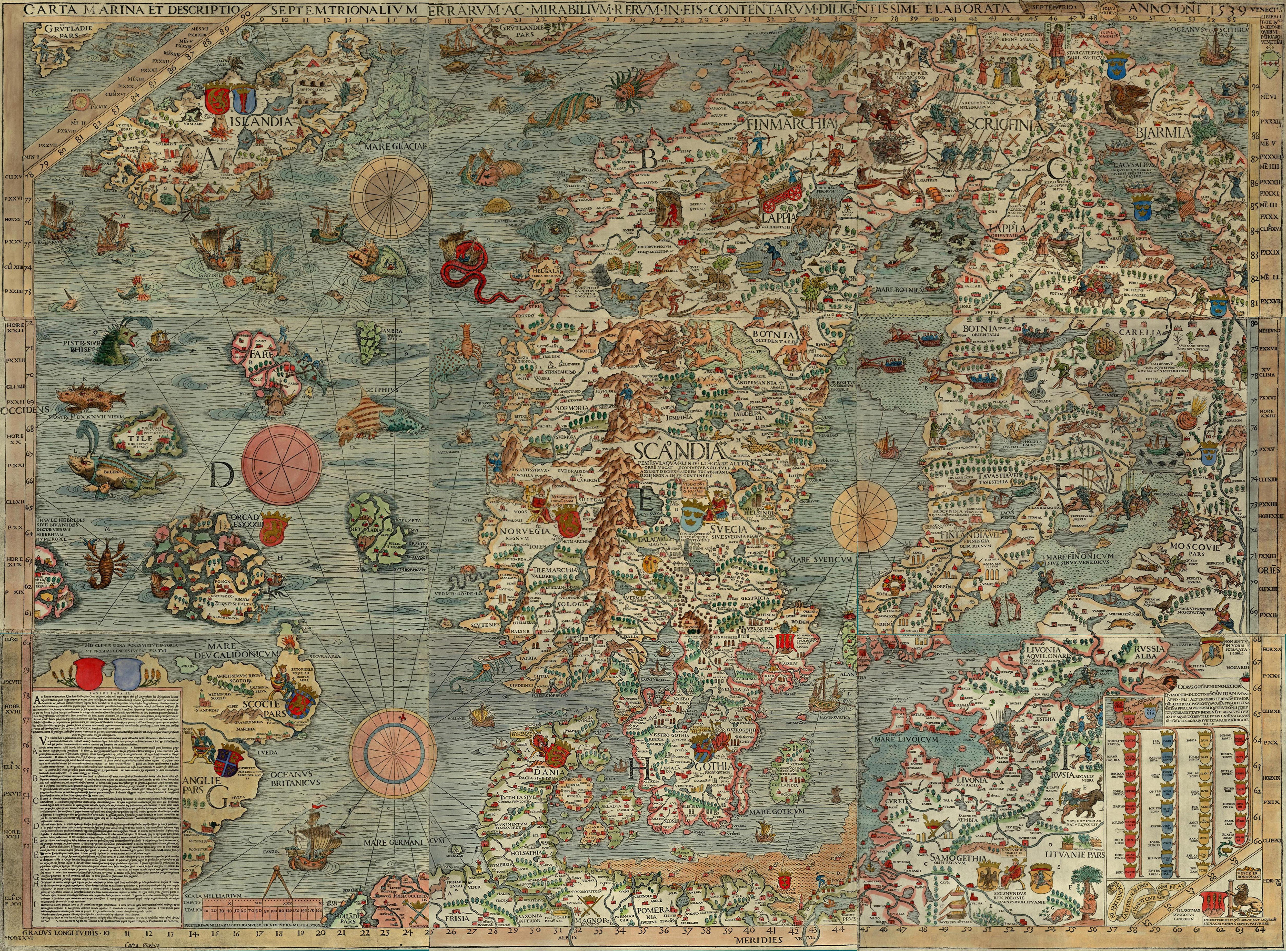
Mentioned in this not-too-recent post is the Carta Marina of Olaus Magnus. As far as weird and mythological aquatic creatures go, this is their holy grail. You'd better click on this and pray you don't have dialup:


You can spend a lot of time picking out crazy stuff in this map. Judging by the names the "Balena" and "Orcha" are supposed to be extant cetaceans, but you can't really tell by the weird collars, tube-like nostrils, piggish faces, and other really strange features. The "Ziphius" sounds like it could be a beaked whale, but the eagle head doesn't seem quite right. Also of note are people camping out on a big "island fish", what appears to be a devil/pan sweeping a stable, a monster with three eyes on its body, a feathery dragon, and lots of other strange things. Like Dürer's Rhinoceros, this is another one of those really iconic images/memes that symbolizes the time period. I for one miss maps that alert us to potential terrors waiting for us in exotic, far away lands. Also take note trivia buffs: the man's face in the clouds blowing wind is another one of my favorite images.


While Magnus worked in the 15th and 16th centuries, fantastic illustrations continued into the 19th century, my favorite era (for this). I recently came across an amazing flickr album (which prompted this post) on a book called Sea and Land from 1889. Not only are the illustrations fantastic and iconic but they're all in the public domain, making this all the sweeter for me. Due to many of these illustrations being fairly common in the Cryptozoology domain, plus me uncontrollably discussing the subject, I suppose the label is justified. Here are some favorites from this volume:

Crab lifting a goat, hmm. Robber crabs/Coconut crabs are pretty big for crustaceans and utterly colossal for a land arthropod (~9 lbs, ~3 foot span max) but lifting a goat? The appearance does seem accurate, but I'll assume this was based on somebody's crazy story/myth.


As usual, marine creatures, in this case reptiles, are depicted rather oddly. The long-tailed fellow with a puppy-dog expression is a plesiosaur with the head placed on the wrong end. Despite the traditional swan-neck pose which is common even today, plesiosaurs and elasmosaurs could not (and probably had no reason to) assume that position. The ichthyosaurs were also portrayed as being rather crocodile-like as opposed to fish like. An actual marine crocodile does seem fairly reasonable, undoubtedly due to living relatives. The small beaked swimmer in the bottom left-hand corner is something is a mystery to me, perhaps a rhynchosaur erroneously depicted as swimming?

[Correction thanks to Matt Celeskey: The "plesiosaur" is actually a mosasaur, and the beaked creature is actually the turtle Osteopygis. See "comments" for more.]


My favorite depiction of the "Kraken" sinking a ship. This is a wonderfully dark and moody piece, or wait no, dark and disturbing, muhaha. I remember as a much younger Crypto-enthusiast I was tantalized by what appear to be two small fins low on the mantle on this cephalopod. Y'see, there was this theory that the St. Augustine monster was in fact a cirrate octopus. Here is a depiction of "Otoctopus giganteus" from Michael Raynal's Institut Virtuel de Cryptozoologie.


An image supposedly representing the St. Augustine carcass. Both the description and drawing in the Pennsylvania Grit were horrendously naive, more like something out of the middle ages than 1896. It actually is a pretty cool monster design though, I'll have to steal it. The carcass wasn't a cephalopod/fish hybrid or a giant octopus, but in fact a sperm whale. I'll discuss globsters some other day.


The best source on the Internet for strange science is, well, Strange Science. Their website has the cream of the crop of all this weird stuff, as well as biographies and an excellent primer on evolution. I'd love to post everything, but, I can't. Here are some of my favorites:


Very very strange things were thought about the appearance of a mammoth. It was assumed to be a burrower and was compared to an ox for size and, well, there you have it.


Very strangely, Japetus Steenstrup realized that two reported instances of a "sea monk" bore a remarkable resemblance to a recently captured squid. If this is in fact the case, it demonstrates that people had some horrendously overactive imaginations in that time period. This is why anecdotal evidence, even (or especially) today can never be used as proof of anything. The squid might be the Octopoteuthid Taningia danae.


I am really lost for an explanation on this one.


So there you have it, a sampling of some of the strangest drawings I've ever seen. Some of these, such as the marine reptiles, were taken seriously; but I wonder about some of the others. Regardless, for some people a bestiary-like mindset lives on in their personal take on cryptozoology. They still think that there are fantastic monsters lurking in the mysterious and not-so-mysterious reaches of the globe. As a kid, I myself depicted bestiary scenes of aquatic cryptids I read about. Consequently, Darren Naish at about the same age made a far-superior depiction...sigh. Older now, I learned that value of critical thinking and realized that upon closer inspection, many of these beasts are most certainly figments of the imagination, modern day mythological creatures. What truly astounds me is that actual discoveries are often more strange than fiction. Take the cnidarian worm (!) Buddenbrockia for example. Coming up with your own world and your own fiction is difficult considering how fantastic our world already is.


I've got a lot of options for posting now, hopefully I'll squeeze something out soon here.

-Cameron


[Addendum 7/15/07: As per suggestion of Kevin Z, I'll talk about the Anthropomorpha of Linneus here. This excellent website was used as a source.

Carolus Linnaeus (born Carl von Linné) as you all known, is the great father of taxonomy. Sure his system is rather antiquated right now thanks to cladistics, but it was definitely a step in the right direction. In another interesting move, Linnaeus chose to classify humans among the animals. Despite being a creationist (like everybody back then) he recognized the obvious similarity between primates and man. His classifications (quite confusingly) changed with publications, and in one scheme he broke the genus Homo into two sub-genera: Homo diurnus and Homo nocturnus. H. diurnus included our species which was (unfortunately) divided into four races. Feral humans were considered a separate species (H. ferus) and a wastebin taxa of various monsters was called H. monstrosus. This included mythical Patagonian giants, Alpine dwarfs, and very real (but not one-testicled) "Hottentots".


Left to Right: "Trogloodyte", "Lucifer", "Satyr", "Pygmee"

The poorly named Homo nocturnus (aka troglodytes) made up the other half of the Anthropomorpha. Linnaeus was far from rigorous in some instances, and despite trying to "de-mythologize" some creatures, ended up making a mess. The above depicted apes were not created with specimens, but with heresy and second-hand accounts of a medieval bestiary quality. For instance, the first one is evidently supposed to be an orangutan! Probably because of him, depictions of apes were very, well, strange for a while and also still have rather peculiar scientific names (Pan troglodytes, Pongo pygmaeus). Eventually this convoluted mess got (mostly) ironed out into neat little families, sub-families and tribes today. Let this be a lesson to cryptozoologists who want to describe and classify with secondhand knowledge!


Even though he did not classify them as Homo monstrosus or even talk about them, that category reminded me of some of my favorite humanoid bestiary monsters.


The giant cyclopes probably* originated from elephants skulls perhaps mixed with observations of the actual disease cyclopia. I find images of that very disturbing, I warn you in advance of googling that. The cynocephali (dog-headed fellow) is evidently based on baboons and perhaps soon-to-be-extinct giant lemurs. The foot-parasol fellow is baffling, perhaps based on elephantiasis? The Strong Mad-esque Anthropophagi is unexplainable, for me at least. The book Curious Creatures in Zoology by John Ashton is online here for more bestiary fun.

*As in probably not. Darren Naish will some day explain this...

Phew, and I'm spent]